
Village Weaver Identification Guide
A social African weaver whose breeding males turn bright yellow with a bold black hood and build elaborate hanging woven nests in colonies.
Read the full Village Weaver encyclopedia entry →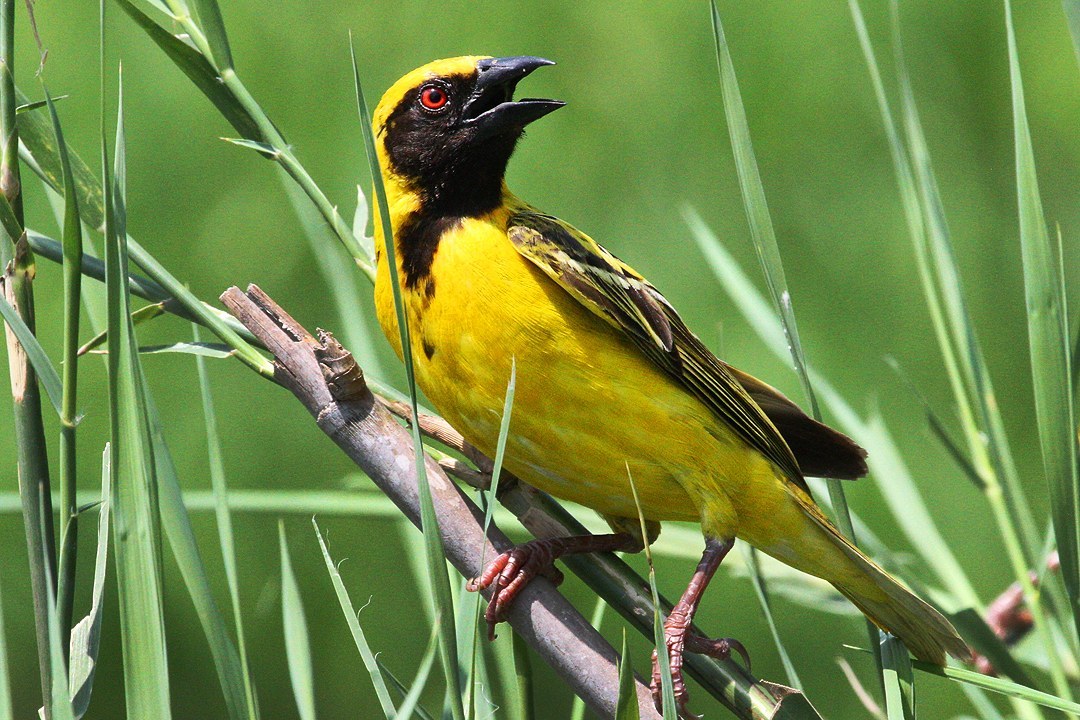
Key Field Marks
- Size & shape: A stocky, medium-sized weaver (about 6–6.5 inches) with a thick, conical, seed-cracking bill typical of weaverbirds.
- Breeding male: Bright yellow body with a black hood covering the face and throat; many populations show a chestnut wash across the nape and crown; eyes are red.
- Female / non-breeding male: Much duller — olive-yellow overall with a streaked, sparrow-like back, lacking the black hood.
- Bill: Heavy and conical, well suited to a diet of seeds and grain as well as insects.
- Behavior: Highly social and colonial, nesting and foraging in noisy groups; males perform display flights and calls at the nest to attract mates.
Separating Village Weaver from Similar Species
- Other Ploceus weavers: Village Weaver is separated from similar yellow weavers by the extent and shape of the black facial hood, red eye color, and (in many races) chestnut nape wash — always check these details carefully as many weaver species overlap in range.
- Female/non-breeding birds: Best identified by association with breeding males at an active colony, plus the heavy weaver bill and streaked back pattern.
Where & When to See One
Village Weaver is widespread and common across sub-Saharan Africa, from savanna and woodland edges to villages, farmland, and gardens — hence the name. It is a non-migratory resident throughout its African range. Colonies are typically built in trees or palms, often overhanging water or near human habitation, where dozens of woven, retort-shaped nests may hang from a single tree. The species has also been introduced to parts of the Caribbean and other regions outside Africa, where feral populations persist.
Voice
A harsh, chattering, wheezy jumble of buzzes and chirps, especially active and constant around a breeding colony, where multiple males call and display simultaneously.
Frequently asked questions
How can I recognize a breeding male Village Weaver?
Look for a bright yellow body, a bold black hood over the face and throat, red eyes, and often a chestnut wash on the nape.
What do female Village Weavers look like?
Duller olive-yellow with a streaked back and no black hood, making them much less conspicuous than breeding males.
Where do Village Weavers build their nests?
In colonies of woven, hanging nests built by males in trees or palms, often over or near water, close to villages and farmland.
Is the Village Weaver found outside Africa?
Yes, feral introduced populations exist in parts of the Caribbean and a few other regions, in addition to its native sub-Saharan African range.