
Veery Identification Guide
A warm cinnamon-brown thrush of eastern and northern woodlands, the least boldly spotted of the Catharus thrushes and famous for its spiraling, flute-like song.
Read the full Veery encyclopedia entry →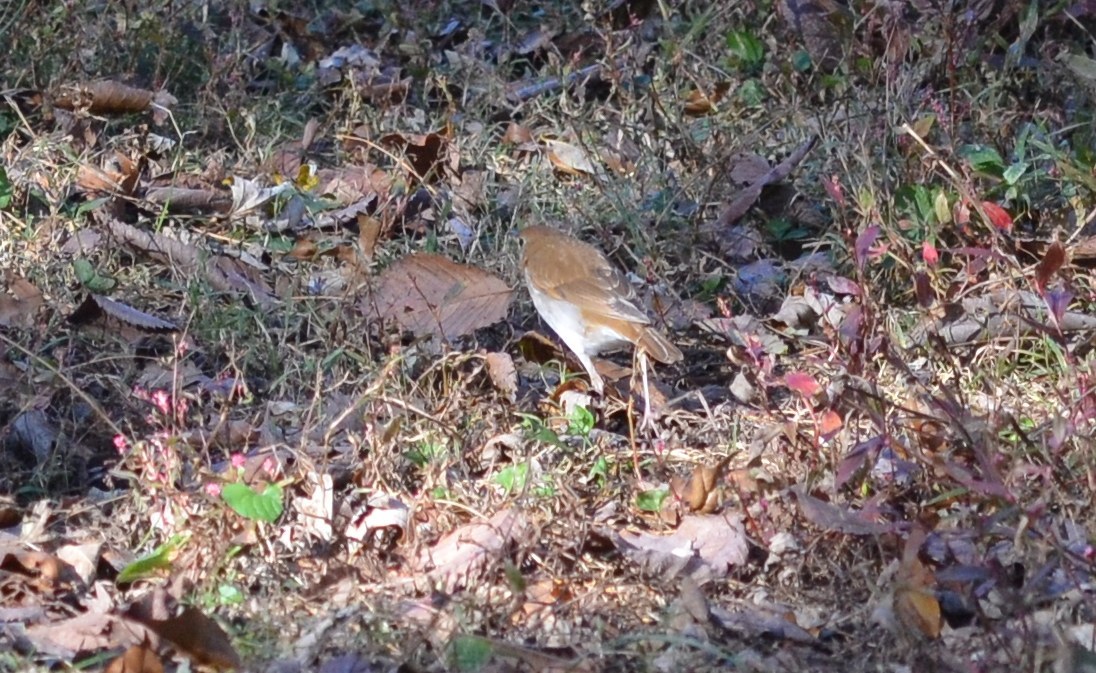
Key Field Marks
- Medium-small thrush (about 16-18 cm) with an unmarked, uniformly warm reddish-brown to tawny-cinnamon back, head, and tail.
- Underparts are pale grayish-white with only faint, indistinct, diffuse spotting restricted to the upper breast, making it the least heavily spotted of the North American Catharus thrushes.
- Faint, incomplete grayish eyering; flanks are pale gray without strong contrast.
- Overall look is a plain, warm-toned, subtly marked thrush rather than a boldly patterned one.
Similar Species
- Swainson's Thrush: shows a bold, complete buffy eyering and buffy wash across the face, olive-brown (not reddish) upperparts, and more distinct, defined spotting on the breast compared to the Veery's faint markings.
- Hermit Thrush: shows a reddish tail that contrasts with a browner or more olive back, a habit of slowly raising the tail and lowering it upon landing, and bolder breast spotting than Veery.
- Wood Thrush: larger, with a bright rufous head and bold, large, well-defined dark spots covering the entire white breast and belly, quite different from Veery's faint, restricted spotting.
- Gray-cheeked Thrush (and Bicknell's Thrush): cooler, grayer-brown upperparts (not warm cinnamon) and a grayer face, lacking Veery's warm tawny tone.
- The uniformly warm cinnamon-brown upperparts combined with faint, restricted breast spotting are the best combination for separating Veery from all other Catharus thrushes.
Habitat, Range & Season
- Breeds across southern Canada and the northern and eastern United States, favoring moist deciduous and mixed woodland with a dense shrubby understory, often near streams or wet areas.
- A long-distance migrant, wintering in central South America, particularly in the Amazon basin region of Brazil and neighboring countries.
- Present on breeding grounds from about May through August; migrates through the rest of the United States mainly in spring (April-May) and fall (August-September).
- Forages on or near the ground in dense understory, often staying low and can be inconspicuous despite its far-carrying song.
Voice
- Song is a distinctive, breezy, downward-spiraling series of flute-like, reedy notes, often rendered as "veer-veer-veer-veer," with a slightly descending and rolling, almost echoing quality unlike any other North American thrush song.
- Call is a sharp, descending, whistled "veer" or "vee-ur," from which the species gets its name.
Frequently asked questions
How do you tell a Veery from a Swainson's Thrush?
Veery has warm, uniformly reddish-brown upperparts and only faint, sparse breast spotting with a weak eyering, while Swainson's Thrush is more olive-brown above with a bold buffy eyering and more clearly defined breast spots.
What does the Veery's song sound like?
It is a breezy, downward-spiraling series of flute-like notes often rendered as 'veer-veer-veer-veer,' with a distinctive rolling, descending quality unlike other thrush songs.
Where does the Veery spend the winter?
Veeries migrate long distances to winter primarily in the Amazon basin of central South America, especially Brazil.
What habitat should I look for to find a Veery?
Search moist deciduous or mixed forest with a dense shrubby understory, often near streams, since Veeries forage low and prefer damp woodland with thick ground cover.