
Vaux's Swift Identification Guide
A tiny, cigar-shaped swift of western North America famous for its flickering flight and spectacular communal roosts in hollow trees and chimneys.
Read the full Vaux's Swift encyclopedia entry →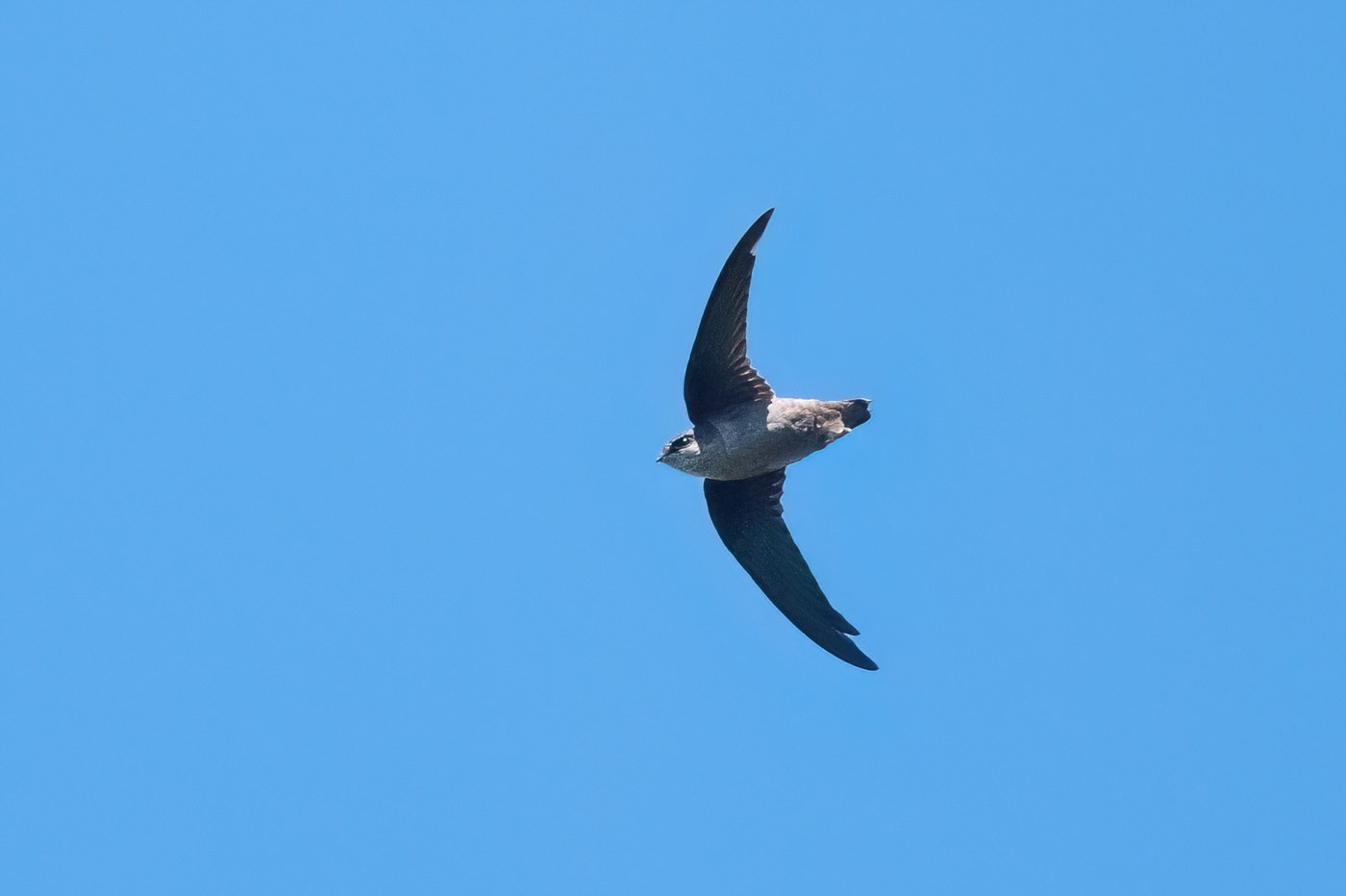
Key Field Marks
- Very small swift (about 11-12 cm), among the smallest swifts in North America, with a compact, cigar-shaped body, short stubby tail, and long narrow, curved wings.
- Overall sooty grayish-brown plumage, slightly paler and grayer on the throat and upper breast, without any sharp white patches.
- Flight is fast and fluttery with stiff, shallow wingbeats interspersed with short glides, often described as bat-like; it almost never perches in the open, instead clinging to vertical surfaces inside hollow trees or chimneys.
- Rarely seen perched; nearly always observed in flight, foraging for flying insects high overhead, sometimes in loose flocks.
Similar Species
- Chimney Swift: extremely similar in shape and behavior but occurs mainly in eastern North America, with limited range overlap; Chimney Swift is very slightly larger and darker overall with less contrast on the throat, and the two are best separated by range and, where they meet, by voice and subtle plumage tone.
- White-throated Swift: notably larger with a bold white throat and belly patch contrasting with black upperparts and flanks, quite different from the uniformly dusky Vaux's Swift.
- Black Swift: larger and blacker overall with a slightly forked tail, lacking the pale throat contrast of Vaux's Swift.
Habitat, Range & Season
- Breeds in old-growth and mature coniferous and mixed forest of the Pacific Northwest, from southeastern Alaska and British Columbia south through Washington, Oregon, and northern California, with a disjunct population in parts of Mexico and Central America.
- Nests and roosts in large hollow trees, particularly old-growth conifer snags, and increasingly uses large chimneys, especially during migration.
- Highly migratory, wintering mainly in Mexico and Central America; spring and fall migration produce spectacular communal roosts where thousands of birds funnel into a single large chimney or hollow tree at dusk.
- Forages on the wing, often high in the sky, over forests, towns, and wetlands, catching flying insects.
Voice
- Gives high, twittering, chattering calls in flight, similar in quality to Chimney Swift but generally described as slightly higher-pitched or more twittering.
- Flocks at communal roosts produce a rising chorus of twittering calls just before the mass entry into the roost site at dusk.
Frequently asked questions
How do you tell a Vaux's Swift from a Chimney Swift?
They are very similar, but Vaux's Swift is slightly smaller and paler on the throat, and the two species are best separated by range, since Vaux's is a western bird and Chimney Swift is primarily eastern, with only narrow overlap.
Why do Vaux's Swifts gather in large numbers at chimneys?
During migration, large numbers roost communally overnight in big hollow trees or chimneys for warmth and safety, producing dramatic swirling flocks at dusk as thousands of birds funnel in together.
Can you tell Vaux's Swift apart from White-throated Swift?
Yes, White-throated Swift is larger with a bold white throat and belly patch, while Vaux's Swift is uniformly dusky brown-gray without sharp white markings.
Where does Vaux's Swift nest?
It nests inside large hollow trees, especially old-growth conifer snags in Pacific Northwest forests, and has adapted in some areas to nesting and roosting in large chimneys.