
Varied Bunting Identification Guide
A striking desert songbird of the southwestern US and Mexico whose breeding male looks nearly black until sunlight reveals deep purple and red tones.
Read the full Varied Bunting encyclopedia entry →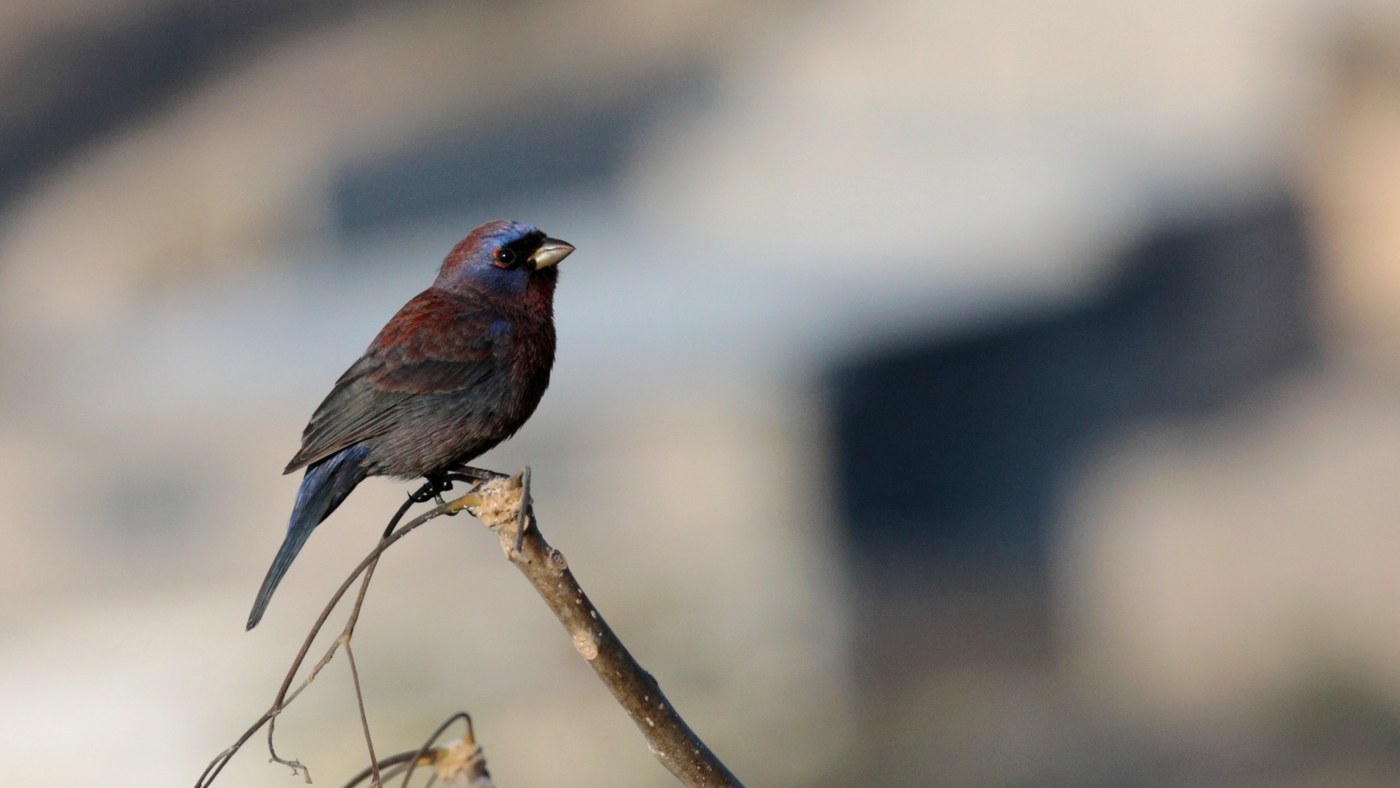
Key Field Marks
- Small, stocky finch-like bird (about 12-14 cm) with a short, thick, conical bill typical of buntings.
- Breeding males appear dark, almost blackish-purple in dim light, but in good light show rich reddish-purple body plumage, a deeper blue-violet rump and crown, and a small but distinctive rosy-red to magenta patch on the nape.
- Females and immatures are plain, unstreaked grayish-brown above and paler warm buff-gray below, with no wing bars and no obvious facial pattern, giving a rather featureless look.
- Bill is grayish and the overall shape is compact and rounded, with a fairly short tail.
Similar Species
- Painted Bunting: males are unmistakably multicolored (blue head, green back, red underparts) rather than the nearly uniform dark purple of male Varied Bunting; females are green rather than brown-gray.
- Indigo Bunting: breeding male is solid blue rather than purple, and lacks the reddish nape patch; female Indigo Bunting is brownish but shows faint blurry streaking on the breast, whereas female Varied Bunting is essentially unstreaked.
- Lazuli Bunting: male shows blue upperparts with a rusty breast band and white belly and wing bars, quite different from the uniformly dark male Varied Bunting.
- In poor light, look for the subtle red-violet nape patch and overall dark, unpatterned look to confirm a male Varied Bunting.
Habitat, Range & Season
- Breeds in the southwestern United States (southern Arizona, New Mexico, and southern Texas) south through Mexico to Guatemala.
- Favors dense thorny desert scrub, mesquite thickets, and streamside brush in arid and semi-arid lowlands and foothills.
- Northern breeders are migratory, arriving on breeding grounds in spring (April-May) and departing by early fall for wintering areas in Mexico; populations further south are largely resident.
- Often skulks low in dense thorny vegetation, making it easier to hear than see.
Voice
- Song is a bright, warbling series of paired phrases, similar in structure to other Passerina buntings but generally thinner and more variable than the fuller song of the Painted Bunting.
- Call note is a sharp, dry "pik" or "chip" given from cover.
Frequently asked questions
How can you tell a male Varied Bunting from a male Indigo Bunting?
Male Varied Bunting looks dark purple-black overall with a small reddish nape patch, while male Indigo Bunting is a more uniform, brighter solid blue without any red nape patch.
Why does the male Varied Bunting sometimes look all black?
Its deep purple, blue, and red tones only show up in good direct light; in shade or poor light the plumage can appear essentially black.
What habitat should I search for Varied Bunting?
Look in dense, thorny desert scrub and mesquite thickets, often along dry washes, in the southwestern US and Mexico, since it tends to stay low and hidden in brushy cover.
Is the female Varied Bunting streaked like a female Indigo Bunting?
No, female Varied Bunting is plain, essentially unstreaked grayish-brown, while female Indigo Bunting typically shows faint, blurry streaking on the breast.