
Ural Owl Identification Guide
A large, long-tailed forest owl of northern and central Eurasia, told from relatives by its pale, plain face and notably long tail.
Read the full Ural Owl encyclopedia entry →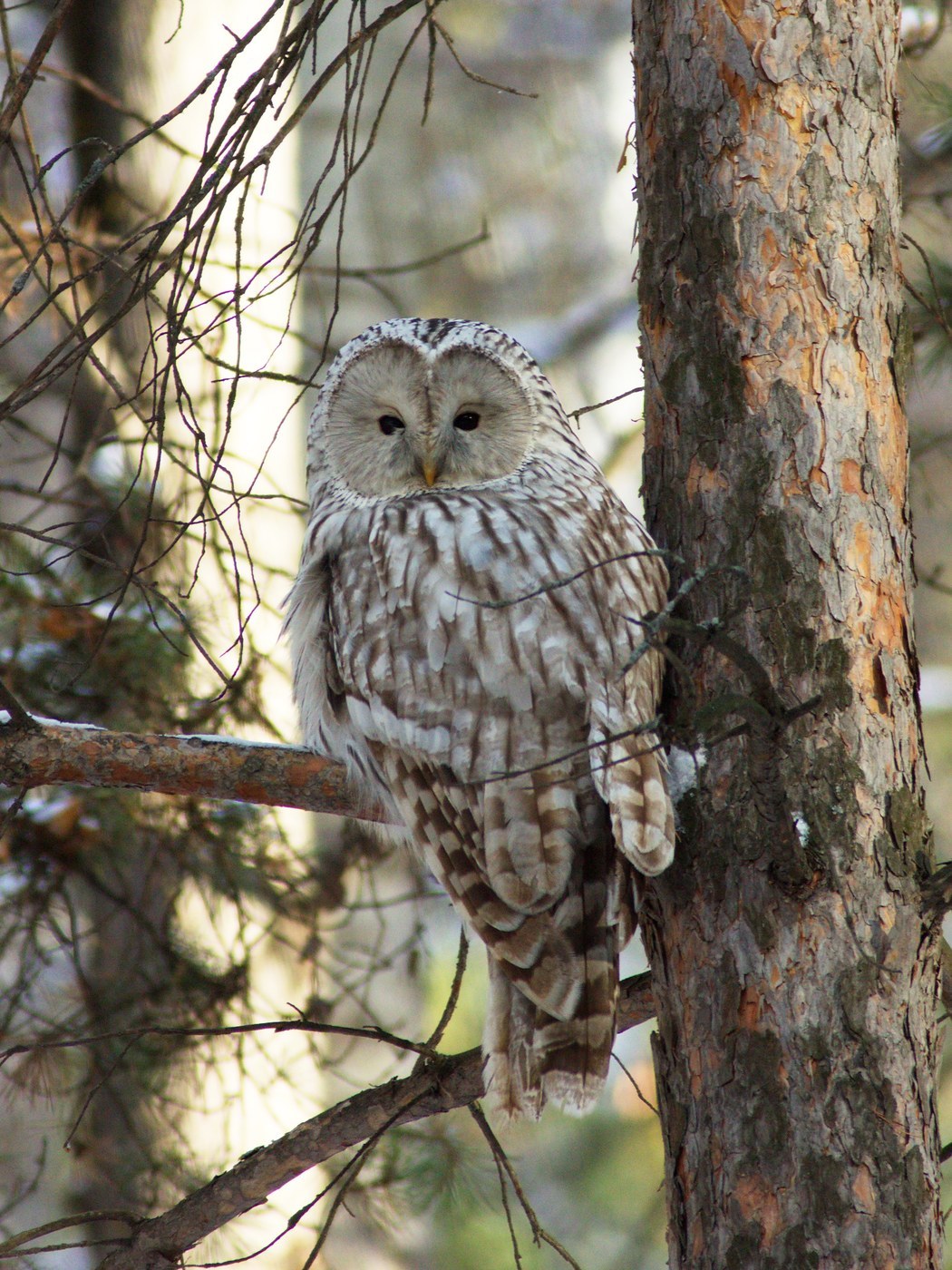
Key Field Marks
- Large owl (roughly 50-62 cm) with a rounded head lacking ear tufts, pale grayish-buff to whitish overall coloring streaked with dark brown, especially heavy streaking on the underparts.
- Facial disc is pale, plain, and rounded (no strong concentric rings), with small, relatively close-set dark eyes that look proportionately small for such a large owl.
- Notably long tail for a Strix owl, often projecting well beyond the folded wingtips at rest and giving a distinctive elongated silhouette in flight.
- Yellow bill; underparts show bold, blackish-brown vertical streaks over a pale ground color rather than the barring seen in some other owls.
Similar Species
- Great Grey Owl: considerably larger and bulkier with a much bigger, more diffuse facial disc showing distinct concentric rings and tiny yellow eyes that look disproportionately small; Great Grey also lacks the Ural Owl's warmer buff tones.
- Tawny Owl: notably smaller and darker/more richly colored (rufous or gray morphs), with a shorter tail that does not project far past the wingtips, and dark eyes set in a more contrastingly patterned face.
- The Ural Owl's combination of large size, plain pale face, small dark eyes, and long protruding tail is the best overall identification package.
Habitat, Range & Season
- Resident across the boreal and montane forest belt of Eurasia, from Scandinavia and eastern Europe across Russia to Japan, Korea, and parts of China, with a separate range extending into the Carpathians and other central European mountains.
- Prefers mature mixed and coniferous forest, often near clearings, bogs, or forest edges, and readily uses large tree cavities or old raptor/corvid nests for breeding.
- Largely non-migratory and territorial year-round, though northernmost populations may make short irruptive movements in poor food years.
- Most active at dusk and through the night, but can be seen perched in daylight, especially near the nest, where females are noted for aggressive nest defense against intruders.
Voice
- Deep, resonant hooting song, often rendered as a series of low "wo-ho" phrases followed by a shorter, faster "ho-ho-hohoho" ending.
- Also gives sharp barking or yapping alarm calls, particularly females near an active nest.
Frequently asked questions
How do you tell a Ural Owl from a Great Grey Owl?
The Great Grey Owl is larger with a much bigger, ring-patterned facial disc and tiny yellow eyes, while the Ural Owl has a plainer pale face, small dark eyes, and warmer buff tones with a long projecting tail.
Does the Ural Owl have ear tufts?
No, like other Strix owls it has a rounded head with no ear tufts at all.
Where can you find a Ural Owl?
It lives in mature boreal and montane forest across a broad swath of Eurasia, from Scandinavia through Russia to Japan, plus isolated mountain populations in central Europe such as the Carpathians and the Bavarian Forest.
What does the Ural Owl eat and when is it active?
It hunts mainly small mammals such as voles, along with birds and amphibians, and is chiefly nocturnal and crepuscular, though it can sometimes be seen on a daytime perch near its nest.