
Turquoise Cotinga Identification Guide
A jewel-toned, fruit-eating cotinga restricted to the Pacific slope forests of Costa Rica and western Panama.
Read the full Turquoise Cotinga encyclopedia entry →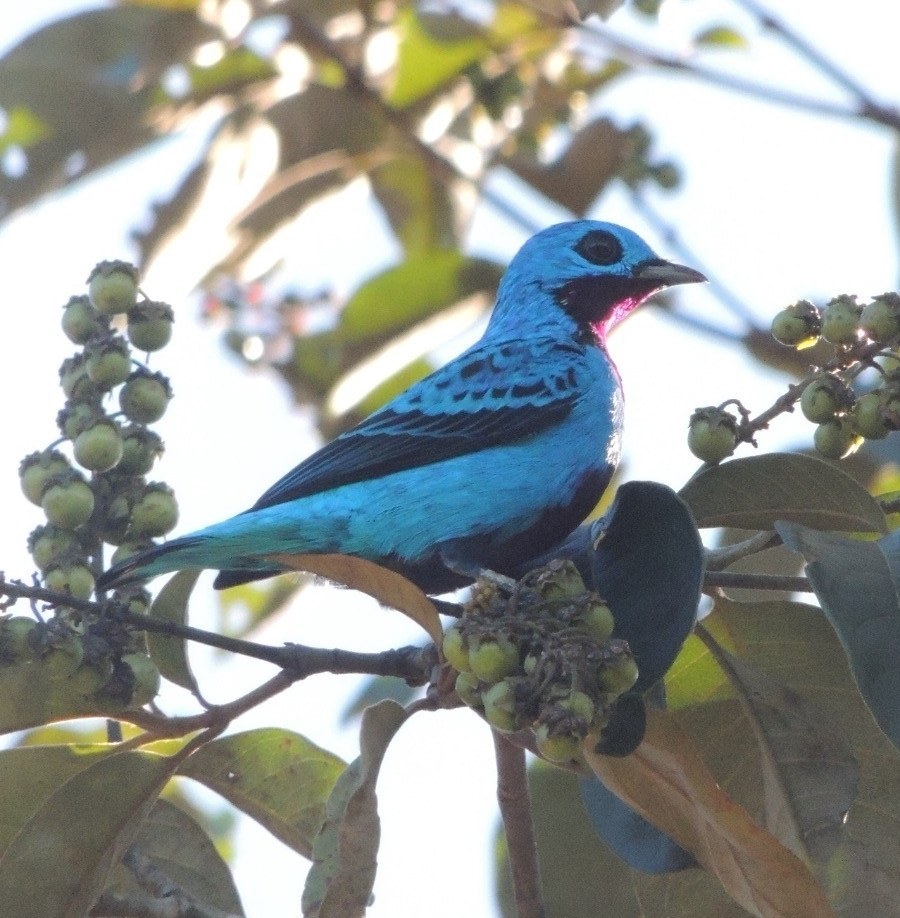
Key Field Marks
- Small, compact, short-tailed bird (about 12-13 cm) that sits upright and motionless for long periods in the canopy.
- Males are brilliant turquoise-blue overall with a striking dark purple throat and breast patch and blackish flight feathers.
- Females are much duller: grayish-brown above and below with fine pale scaling/mottling, lacking any blue or purple.
- Short, fairly thin bill typical of fruit-eating cotingas; stocky-headed, short-necked silhouette.
Similar Species
- Lovely Cotinga: males are also turquoise-blue with a purple throat but occur mainly on the Caribbean slope from Mexico to Costa Rica, with limited range overlap; Lovely Cotinga tends to show a more extensively purple breast band bordered by blue.
- Blue Cotinga: found in South America, not in Central America, so range alone separates it.
- Female cotingas of these species are extremely similar and often best identified by location and by association with a male, since plumage differences are subtle.
Habitat, Range & Season
- A range-restricted resident found only on the South Pacific slope of Costa Rica and adjacent western Panama (Chiriqui/Bocas del Toro highlands and foothills).
- Inhabits humid lowland and foothill forest canopy and forest edge, including partially cleared areas with scattered fruiting trees.
- Non-migratory; present year-round but can be locally nomadic, following fruiting trees such as those in the laurel and melastome families.
- Often perches high and still in the open canopy, making it easier to spot by scanning treetops than by sound.
Voice
- Largely silent; cotingas in this genus lack complex songs and are best located visually.
- Occasionally gives soft, nondescript call notes, but vocalizations are not a reliable identification tool.
Frequently asked questions
Where is the Turquoise Cotinga found?
It is restricted to the Pacific slope of southern Costa Rica and adjacent western Panama, making it a range-restricted specialty for birders visiting that region.
How do you tell a male Turquoise Cotinga from a Lovely Cotinga?
Both are turquoise-blue males with a purple throat patch, but their ranges barely overlap: Turquoise Cotinga is Pacific-slope Costa Rica/Panama, while Lovely Cotinga occurs from Mexico to Costa Rica mainly on the Caribbean slope.
What does a female Turquoise Cotinga look like?
Females are drab grayish-brown with fine pale scaling and show none of the male's blue or purple coloring, making them much harder to identify without a male nearby.
What does the Turquoise Cotinga eat?
It feeds primarily on fruit taken from canopy trees, sallying out briefly to pluck fruit while perched, typical of cotinga foraging behavior.