
Turkey Vulture Identification Guide
A large, dark scavenging bird of prey found throughout the Americas, recognized in flight by its bare red head, silvery flight feathers, and wobbly, V-shaped soaring on wings held in a shallow dihedral.
Read the full Turkey Vulture encyclopedia entry →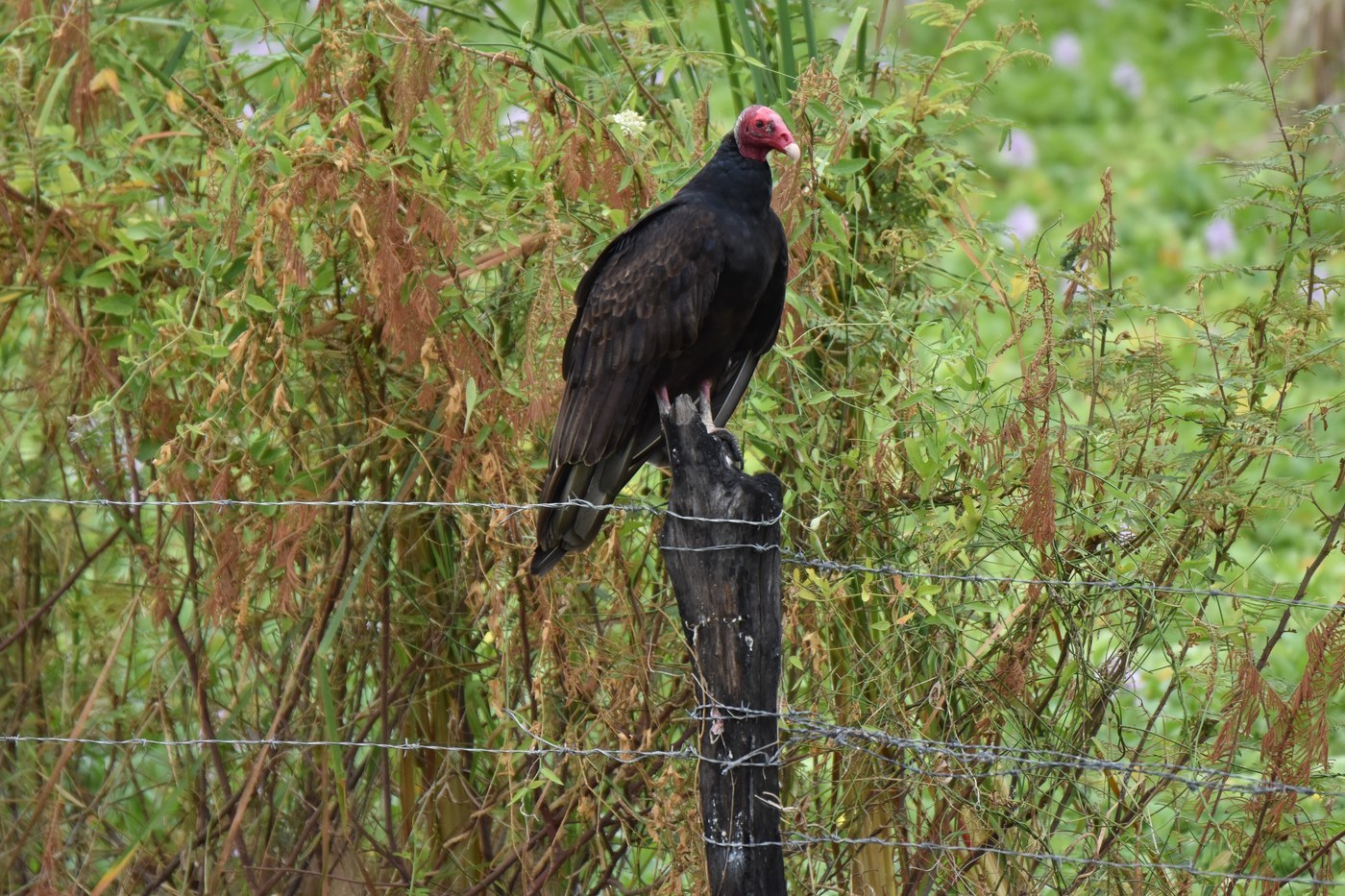
Key Field Marks
- Size & shape: A large raptor-like bird with long, broad wings, a small head relative to the body, and a fairly short tail that extends only slightly beyond the trailing edge of the wings in flight.
- Plumage: Overall blackish-brown body and wing coverts contrasting sharply, in flight, with pale silvery-gray flight feathers (primaries and secondaries) on the underwing, giving a strong two-toned appearance visible from below at a distance.
- Head: Adults have a small, featherless, red head (an adaptation for carrion feeding); juveniles have a gray or blackish bare head instead of red, which can cause confusion with Black Vulture until the tail and wing pattern are checked.
- Flight style: Soars with wings held in a shallow, upward V shape (dihedral), rarely flapping, and rocks and teeters unsteadily from side to side in flight — a highly distinctive, "wobbly" soaring style that alone can identify the species at great distance.
- Behavior: Locates carrion largely by an unusually well-developed sense of smell (unlike most birds), often seen circling low over roads, fields, and forests, or gathered communally at roosts and around carcasses.
Separating Turkey Vulture from Similar Species
- Black Vulture: Shows a shorter, more square-cut tail, whitish patches confined to the wingtips only (not the whole trailing flight feathers), a bare gray-black (not red) head, and flies with quicker, choppier wingbeats interspersed with flat-winged glides rather than a steady V-shaped soar.
- Golden Eagle / other large raptors: Turkey Vulture's small head, two-toned underwing, and wobbly flight readily separate it from eagles, which soar on flatter wings with a solid, powerful, direct flight style and a proportionally larger head and bill.
- Zone-tailed Hawk (range overlap in the southwestern U.S./Mexico): A remarkable mimic of Turkey Vulture in flight silhouette and dihedral soaring style, but shows a banded tail, yellow legs/cere, and a more compact raptor build with a hooked bill visible at closer range — a classic identification challenge in vulture-mimicry.
Where & When to See It
Widespread and common across nearly all of the Americas, from southern Canada through the United States, Mexico, Central America, and much of South America, in virtually any open or semi-open habitat including farmland, forests, deserts, and roadsides. Northern populations are migratory, sometimes forming large, spectacular migrating flocks ("kettles") that ride thermals; southern populations are largely resident. Present year-round through much of the southern and central range, with northern breeders arriving in spring and departing south in fall.
Voice
Essentially voiceless in the usual sense, since Turkey Vultures lack a syrinx; the only sounds produced are low hisses and grunts, given mainly when threatened, feeding, or interacting at roosts and nest sites.
Frequently asked questions
How can you tell Turkey Vulture from Black Vulture in flight?
Turkey Vulture soars on wings held in a shallow V and rocks unsteadily, with pale silvery flight feathers along the entire trailing edge of the underwing, while Black Vulture flies on flatter wings with quicker flapping, has a shorter tail, and shows white patches only at the wingtips.
Why does a Turkey Vulture have a bare red head?
The featherless head is an adaptation for feeding on carrion, helping keep the head cleaner than feathers would when reaching into carcasses; the red coloration is most vivid in adults, while juveniles have a duller gray-black head.
Does Turkey Vulture use smell to find food?
Yes, unusually for birds, Turkey Vulture has a well-developed sense of smell that it uses, along with sight, to locate carrion, even under a forest canopy where carcasses may not be visible from above.
What other bird can be confused with a soaring Turkey Vulture?
Zone-tailed Hawk, found in parts of the southwestern U.S. and Mexico, closely mimics Turkey Vulture's flight silhouette and wobbly dihedral soaring style, but shows a banded tail and yellow legs at closer range.