
Tundra Swan Identification Guide
A smaller, higher-voiced relative of Trumpeter Swan that breeds on the high Arctic tundra, often showing a small yellow spot at the base of the bill but best separated from Trumpeter Swan by size, head shape, and call.
Read the full Tundra Swan encyclopedia entry →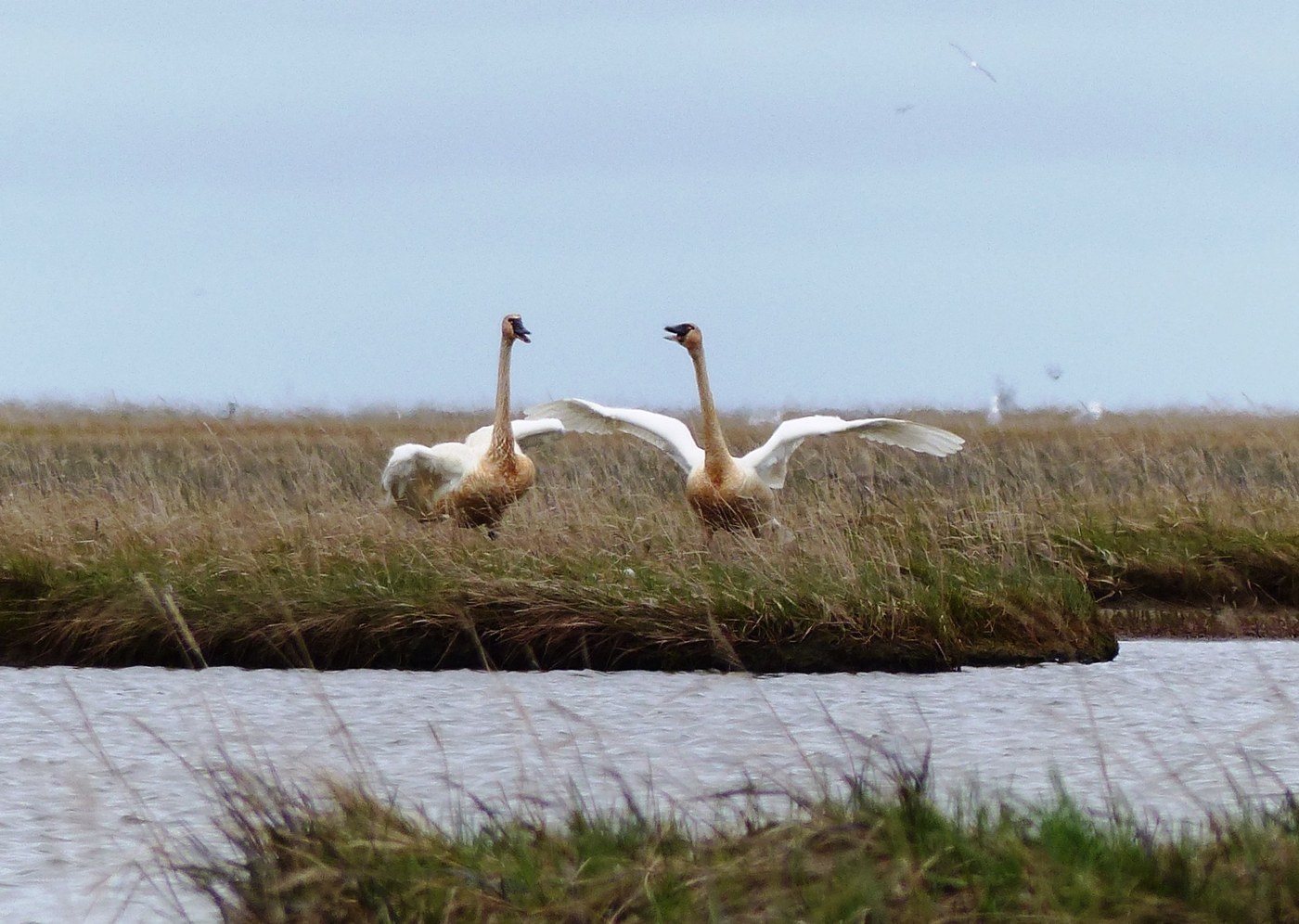
Key Field Marks
- Size & shape: A large white swan, but distinctly smaller and more compact than Trumpeter Swan, with a shorter, more rounded head and a somewhat shorter, less wedge-shaped bill; the neck, while long, is typically held slightly less rigidly straight than Trumpeter's.
- Plumage: Entirely white in adults; cygnets are pale gray, whitening over their first year, similar to young Trumpeter Swans.
- Bill: Black, often (but not always) showing a small yellow spot at the base near the eye (the lore) — variably present and sometimes entirely absent, so it should be used cautiously rather than as a sole field mark. The bill's culmen is more concave near the forehead than the straighter profile of Trumpeter Swan.
- Legs: Black legs and feet.
- Behavior: Highly gregarious, migrating and wintering in large, vocal flocks; feeds by dabbling, upending, and grazing on aquatic tubers, grasses, and waste grain in agricultural fields, often in large numbers alongside geese.
Separating Tundra Swan from Similar Species
- Trumpeter Swan: Larger overall, with a longer, straighter bill profile and a flatter forehead, an all-black bill lacking (or very rarely showing traces of) yellow, and a much deeper, more resonant trumpeting call versus Tundra Swan's higher, more musical, yelping call.
- Mute Swan (introduced): Orange-red bill with a black basal knob and a graceful curved neck, quite unlike Tundra Swan's straight black bill and straighter neck carriage.
- Bewick's Swan (Eurasian counterpart, sometimes considered a subspecies of Tundra Swan): Shows a more extensive yellow patch on the bill (typically covering more of the bill base) compared to the smaller, more restricted yellow spot typical of the North American "Whistling Swan" subspecies.
Where & When to See It
Breeds on Arctic tundra across northern Alaska and northern Canada, nesting near tundra ponds, lakes, and river deltas. A long-distance migrant, it winters in large concentrations in traditional staging and wintering areas including Chesapeake Bay and other mid-Atlantic estuaries, the Central Valley of California, and the Klamath Basin, typically arriving on wintering grounds in November and departing north again by March–April.
Voice
A high-pitched, musical, somewhat goose-like whooping or yelping call — "whoo-ho, whoo-whoo" — given frequently in flight and by flocks on the water, noticeably higher-pitched and less resonant than the deep trumpeting of Trumpeter Swan; large wintering flocks produce a constant chorus of these calls.
Frequently asked questions
Does every Tundra Swan have a yellow spot on the bill?
No. The yellow lore spot is variable in size and some individuals lack it entirely, so it should be used only as a supporting clue, not a definitive mark, especially where Trumpeter Swan also occurs.
How do you separate Tundra Swan from Trumpeter Swan by voice?
Tundra Swan gives a higher-pitched, more musical, whooping or yelping call, while Trumpeter Swan's call is deeper, more resonant, and more trumpet-like — voice is often the most reliable field distinction when the birds are together.
Where does Tundra Swan breed?
On Arctic tundra across northern Alaska and northern Canada, nesting near tundra ponds, lakes, and river deltas well north of the tree line.
Where are the major wintering areas for Tundra Swan in North America?
Key wintering concentrations occur in Chesapeake Bay and other mid-Atlantic estuaries, California's Central Valley, and the Klamath Basin, generally from November through March.