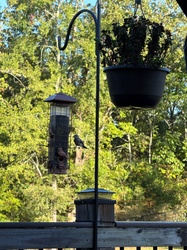
Tufted Titmouse Identification Guide
A common, curious backyard songbird of the eastern and central United States, easily known by its pointed gray crest, black forehead patch, and peachy-orange flanks.
Read the full Tufted Titmouse encyclopedia entry →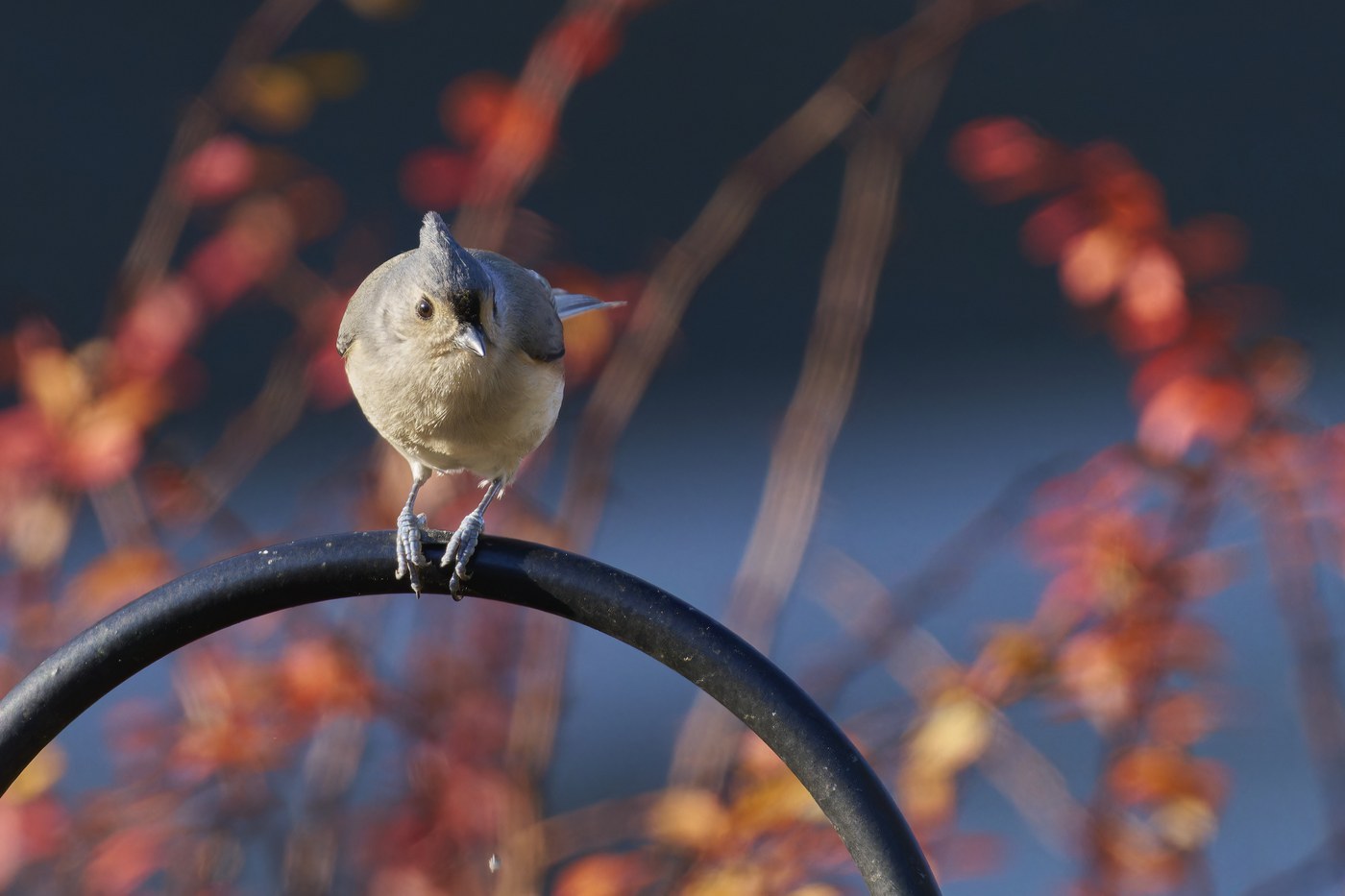
Key Field Marks
- Size & shape: A small, plump songbird with a distinctive pointed crest, a fairly large head, short stout bill, and a moderately long tail — a member of the chickadee/titmouse family with a similarly acrobatic, active manner.
- Plumage: Soft blue-gray upperparts, pale gray underparts, and a wash of peachy-orange along the flanks that becomes more or less visible depending on posture and light; a small black patch above the bill (forehead) contrasts with the pale face and gray crest.
- Eye: Large, dark eye that stands out against the plain gray face, giving the bird an alert, wide-eyed expression.
- Behavior: Active and acrobatic, often hanging upside-down while foraging on branches and twigs; visits feeders readily, especially for sunflower seeds, which it typically carries off one at a time to hammer open or cache. Frequently joins mixed-species foraging flocks with chickadees, nuthatches, and woodpeckers in fall and winter, and is often the noisiest, most inquisitive member of the group, readily approaching to scold at intruders ("mobbing").
- Voice-driven curiosity: Known for boldly investigating pished or squeaked sounds, often coming quite close to observers.
Separating Tufted Titmouse from Similar Species
- Black-crested Titmouse (south-central Texas/Mexico): Very similar in shape and behavior but shows a black crest rather than gray, and a pale (not black) forehead — essentially a color-reversed pattern from Tufted Titmouse; the two forms meet in a narrow hybrid zone in central Texas.
- Chickadees (Carolina/Black-capped): Lack any crest entirely, show a black cap and bib rather than a black forehead patch, and are noticeably smaller and rounder-headed.
- Bridled Titmouse (southwestern U.S.): Shows a bold black-and-white facial pattern with a "bridle" of black lines on the face — quite different from the plain gray face of Tufted Titmouse, and ranges do not overlap.
- No other eastern songbird combines a gray crest with peachy flanks, making Tufted Titmouse essentially unmistakable within its normal range once the crest is seen.
Where & When to See It
A year-round resident throughout the eastern and central United States, from the Great Lakes and New England south to the Gulf Coast and west to the Great Plains, with its range having expanded northward over recent decades. Found in deciduous and mixed forests, woodland edges, parks, and residential areas with mature trees; a common and confiding visitor to backyard bird feeders, particularly in winter.
Voice
The song is a loud, whistled, repeated "peter-peter-peter" (sometimes rendered "here-here-here"), given year-round but most frequently in late winter and spring. Calls include scratchy, scolding chatter notes similar to a chickadee's but harsher and lower, often used when mobbing predators or investigating disturbances.
Frequently asked questions
What is the easiest way to identify a Tufted Titmouse?
Look for the pointed gray crest, black forehead patch, plain gray face with a large dark eye, and a wash of peachy-orange along the flanks — a combination unique among common eastern backyard birds.
How is Tufted Titmouse different from a chickadee?
Tufted Titmouse has a pointed crest and lacks a chickadee's black cap-and-bib pattern; it also tends to be slightly larger with a proportionally larger head, though both often forage together in mixed flocks.
What is the difference between Tufted Titmouse and Black-crested Titmouse?
Black-crested Titmouse, found mainly in south-central Texas and Mexico, has a black crest and pale forehead — essentially the reverse pattern of Tufted Titmouse's gray crest and black forehead. The two hybridize in a narrow contact zone.
What does a Tufted Titmouse's song sound like?
A loud, clear, whistled "peter-peter-peter," repeated several times, often sung from a high perch, especially in late winter and spring.
Tufted Titmouse identified by the community
Recent Tufted Titmouse sightings identified with Bird Identifier.