
Tufted Puffin Identification Guide
A striking North Pacific seabird with an all-black body, white face mask, and massive orange bill, made unmistakable in breeding plumage by long golden head plumes sweeping back from above each eye.
Read the full Tufted Puffin encyclopedia entry →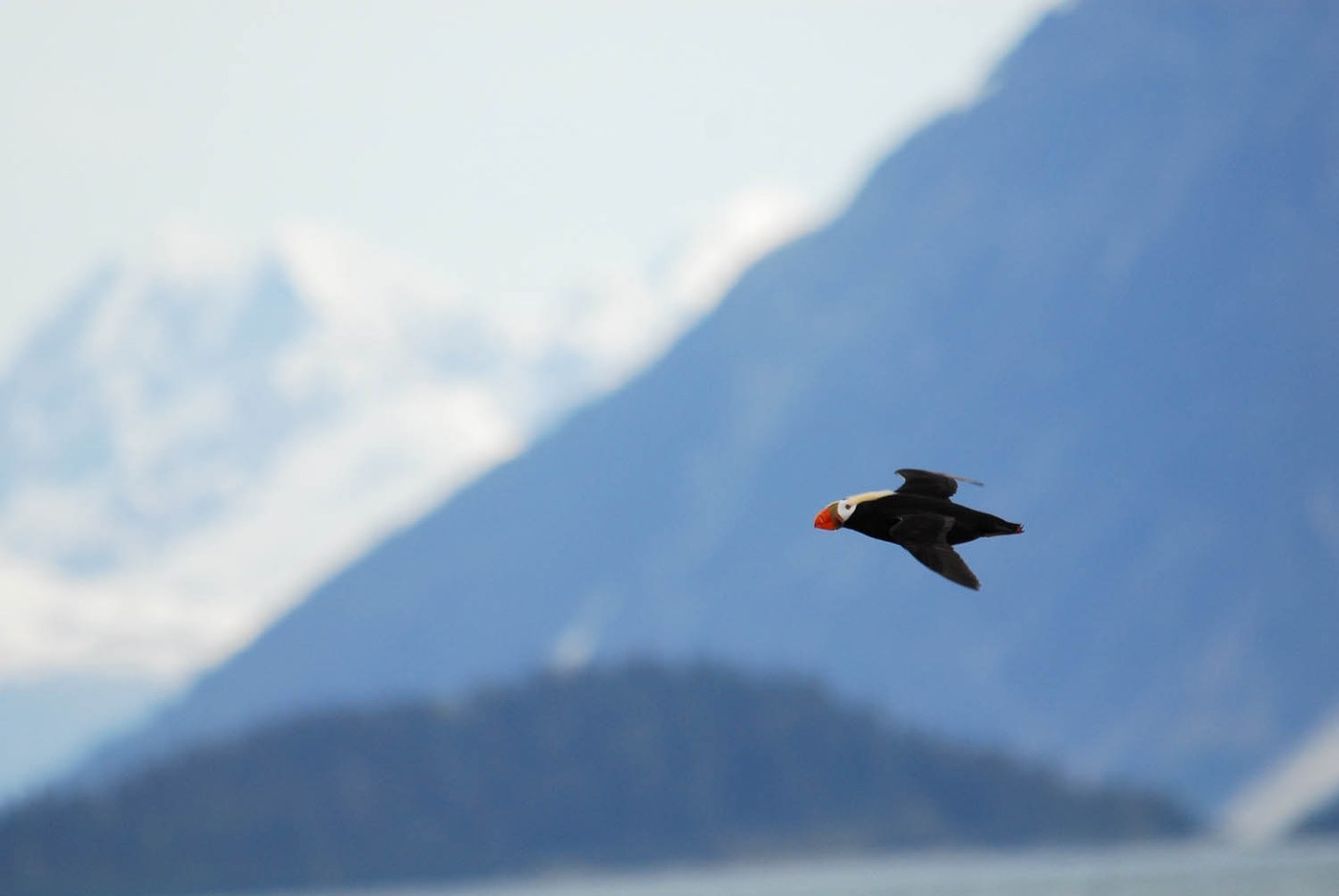
Key Field Marks
- Size & shape: A stocky, large-headed alcid with a barrel-shaped body, short neck, and short wings adapted for both diving underwater and fast whirring flight; noticeably larger and bulkier than Atlantic or Horned Puffin.
- Breeding plumage: Entirely sooty-black body plumage with a bold white/pale facial disc, a massive, laterally compressed orange-red bill, orange legs and feet, and long, drooping straw-yellow tufts of feathers curving back from behind each eye — unmistakable when present.
- Non-breeding/winter plumage: Loses the golden head tufts and much of the bill's outer colorful plates (bill becomes smaller and duller), face becomes duskier/grayer rather than crisp white, making winter birds far less showy and easily overlooked among other alcids at sea.
- Juveniles: Dusky overall with a smaller, dark grayish bill lacking the adult's bright colors and any head plumes.
- Behavior: Nests colonially in burrows on grassy sea cliffs and islands; flies with rapid, whirring wingbeats low over the water, and dives and swims underwater using its wings to "fly" in pursuit of small fish, which it carries back to the burrow crosswise in its bill, sometimes in large numbers at once.
Separating Tufted Puffin from Similar Species
- Horned Puffin: Shares the North Pacific range but shows a mostly white face and underparts year-round contrasting with a black back (Tufted Puffin is entirely black-bodied), plus a small dark fleshy "horn" above the eye rather than yellow tufts; Horned Puffin's bill is yellow at the base and red at the tip, more sharply bicolored than Tufted Puffin's.
- Atlantic Puffin: Not found in the Pacific (allopatric, ranges essentially do not overlap), but if compared, Atlantic Puffin has white underparts and a smaller, more triangular, tricolored bill, unlike Tufted Puffin's all-black body.
- Rhinoceros Auklet: Superficially similar dark seabird with a pale face in breeding plumage, but much smaller with a stubby yellowish bill and a pale horn-like knob at the base rather than a large laterally flattened orange puffin bill; lacks the puffin's dramatic head tufts.
- Winter-plumage confusion: Non-breeding Tufted Puffins can be mistaken for other dark alcids at sea; the large head, heavy bill base, and overall bulk usually still distinguish it from murres and guillemots, which have thinner, pointed bills.
Where & When to See It
Breeds on grassy, burrow-riddled sea cliffs and offshore islands around the North Pacific Rim, from California north through the Pacific Northwest, coastal Alaska, and the Aleutians, west to the Russian Far East and Japan. Spends the non-breeding season far out at sea, typically well offshore in the North Pacific, making it rarely seen from land outside the breeding season; breeding colonies are active roughly April through August, after which birds disperse widely over open ocean.
Voice
Largely silent at sea; at breeding colonies, gives a low, growling or groaning "arrr" or grunting call from within or near the nest burrow, used mainly in territorial and courtship interactions rather than in flight.
Frequently asked questions
What is the most distinctive feature of a breeding Tufted Puffin?
The long, curved, straw-yellow head plumes sweeping back from behind each eye, combined with an all-black body and a massive orange bill — a combination unique among North Pacific seabirds.
How does Tufted Puffin differ from Horned Puffin?
Tufted Puffin is entirely black-bodied with a white face patch and, in breeding season, long yellow head tufts, while Horned Puffin has white underparts contrasting with a black back and only a small dark fleshy "horn" above the eye rather than plumes.
What does a Tufted Puffin look like outside the breeding season?
It loses its golden head tufts, the bill becomes smaller and duller, and the face turns duskier gray rather than crisp white, making winter birds much plainer and harder to identify at sea.
Where is the best place to see Tufted Puffins?
At breeding colonies on grassy sea cliffs and offshore islands around the North Pacific Rim, from California and the Pacific Northwest north through coastal Alaska, generally between April and August; outside the breeding season they range far offshore and are rarely seen from shore.