Tufted Duck Identification Guide
A Eurasian diving duck easily recognized by the male's crisp black-and-white plumage, golden eye, and drooping head tuft, told from similar diving ducks by its white flanks and rounded head shape.
Read the full Tufted Duck encyclopedia entry →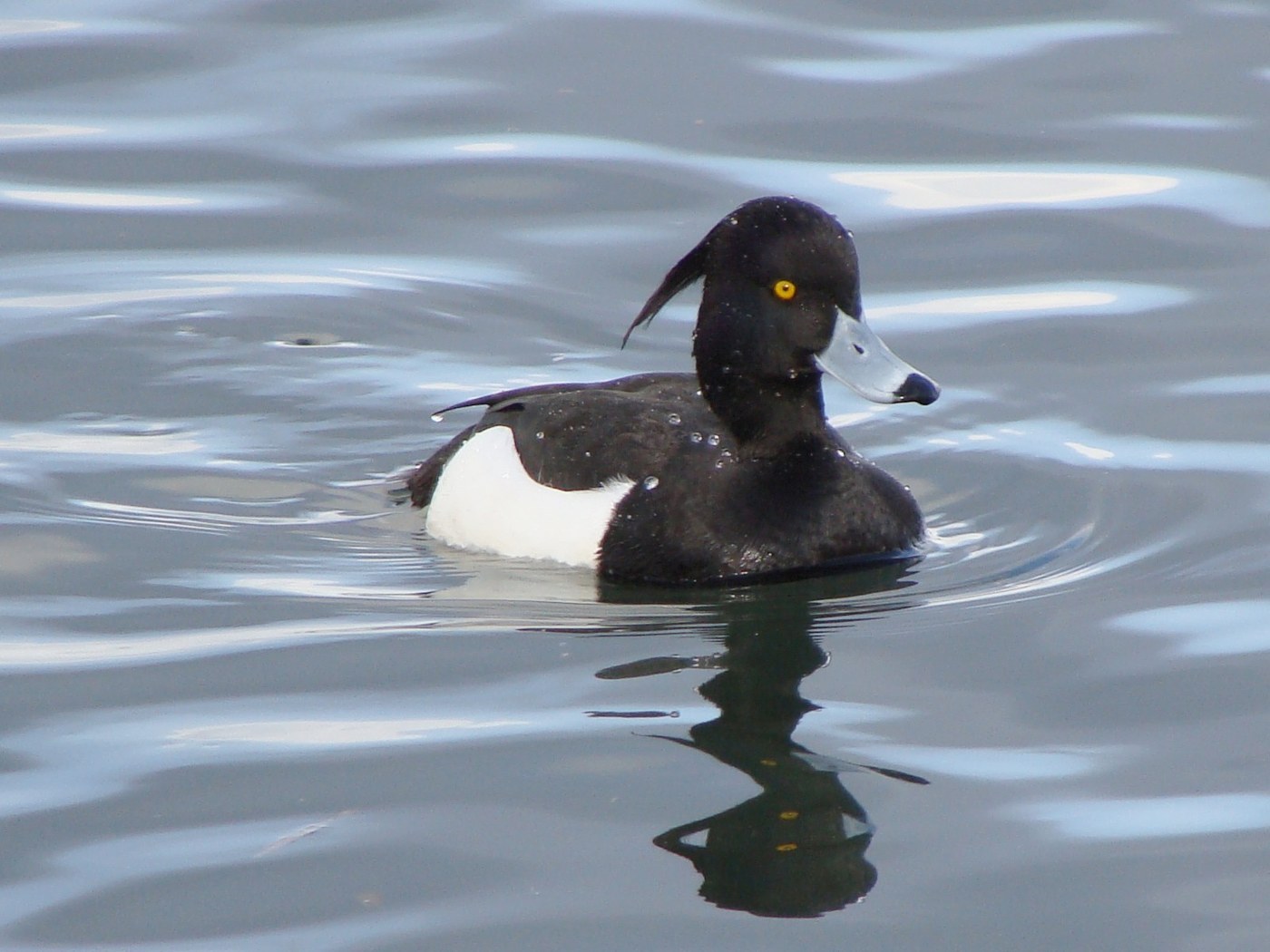
Key Field Marks
- Size & shape: A small, compact diving duck (Aythya genus) with a rounded head, a distinctive drooping tuft of feathers at the back of the crown (longer in males, shorter in females), and a fairly short, broad bill with a black nail tip.
- Male plumage: Striking black overall with clean, bright white flanks, a glossy purplish-black head, and a vivid golden-yellow eye — one of the most contrastingly patterned diving ducks in its range.
- Female plumage: Dark brown overall with paler, dusky-brown (not white) flanks, a smaller head tuft, and sometimes a small whitish patch at the base of the bill (which can suggest scaup, requiring care).
- In flight: Shows a bold white wing stripe running along the length of both the secondaries and primaries — broader/more extensive than the wing stripe of scaup.
- Behavior: An active diver, feeding on aquatic invertebrates (notably mollusks) and vegetation by diving from the surface; often forms large rafts on lakes and reservoirs, frequently mixing with scaup and Pochard.
Separating Tufted Duck from Similar Species
- Greater and Lesser Scaup: Lack any head tuft, have a more rounded (Greater) or peaked (Lesser) head shape without a drooping crest, and show gray (not white) backs on males — Tufted Duck's male has a solidly black back, contrasting with scaups' pale gray back.
- Ring-necked Duck (North America): Has a peaked, angular head shape (no tuft), a bold white ring near the bill tip and a subtler pale ring at the base, and a gray (not white) flank with a pale wedge in front of the wing on the male — Tufted Duck shows uniformly white flanks and no bill rings.
- Ferruginous Duck: Smaller, rich chestnut-brown overall with a white eye (male) and white undertail patch, entirely different from Tufted Duck's black-and-white pattern.
- Female Tufted Duck vs. female scaup: Both can show a whitish face patch, but female Tufted Duck retains a small head tuft and has darker, more uniformly brown flanks compared to the grayer-brown flanks of female scaup.
Where & When to See It
Breeds across a broad swath of Europe and northern/central Asia on lakes, reservoirs, and slow rivers with emergent vegetation. Highly migratory in the northern parts of its range, wintering on lakes, reservoirs, coastal bays, and estuaries across western and southern Europe, the Mediterranean, the Middle East, and South and East Asia; a regular winter visitor and increasingly regular vagrant to North America, especially in the Northeast and along the Pacific coast, often found associating with scaup flocks.
Voice
Generally quiet outside the breeding season; males give soft wheezy or whistling courtship notes during display, while females utter a harsh, growling "karr" or "krrr," mainly around the nest or when alarmed.
Frequently asked questions
What is the easiest way to identify a male Tufted Duck?
Look for the combination of a solid black back and breast, crisp white flanks, a golden-yellow eye, and a drooping tuft of feathers at the back of the head — a combination no scaup or Ring-necked Duck shares.
How do you tell Tufted Duck from scaup?
Tufted Duck has a head tuft and a black back on the male (scaup have gray backs and no tuft); in flight, Tufted Duck's white wing stripe extends further out onto the primaries than in scaup.
Is Tufted Duck ever seen in North America?
Yes, it is a regular but scarce winter visitor and vagrant, most often found in the Northeast and along the Pacific coast, typically mixed in with flocks of scaup on lakes, reservoirs, and coastal waters.
What does a female Tufted Duck look like?
Dark brown overall with a small head tuft, darker brown (not white) flanks compared to the male, and sometimes a limited whitish patch at the base of the bill that can cause confusion with female scaup.
Tufted Duck identified by the community
Recent Tufted Duck sightings identified with Bird Identifier.