
Trumpeter Swan Identification Guide
North America's largest native waterfowl, an all-white swan with a straight neck and solid black bill, told from the similar Tundra Swan mainly by larger size, bill shape, and its deep, resonant, trumpet-like call.
Read the full Trumpeter Swan encyclopedia entry →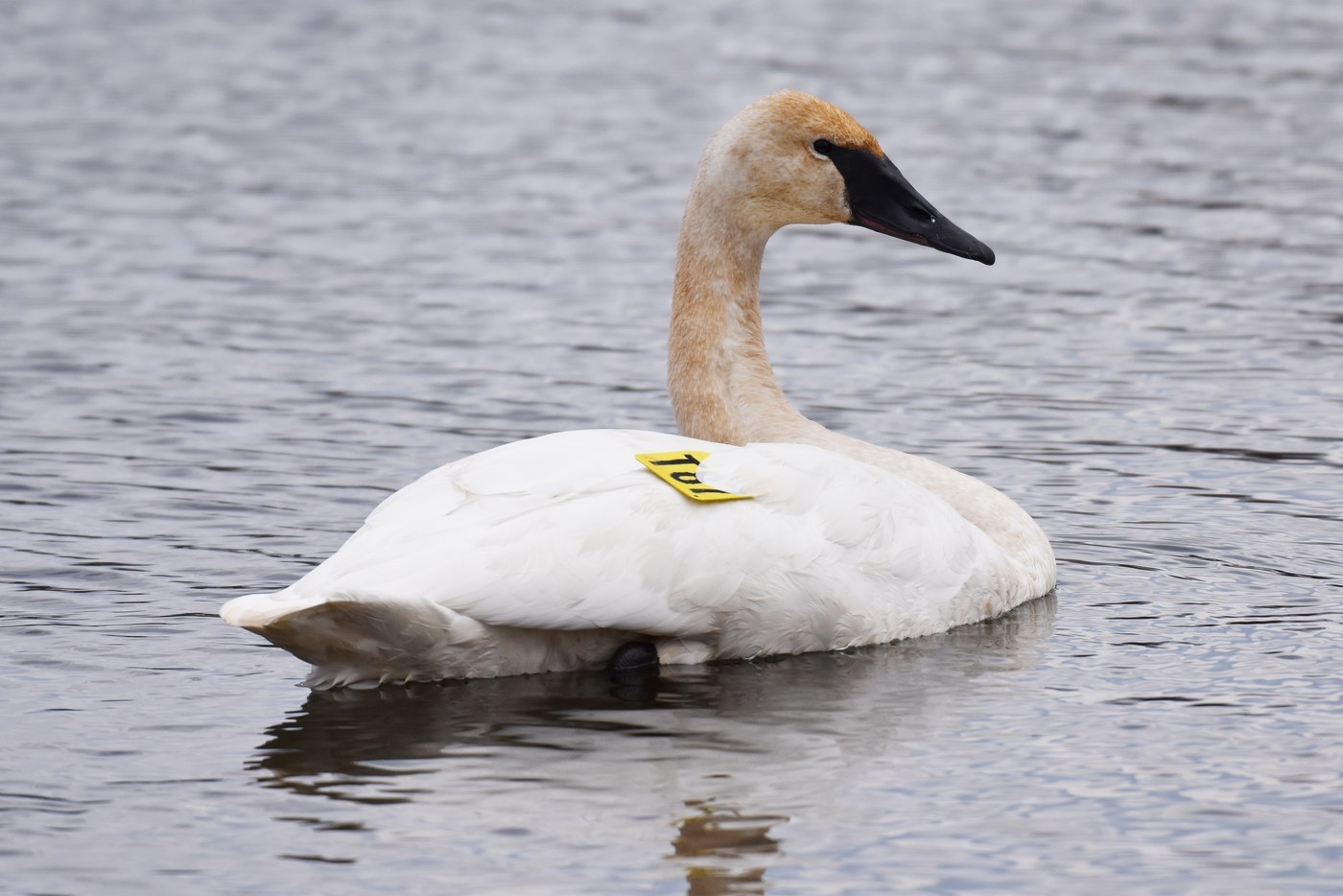
Key Field Marks
- Size & shape: Enormous — the largest native waterfowl species in North America, with a long, straight neck typically held erect, a large body, and a proportionally large, wedge-shaped head and bill profile that blends smoothly into a straight forehead (no forehead "bump").
- Plumage: Entirely white in adults; cygnets (first-year birds) are pale gray-brown, gradually whitening through their first year, often retaining some dusky wash into a second year.
- Bill: Solid black, long, and heavy, with a fairly straight culmen and a thin reddish-orange line along the lower mandible (the "lipstick" or "grin patch") visible at close range — Trumpeter Swan lacks any yellow at the base of the bill.
- Legs: Black legs and feet.
- Behavior: Swims with a straight, upright neck (versus the graceful curved neck of Mute Swan); feeds by dabbling, upending, and grazing on aquatic vegetation and grain in fields; strong, direct flight in lines or V-formations with slow, powerful wingbeats.
Separating Trumpeter Swan from Similar Species
- Tundra Swan: Smaller and more compact, with a shorter neck and a rounder head; most (but not all) Tundra Swans show a small yellow spot in front of the eye at the base of the bill, though some lack it entirely, making bill shape and voice more reliable. The bill profile is more concave/rounded near the forehead compared to Trumpeter's straighter, sloping profile.
- Mute Swan (introduced): Has a distinctive orange-red bill with a black basal knob, holds its neck in a graceful S-curve, and often swims with wings raised in an aggressive "busking" posture — very different from Trumpeter Swan's straight neck and all-black bill.
- Snow Goose (white morph) and white domestic geese: Much smaller with shorter necks and pink or orange bills — size and bill color quickly rule these out.
Where & When to See It
Breeds across Alaska, western Canada, and reintroduced populations in the northern Rocky Mountains, Great Lakes region, and other pockets of the northern U.S., using large lakes, marshes, and slow rivers with abundant aquatic vegetation. Northern populations are migratory, wintering on ice-free lakes, rivers, and coastal estuaries in the Pacific Northwest, the Rockies (e.g., the Yellowstone/Henry's Fork region), and the upper Midwest; some reintroduced populations are largely non-migratory or short-distance migrants.
Voice
A deep, loud, resonant, brassy trumpeting or bugling call — "koh-hoh" or "ohh-OH" — much lower-pitched than the higher, more musical whooping/yelping calls of Tundra Swan, and the origin of the species' name. The call carries a long distance and is one of the most useful field marks when the two swan species are together.
Frequently asked questions
What is the best way to tell Trumpeter Swan from Tundra Swan?
Voice is the most reliable clue: Trumpeter Swan gives a deep, resonant trumpeting call, while Tundra Swan's call is higher-pitched and more yelping. Structurally, Trumpeter Swan is larger with a straighter bill profile and longer, straighter neck, while many (not all) Tundra Swans show a small yellow spot at the base of the bill.
Does every Tundra Swan have a yellow spot on the bill?
No — the yellow loral spot is variable and some Tundra Swans lack it entirely, so it should not be relied on alone; size, bill shape, and voice are more consistent identification features.
How is Trumpeter Swan different from Mute Swan?
Mute Swan has an orange-red bill with a black knob at the base and holds its neck in a curved S-shape, while Trumpeter Swan has an all-black bill and a straight, upright neck.
Where can Trumpeter Swans be seen in winter?
Key wintering areas include ice-free rivers and lakes in the Pacific Northwest, the Yellowstone/Henry's Fork region of the northern Rockies, and parts of the upper Midwest, wherever open water and aquatic vegetation or waste grain remain available.