
Trumpeter Hornbill Identification Guide
A large, boldly black-and-white African forest hornbill named for its far-carrying, baby-like wailing and braying calls, identified by its casqued bill and white-spotted wings.
Read the full Trumpeter Hornbill encyclopedia entry →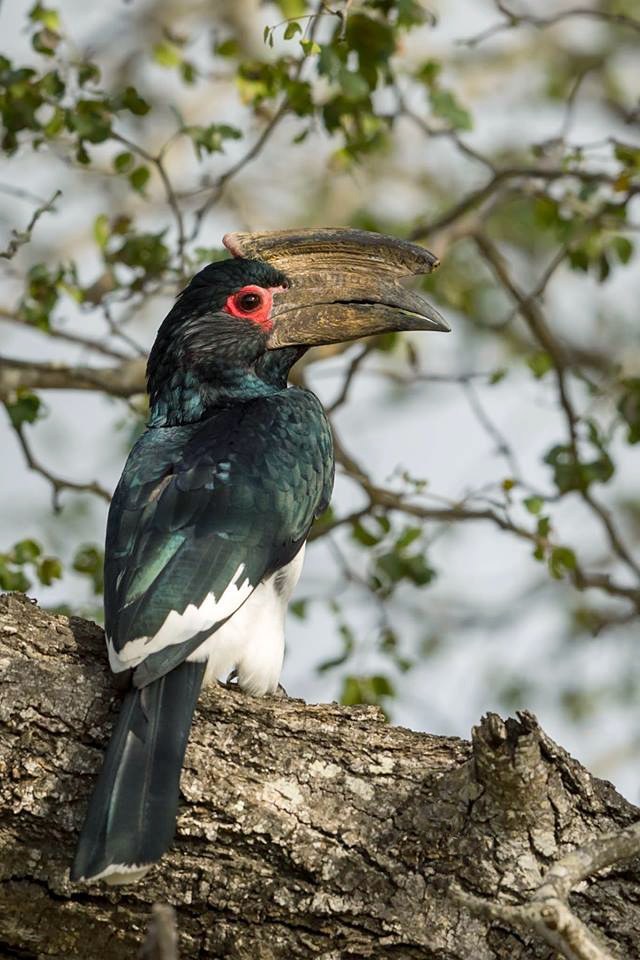
Key Field Marks
- Size & shape: A large hornbill with a heavy body, broad rounded wings, and a long tail — built for powerful, undulating flight over forest canopy, with audible whooshing wingbeats caused by specialized wing feathers.
- Plumage: Glossy black head, neck, and upperparts with a white belly and white-tipped wing feathers that create a spotted/speckled pattern on the closed wing; the tail is black with a broad white terminal band.
- Bill & casque: Large, mostly blackish bill topped with a prominent casque (helmet-like ridge) — males show a larger, more prominent, laterally flattened casque than females, which have a smaller, more rounded casque.
- Bare skin: Pinkish-red bare skin around the eye contrasts with the dark plumage.
- Behavior: Highly social and noisy, usually in small groups or larger flocks moving through the forest canopy in search of fruiting trees; flight is heavy and undulating, alternating flapping bursts with glides, with wingbeats producing a distinctive whooshing/rushing sound audible well before the birds are seen.
Separating Trumpeter Hornbill from Similar Species
- Silvery-cheeked Hornbill: Larger still, with a pale grayish-white cheek patch and a much taller, more prominent casque with a distinct ridge — found in similar East African forest habitat but easily told apart at close range by the cheek pattern and bigger casque.
- Crowned Hornbill: Considerably smaller, browner-toned rather than glossy black, with a slimmer bill and much smaller casque, and a different, more grunting call.
- Black-and-white-casqued Hornbill (West/Central Africa): Similar black-and-white pattern but ranges do not overlap with Trumpeter Hornbill (which is a southern/eastern African species), and it shows a taller, more angular casque.
- African Grey Hornbill: Much smaller and grayer overall, lacking the bold black-and-white contrast and large casque of Trumpeter Hornbill.
Where & When to See It
Resident across forest, woodland, and riverine forest patches of eastern and southern Africa, from Kenya and Uganda south through Tanzania, Malawi, Mozambique, Zimbabwe, and into eastern South Africa (notably coastal KwaZulu-Natal forests). Non-migratory, but flocks move locally in response to fruiting tree availability, particularly figs, which form a major part of the diet.
Voice
Named for its loud, far-carrying call — a series of wailing, nasal, trumpet- or bray-like notes that has been likened to a crying baby or a braying donkey; often given as duets or group choruses that carry for long distances through the forest, frequently the first clue to the birds' presence before they are seen.
Frequently asked questions
Why is it called the Trumpeter Hornbill?
For its loud, wailing, trumpet- or bray-like call, often compared to a crying baby, which carries far through the forest canopy and is usually heard before the birds are seen.
How can you tell male and female Trumpeter Hornbills apart?
Males have a larger, more prominent, laterally flattened casque on top of the bill, while females show a smaller, more rounded casque.
What does Trumpeter Hornbill eat?
Primarily fruit, especially figs, supplemented with insects and small animals; flocks track fruiting trees through forest and woodland habitat.
How is Trumpeter Hornbill different from Silvery-cheeked Hornbill?
Silvery-cheeked Hornbill is larger, has a pale gray-white cheek patch, and a taller, more prominent casque, whereas Trumpeter Hornbill lacks the pale cheek and has a comparatively smaller casque.