
Tree Pipit Identification Guide
A streaky brown Eurasian pipit best told from the very similar Meadow Pipit by its stronger bill, bolder facial pattern, upright stance, and distinctive parachuting song flight ending in a drawn-out "seeaa."
Read the full Tree Pipit encyclopedia entry →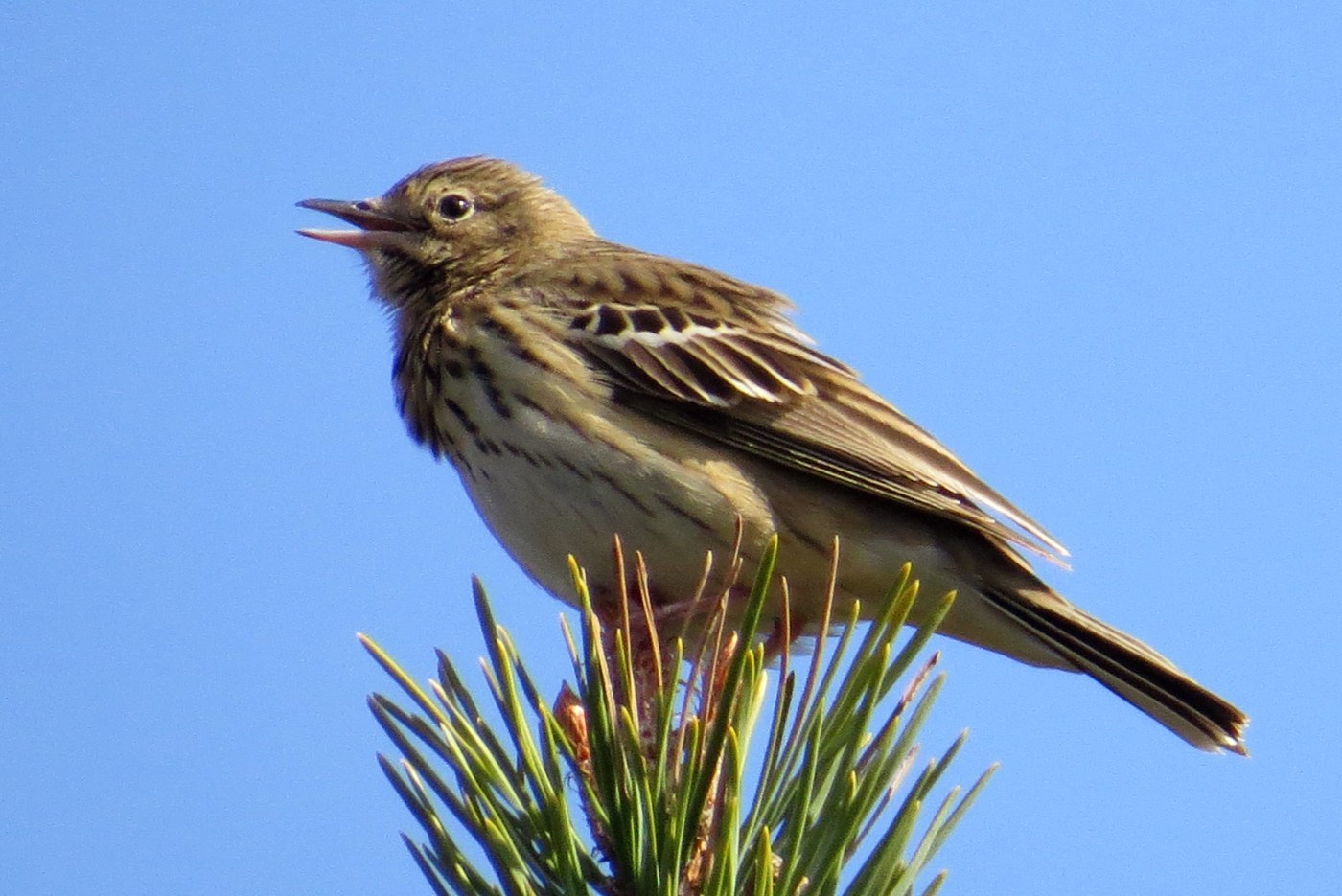
Key Field Marks
- Size & shape: A medium-sized pipit, roughly sparrow-to-starling sized, with a fairly stout build, longish tail, and an upright, alert posture when perched.
- Plumage: Warm brown-olive upperparts with dark streaking on the back; underparts buffy-white with bold blackish streaking concentrated on the breast, fading on the flanks.
- Bill: Noticeably stronger and stubbier than most other pipits, with a pale base to the lower mandible — a useful clue at close range.
- Legs & feet: Pinkish legs with a short hind claw, distinctly shorter and more curved than the long, straight hind claw of Meadow Pipit. This is the classic in-hand distinction, though rarely useful in the field.
- Behavior: Frequently perches in trees and on bushes or wires, unlike the more ground-bound Meadow Pipit — hence the name. Walks and creeps on the ground when feeding, pumping its tail gently.
Separating Tree Pipit from Similar Species
- Meadow Pipit: Very similar but slimmer-billed, more finely streaked below, greener-toned above, almost never perches in trees, and gives a thin "ist-ist-ist" flight call rather than the Tree Pipit's buzzy "spzeeh."
- Olive-backed Pipit (in Asia/vagrant contexts): Shows a more contrasting head pattern with a bold pale supercilium bordered dark above and below, and distinctly unstreaked or lightly streaked flanks/rump — Tree Pipit is streakier overall on the mantle and lacks the strong facial contrast.
- Richard's Pipit / larger pipits: Much bigger, longer-legged, and more upright, with a very different, harsher flight call.
Where & When to See It
Tree Pipit breeds across most of temperate Europe and into western Asia, favoring open woodland edges, heathland with scattered trees, forest clearings, and scrubby hillsides — always needs at least a few song-perches (trees, tall bushes, or even fence posts). It is a long-distance migrant, wintering in sub-Saharan Africa, and is present on breeding grounds only from mid-spring through late summer, arriving April–May and departing by August–September.
Voice
The song is the best identification tool: delivered from a high perch or, more famously, during a parachuting display flight — the bird flies up steeply from a treetop, then glides down on stiff, outstretched wings while singing a rich series of trills and repeated phrases that ends with a distinctive, drawn-out, descending "seeaa-seeaa-seeaa." The flight call is a hoarse, buzzy "spzeeh" or "teez," lower and buzzier than Meadow Pipit's thinner call.
Frequently asked questions
What is the easiest way to tell Tree Pipit from Meadow Pipit in the field?
Behavior and voice are the most reliable clues: Tree Pipit habitually perches in trees and bushes and gives a buzzy, husky flight call, while Meadow Pipit stays close to the ground and gives a thin, high "ist-ist" call. The song flight, ending in a long drawn-out "seeaa," is diagnostic when heard.
Does Tree Pipit have a distinctive song flight?
Yes. Males rise from a treetop in a steep display flight, then parachute down on stiffly held wings while singing, finishing with several repeated, drawn-out descending notes — a pattern unlike any other common European pipit.
Where is the best habitat to find Tree Pipit?
Look for open, sunny habitats with scattered trees for singing perches: woodland edges, clearcuts and young plantations, heathland, and scrubby hillsides. Dense closed-canopy forest and treeless open fields are both avoided.
When does Tree Pipit arrive on its breeding grounds?
It is a trans-Saharan migrant, typically arriving on European breeding grounds in April or May and departing again by late August or September to winter in sub-Saharan Africa.