
Townsend's Warbler Identification Guide
Townsend's Warbler is a striking Pacific Northwest warbler with a black throat and cheek patch bordered by yellow, best separated from the closely related Hermit Warbler by its darker, more patterned face.
Read the full Townsend's Warbler encyclopedia entry →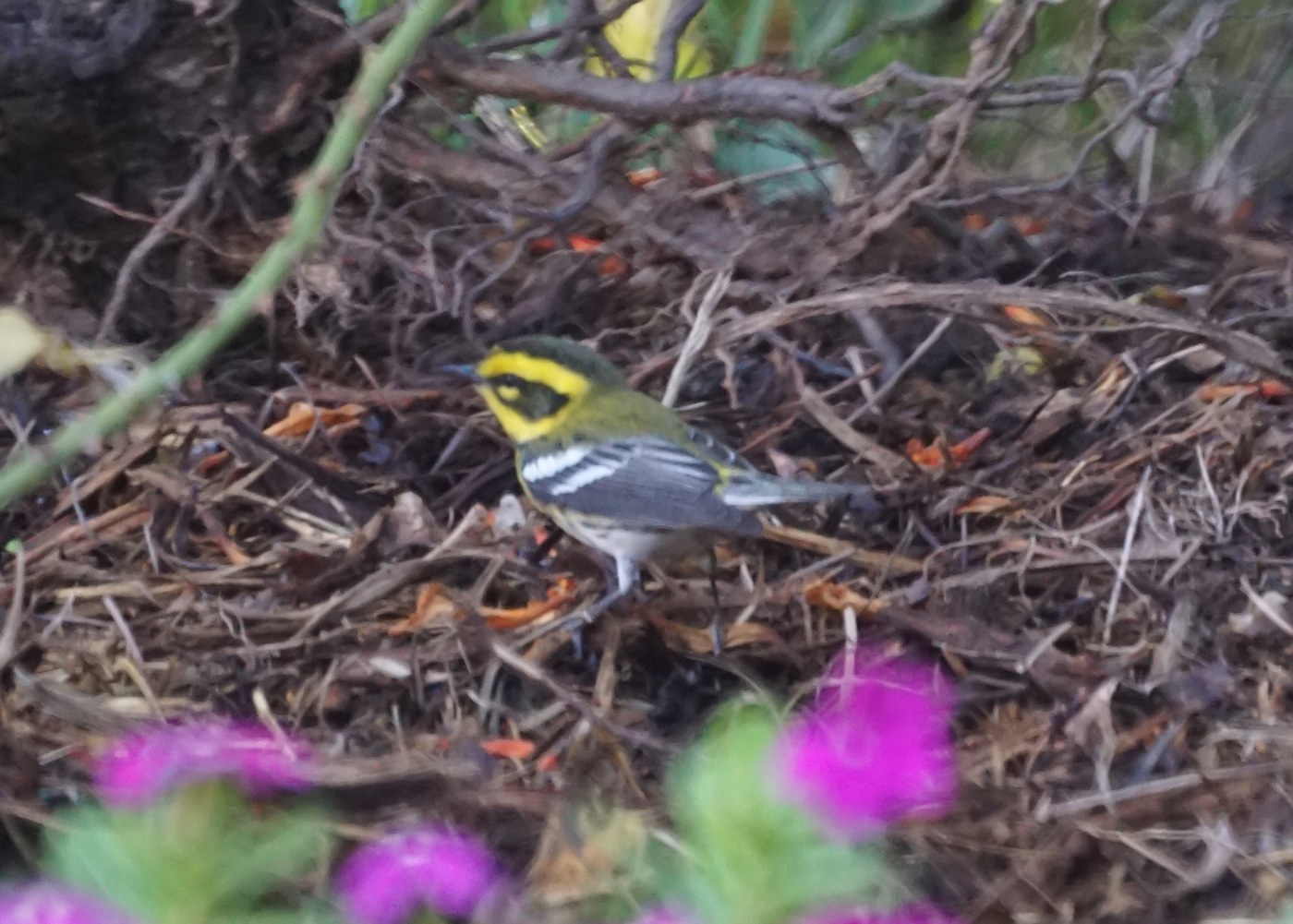
Key Field Marks
- Size & shape: A small, active warbler, 11–13 cm, typical warbler proportions with a fine, pointed bill.
- Adult male: Black throat and a bold black cheek (auricular) patch sharply outlined by bright yellow surrounding the face, yellow breast with dark streaking along the flanks, olive-green back, and two white wingbars.
- Female / immature: Duller version of the male pattern — an olive rather than solid black cheek patch and a yellow (rather than black) throat, but retaining the same basic yellow-and-black facial framework.
- Behavior: Forages actively, often high in conifer canopy, gleaning and occasionally hover-picking insects from needle clusters; frequently joins mixed-species foraging flocks outside the breeding season.
Separating Townsend's Warbler from Similar Species
- Hermit Warbler: Male Hermit has a plain, unmarked yellow head without the black cheek patch or black throat of Townsend's; the two species hybridize where their ranges meet in Washington and Oregon, producing intermediate-looking birds that can complicate identification.
- Black-throated Green Warbler: An eastern counterpart with a similar yellow face, but shows a plain (unpatterned) yellow cheek without the bold black auricular patch, and typically far less streaking on the flanks.
- Golden-cheeked Warbler: Range does not normally overlap (central Texas breeder), but shows a solid black cap and back versus Townsend's olive-green back.
Where and When to See One
- Range: Breeds in coniferous forest of the Pacific Northwest, from south-central Alaska and the Yukon south through British Columbia to Washington and Oregon (and locally hybridizing with Hermit Warbler further south).
- Habitat: Breeds high in tall conifers (Douglas-fir, hemlock, spruce); on migration and in winter uses a broader range of wooded and even coffee-shade habitats.
- Season: Winters along the Pacific coast from coastal California south through Mexico and Central America; migrates through the western United States in spring and fall.
Voice
- A high, buzzy song with a distinctive rising-and-falling quality, often transcribed as "zeezee zeezee zoozee" or similar buzzy phrases, with considerable individual and regional variation typical of Setophaga warblers.
Frequently asked questions
How do I tell Townsend's Warbler from Hermit Warbler?
Townsend's shows a black throat and a bold black cheek patch outlined in yellow, while Hermit Warbler has a plain unmarked yellow face without that black patterning.
Do Townsend's and Hermit Warblers interbreed?
Yes, they hybridize in a contact zone in Washington and Oregon, producing birds with intermediate facial patterns that can be difficult to assign to either parent species.
Where does Townsend's Warbler spend the winter?
Along the Pacific coast from central California south through Mexico and Central America, with some wintering in coastal shade-coffee plantations.
What habitat does Townsend's Warbler breed in?
Tall coniferous forest in the Pacific Northwest, typically foraging high in the canopy of Douglas-fir, hemlock, or spruce.