
Townsend's Solitaire Identification Guide
Townsend's Solitaire is a slender, gray, long-tailed western thrush relative best known for perching upright on treetops and singing its flutelike song even through winter while defending juniper berry territories.
Read the full Townsend's Solitaire encyclopedia entry →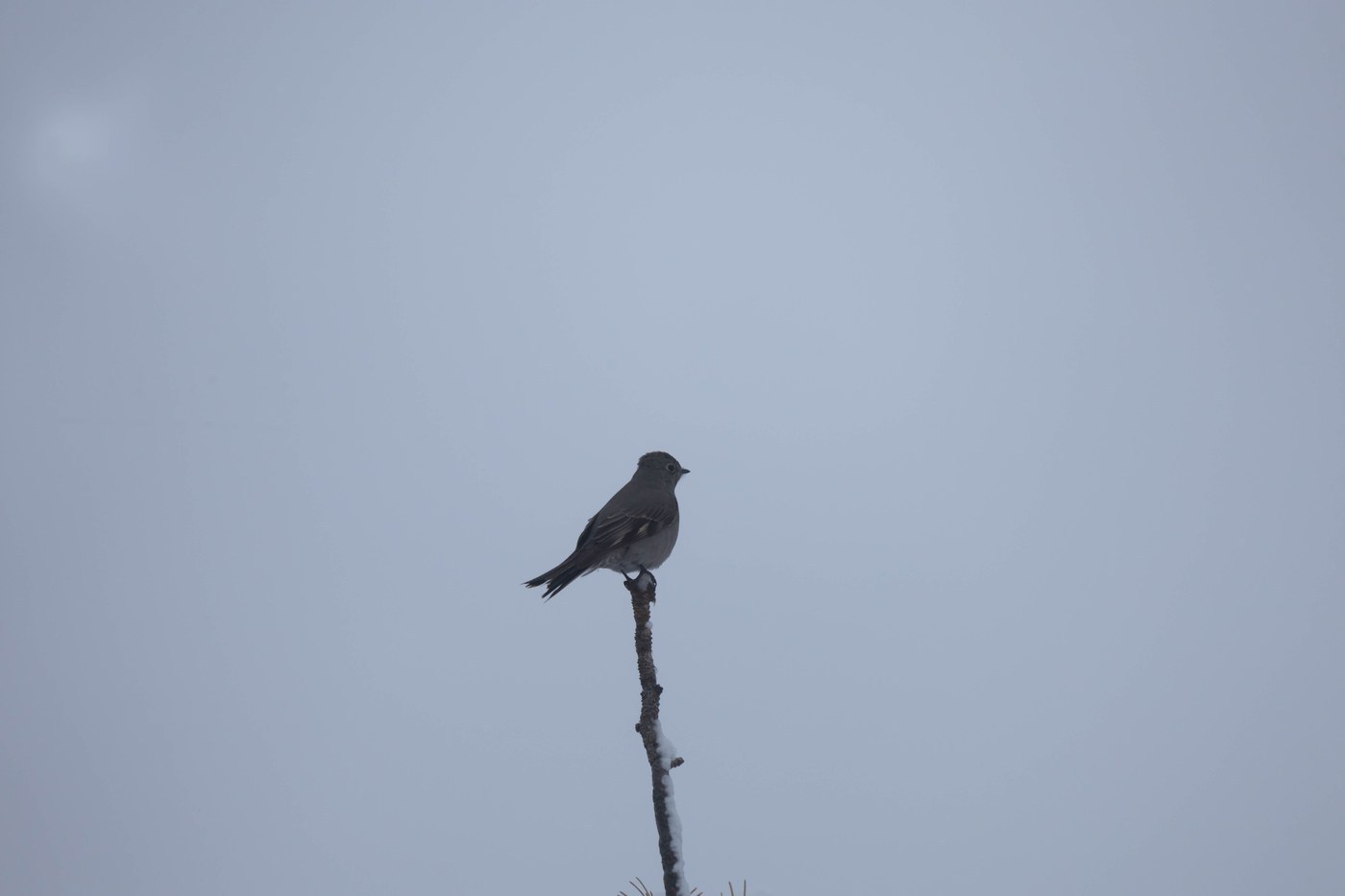
Key Field Marks
- Size & shape: Slim and long-tailed for a thrush relative, 21–24 cm, with an upright posture and a comparatively small head and thin bill.
- Plumage: Overall soft gray with a bold, complete white eye-ring that stands out even at a distance; wings show buffy-tan patches, most visible in flight, and the tail has white outer feathers flashing when spread.
- Behavior: Often perches conspicuously and motionlessly atop a high tree, snag, or utility wire; also flycatches for insects in summer. In winter it becomes strongly territorial, defending individual juniper trees as a food resource against other frugivores.
Separating Townsend's Solitaire from Similar Species
- Northern Mockingbird: Superficially similar gray tone and white wing/tail flashes, but Mockingbird has a longer bill, lacks the bold white eye-ring, and prefers open scrub/urban habitat rather than montane conifer forest.
- Female/immature Bluebirds: Similar overall shape but Solitaire is uniformly gray without any blue or orange tones, and shows the diagnostic white eye-ring and buffy wing patch.
- Overall structure: The combination of upright treetop perching posture, thin bill, and white eye-ring on an otherwise plain gray bird is distinctive once learned.
Where and When to See One
- Range: Breeds throughout mountainous western North America, from Alaska and western Canada south through the Rockies and Sierra Nevada into Mexico.
- Habitat: Breeds in coniferous and mixed subalpine forest, often near rocky slopes, cliffs, or canyons used for nest sites; in winter descends to lower elevations, concentrating in pinyon-juniper woodland where it feeds heavily on juniper berries.
- Season: Present year-round across parts of its range through elevational movement rather than long-distance migration; winter is often the easiest season to find one on a defended juniper territory.
Voice
- A clear, warbling, flutelike song delivered even in mid-winter, unusual among North American songbirds for singing outside the breeding season; the call is a distinctive thin, squeaky "eek" note, often the first clue to the bird's presence.
Frequently asked questions
Why does Townsend's Solitaire sing in winter?
Unlike most songbirds, it sings year-round, including a version of its warbling song used to defend individual juniper trees as a winter food resource.
What is the best field mark for Townsend's Solitaire?
A bold white eye-ring on an otherwise plain gray body, combined with buffy wing patches visible in flight and an upright treetop perching habit.
Where should I look for Townsend's Solitaire in winter?
Pinyon-juniper woodland at lower elevations, where individuals aggressively defend berry-laden juniper trees against other birds.
Is Townsend's Solitaire related to bluebirds?
Yes, it is a member of the thrush family, related to bluebirds and true thrushes, though its slim shape and gray color set it apart visually.