
Thick-billed Murre Identification Guide
The Thick-billed Murre is a stocky black-and-white Arctic auk, distinguished from the similar Common Murre by its thicker bill with a pale gape line and a sharp, pointed extension of dark plumage onto the white breast.
Read the full Thick-billed Murre encyclopedia entry →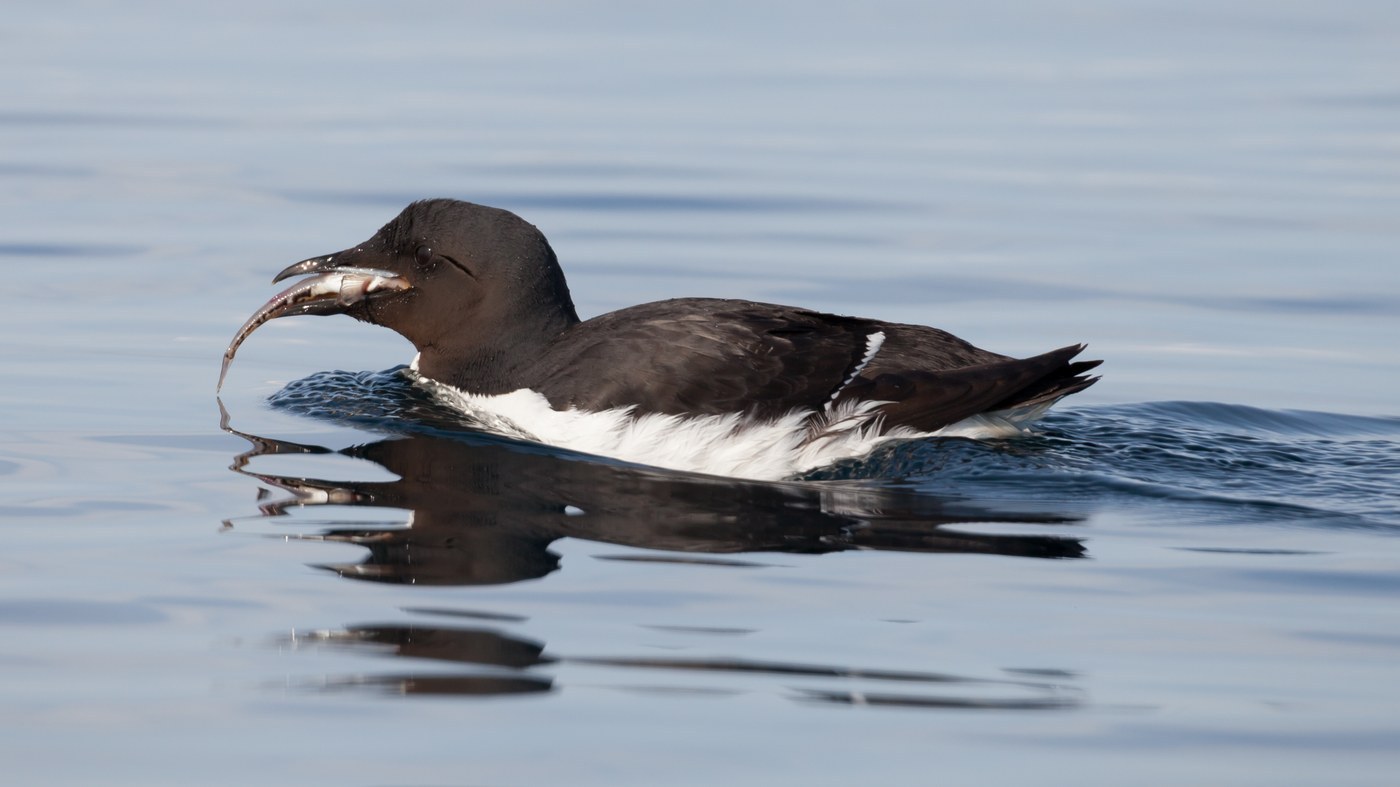
Key Field Marks
- Size & shape: A large, heavy-bodied auk, 40–48 cm, with a thick neck, short pointed wings, and an upright penguin-like stance on land.
- Plumage: Blackish head, neck, and upperparts contrasting sharply with clean white underparts; in breeding plumage the dark hood extends down the throat and comes to a distinct point on the upper breast.
- Bill: Relatively short and notably thick, all-dark, with a thin pale (whitish) line running along the gape near the base of the bill — the single best mark separating this species from Common Murre.
- Behavior: Highly gregarious, nesting in dense colonies on narrow cliff ledges; dives to considerable depths pursuing fish and invertebrates, using wings to "fly" underwater.
Separating Thick-billed Murre from Common Murre
- Bill shape: Thick-billed Murre has a notably stouter, shorter bill with the pale gape-line stripe; Common Murre's bill is thinner and lacks this pale line.
- Hood border: Thick-billed Murre's dark hood dips to a sharp point on the breast; Common Murre shows a straighter, less pointed border between dark throat and white breast.
- "Bridled" morph: Some Common Murres show a white eye-ring with a thin white line trailing back from the eye (the bridled morph) — a pattern Thick-billed Murre never shows.
- Overall tone: Common Murre upperparts often look slightly browner, while Thick-billed Murre appears more solidly blackish.
Where and When to See One
- Range: Circumpolar in the high Arctic and subarctic, breeding on sea cliffs from Alaska and Arctic Canada across Greenland, Svalbard, and northern Russia.
- Habitat: Nests colonially on narrow, bare rock ledges of steep sea cliffs, laying a single pointed (pear-shaped) egg directly on rock, an adaptation that reduces the chance of it rolling off.
- Season: Present at colonies spring through late summer; winters at sea, sometimes moving as far south as the northern United States and southern Europe during irruptive winters.
Voice
- Colonies are noisy with harsh, growling and purring calls exchanged between mates and neighbors; largely silent away from the breeding cliffs and while at sea.
Frequently asked questions
What is the main field mark separating Thick-billed Murre from Common Murre?
A thin pale line along the gape at the base of the bill, combined with a thicker bill and a sharply pointed extension of the dark hood onto the breast.
Where do Thick-billed Murres nest?
In dense colonies on narrow, bare ledges of high Arctic and subarctic sea cliffs, laying a single pointed egg directly on rock.
Can Thick-billed Murre and Common Murre be seen together?
Yes, their ranges overlap at some subarctic colonies, making direct bill and hood-pattern comparison the best way to separate them.
How deep can Thick-billed Murres dive?
They are capable of diving over 100 meters in pursuit of fish and invertebrates, among the deepest-diving flying birds.