
Tennessee Warbler Identification Guide
The Tennessee Warbler is a small, plain, fast-moving boreal warbler with a gray head, olive back, thin bill, and white undertail coverts that separate it from the similar Orange-crowned Warbler.
Read the full Tennessee Warbler encyclopedia entry →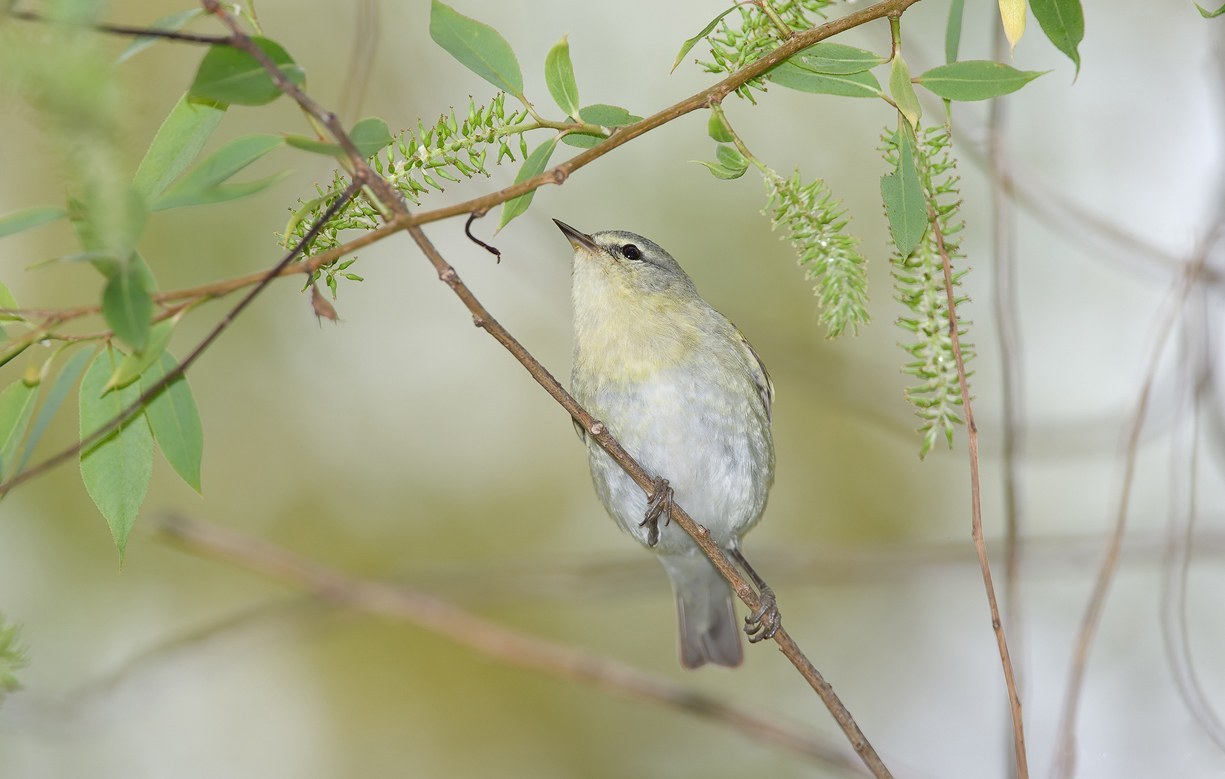
Key Field Marks
- Size & shape: Small and compact, 11–13 cm, with a short tail and a thin, sharply pointed bill adapted for gleaning insects and, outside the breeding season, sipping nectar.
- Breeding male: Clean gray head and nape, olive-green back, white underparts, a bold white supercilium, and a dark eyeline giving a clean-faced look; usually shows no wingbars or only a faint one.
- Female / fall birds: Duller and more uniformly olive above with a yellowish wash below and a less contrasting head pattern; fall birds can look confusingly plain.
- Behavior: Very active, constantly gleaning foliage high in the canopy; forages quickly with flicking movements rather than sustained hovering.
Separating Tennessee Warbler from Similar Species
- Orange-crowned Warbler: Shows diffuse blurry streaking on the breast, a broken eye-ring, and — most usefully — bright yellow undertail coverts, whereas Tennessee Warbler has clean whitish or pale undertail coverts and an unstreaked breast.
- Red-eyed Vireo: Larger and heavier-billed with a slower, more deliberate foraging pace, a stronger head pattern (blue-gray cap bordered by black lines), and red eyes in adults versus the warbler's thin bill and dark eye.
- Philadelphia Vireo: Also similar in fall but bulkier-billed with a yellow wash across the entire underparts rather than the Tennessee's whiter belly.
Where and When to See One
- Range: Breeds across the boreal forest of Canada and the northernmost United States; winters mainly in Central America and the northern Andes of South America.
- Migration: A common but often overlooked migrant through the central and eastern United States, moving through in spring (peak April–May) and fall (peak August–September).
- Habitat: Breeds in spruce-fir and mixed boreal forest, often near bogs; on migration and winter grounds uses a wide range of woodland, shade coffee, and second growth, and will visit flowering trees for nectar.
Voice
- A loud, staccato, three-part song that accelerates and rises in pitch, often rendered "titi-titi-titi, chichichichi, sisisisisi" — far louder and more insistent than the bird's small size would suggest, useful for locating it high in dense canopy.
Frequently asked questions
How do I separate a fall Tennessee Warbler from an Orange-crowned Warbler?
Check the undertail coverts: bright yellow indicates Orange-crowned Warbler, while whitish or pale undertail coverts point to Tennessee Warbler.
Does the Tennessee Warbler have wingbars?
Usually not, or only a very faint one, which helps rule out several other similarly plain fall warblers that show crisper wingbars.
Where does the Tennessee Warbler breed?
In boreal spruce-fir forest across Canada and the northern-tier United States, often near bogs and wet clearings.
Why is the Tennessee Warbler named after a state it barely occurs in?
It was first described from a specimen collected in Tennessee during migration, even though the species only briefly passes through the state on its way between boreal breeding grounds and tropical wintering areas.