
Tawny Owl Identification Guide
The Tawny Owl is a stocky, round-headed European woodland owl with dark eyes and mottled rufous or grey plumage, best known for its classic hooting duet.
Read the full Tawny Owl encyclopedia entry →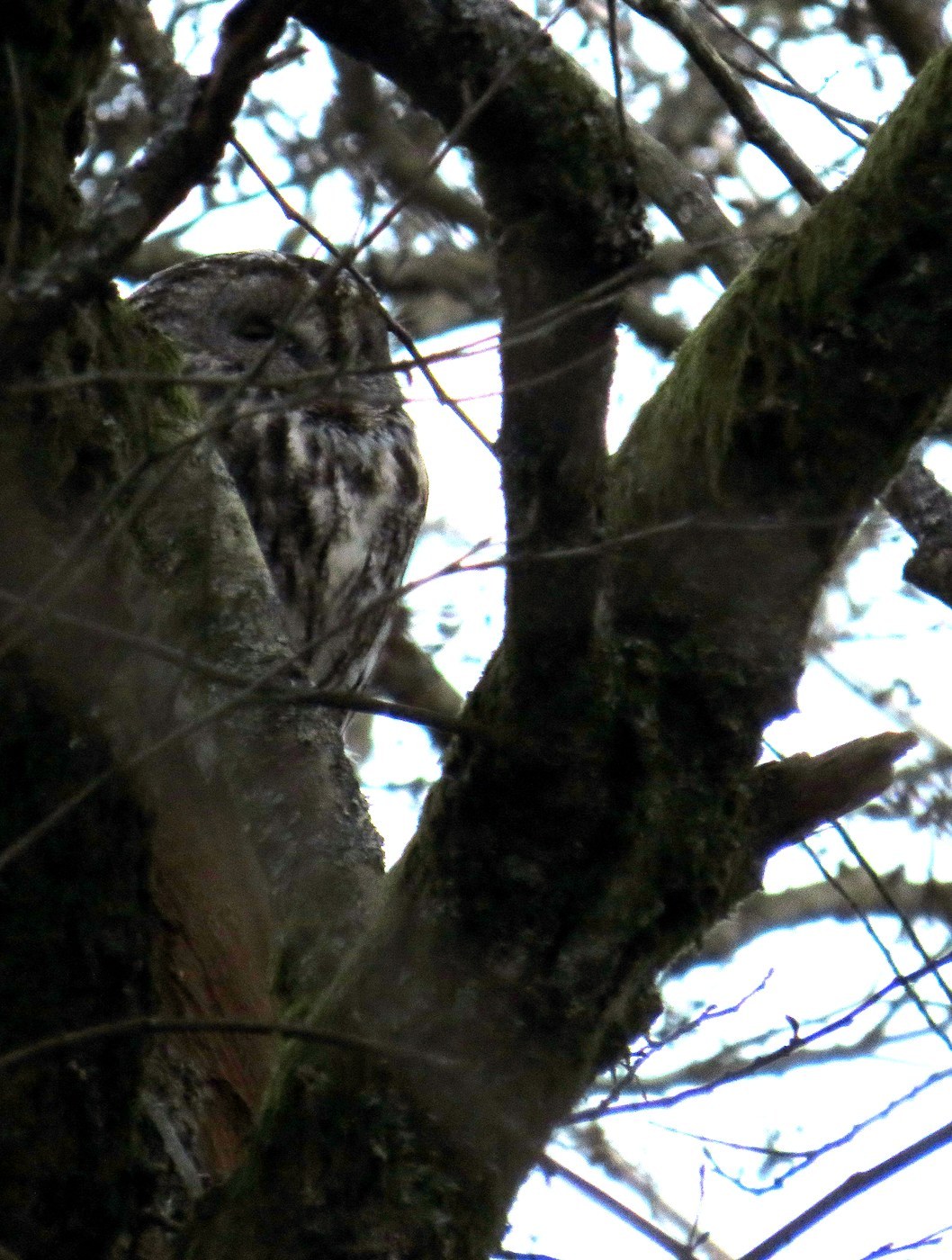
Key Field Marks
- Size & shape: A medium-sized, compact owl, 37–39 cm long, with a large, round head and no ear tufts, giving it a distinctly "earless" silhouette compared to many other European owls.
- Plumage: Occurs in two main color morphs — rufous-brown and grey-brown — both densely mottled and streaked for excellent camouflage against tree bark; underparts are pale with dark streaking.
- Eyes: Uniquely among common European owls, Tawny Owl has dark brown-black eyes rather than yellow or orange, giving the face a soft, dark-eyed expression.
- Behavior: Strictly nocturnal and rarely seen in daylight except when mobbed by songbirds at a roost site in dense ivy, a tree cavity, or thick conifer cover.
Separating Tawny Owl from Similar Species
- Long-eared Owl: Has obvious ear tufts and bright orange eyes, a slimmer build, and a more streaked (less mottled/barred) plumage pattern; Tawny Owl lacks ear tufts and has dark eyes.
- Little Owl: Much smaller, flat-headed, with staring pale yellow eyes and a more horizontal stance; often active at dusk/dawn or even by day, unlike the strictly nocturnal Tawny Owl.
- Barn Owl: Pale, heart-shaped white face and golden-buff upperparts contrast strongly with the dark-eyed, mottled brown Tawny Owl.
Where and When to See One
- Range: Widespread and common resident across most of Europe, extending into western Asia and North Africa.
- Habitat: Deciduous and mixed woodland, parks, large gardens, and churchyards with mature trees offering nest cavities; highly territorial and sedentary once settled.
- Season: Present and vocal year-round, but calling activity peaks in autumn (territory establishment) and late winter into early spring (pair bonding ahead of nesting).
Voice
- The source of the classic "tu-whit, tu-whoo" is actually a duet: the male gives a quavering, resonant hoot ("hooo... hu hu huhooooo"), while the female answers with a sharp, disyllabic "ke-wick." It is the most frequently heard owl call in Britain and much of Europe after dark.
Frequently asked questions
Is the famous 'tu-whit tu-whoo' call one bird or two?
It's typically two birds calling back and forth — the male's hoot and the female's sharp 'ke-wick' — combined in folklore into a single phrase.
What color are a Tawny Owl's eyes?
Dark brown to almost black, which distinguishes it from most other European owls that have yellow or orange eyes.
Does the Tawny Owl have ear tufts?
No, it has a rounded, tuft-free head, unlike Long-eared or Short-eared Owls.
When is the best time to hear a Tawny Owl?
After dark, especially on calm autumn or late-winter evenings when territorial and pair-bonding calling peaks.