
Tawny Frogmouth Identification Guide
The Tawny Frogmouth is a bark-camouflaged Australian nightbird with huge yellow eyes and a wide, hooked-tipped bill that freezes upright on branches to mimic a broken stump by day.
Read the full Tawny Frogmouth encyclopedia entry →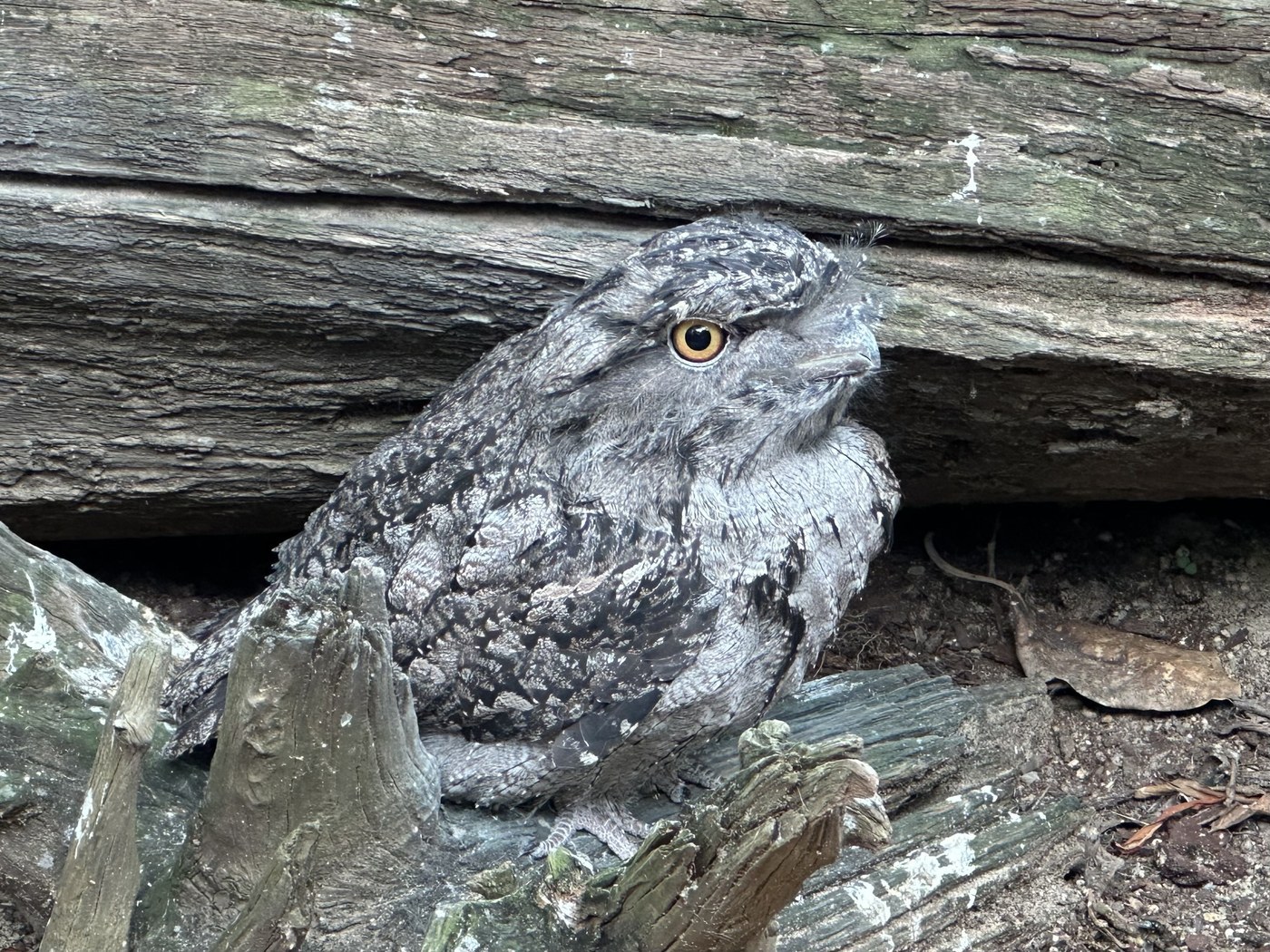
Key Field Marks
- Size & shape: Stocky and large-headed, 34–53 cm long, with a flattened, wide, almost triangular bill and short legs. Sits upright and rigid, often with the body angled to look like a broken branch stub.
- Plumage: Intricately mottled grey, brown, black, and rufous streaking that closely mimics tree bark and lichen — exceptional camouflage when roosting motionless against a branch by day.
- Face: Large forward-facing eyes (pale yellow to orange) and prominent bristly feather tufts at the base of the broad, gape-heavy bill give it a distinctive frog-like mouth, the source of its name.
- Behavior: Strictly nocturnal; roosts by day in the open on a horizontal branch, often in pairs or family groups, remaining frozen with eyes narrowed to slits if approached rather than flushing.
Separating Tawny Frogmouth from Owls
- Frogmouths are frequently mistaken for owls but belong to an entirely different order (nightjar relatives, Caprimulgiformes, not Strigiformes).
- Bill shape: Frogmouths have a broad, flattened, gape-heavy bill adapted for snapping up insects in flight or on the ground, unlike the small, sharply hooked bill of owls.
- Feet: Frogmouth feet are small and weak, used for perching only — they do not grasp prey with their talons the way owls do; prey is caught and killed with the bill.
- Posture: Frogmouths habitually freeze bolt upright to mimic a broken branch; owls more often perch normally or peer alertly at intruders rather than feigning camouflage.
Where and When to See One
- Range: Found throughout mainland Australia and Tasmania in a wide range of wooded habitats.
- Habitat: Open forests, woodlands, scrub, farmland with scattered trees, and even leafy suburban parks and gardens, where daytime roosts on a favored branch can be reused for years.
- Season: Resident and non-migratory; visible year-round, though most active and vocal around dusk and through the breeding season (roughly August–December).
Voice
- A soft, low, continuous "oom-oom-oom" booming or grunting call repeated on one pitch, given mainly at night, along with occasional harsh hissing or bill-snapping when disturbed at the roost.
Frequently asked questions
Is the Tawny Frogmouth an owl?
No, despite superficial resemblance, it belongs to a different bird order (nightjar relatives) and differs in bill shape, weak feet, and hunting technique.
Why do Tawny Frogmouths sit so still during the day?
Their mottled bark-like plumage combined with a frozen, branch-like posture is a camouflage strategy to avoid detection by predators while roosting.
Where in a garden might I find a roosting Tawny Frogmouth?
Look for a stationary, bark-colored lump on a bare horizontal branch, often at a moderate height in eucalypts or other open-canopy trees.
What does a Tawny Frogmouth eat?
Mostly large insects, along with spiders, worms, and occasionally small vertebrates, caught by pouncing from a perch rather than in flight.