
Tawny Eagle Identification Guide
The Tawny Eagle is a variably brown, broad-winged eagle of African and Asian savanna, told from larger migrant eagles by its smaller yellow-based bill, rounded head, and pale gape.
Read the full Tawny Eagle encyclopedia entry →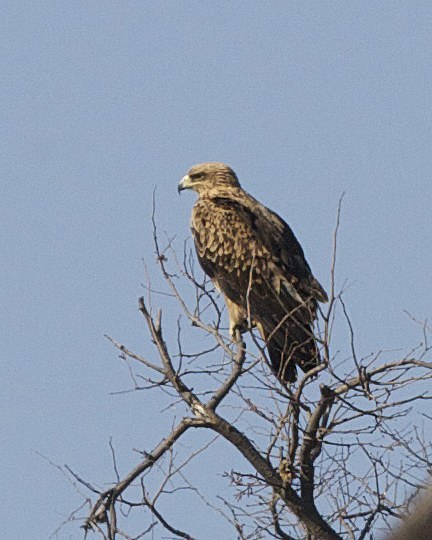
Key Field Marks
- Size & shape: A medium-large eagle, 62–72 cm long with a 165–210 cm wingspan — noticeably smaller and less bulky than Steppe or Golden Eagles. In flight shows broad, fairly parallel-edged wings and a short, square-ish tail.
- Plumage: Highly variable, from pale sandy-tawny to dark chocolate-brown; palest birds show a contrastingly darker flight feathers, while dark morphs can look almost uniformly blackish-brown. Juveniles are paler rufous-buff with a pale trailing edge to the wing.
- Bare parts: Relatively small bill with a yellow cere and gape; eye color ranges from yellowish-brown to dark brown. Legs are feathered to the toes (typical of "booted" eagles).
- Behavior: Perches conspicuously on low trees, poles, or the ground; soars on flattish wings while foraging; a habitual kleptoparasite that harasses other raptors and vultures for food, and readily scavenges at carcasses.
Separating Tawny Eagle from Similar Species
- Steppe Eagle: Larger and more heavily built with a bigger, deeper bill, a longer gape line that reaches back to below the center of the eye (Tawny's gape stops roughly below the front of the eye), and typically a more uniform dark brown plumage in adults.
- Wahlberg's Eagle: Much slimmer, smaller-headed, with parallel-edged wings and a longer tail; lacks the bulky, big-headed look of Tawny Eagle.
- Immature Bateleur: Longer-legged and shorter-tailed in flight with a very different silhouette (almost tailless); Tawny Eagle always shows a proper, if short, tail.
Where and When to See One
- Range: Widespread across sub-Saharan Africa and locally in the Middle East and Indian subcontinent (where sometimes treated as a separate species, Indian Tawny Eagle).
- Habitat: Open savanna, semi-desert, dry woodland edge, and cultivated land with scattered trees; avoids dense forest.
- Season: Largely resident, though some populations show local seasonal movements tied to rainfall and prey availability.
Voice
- Utters harsh barking or croaking calls, often rendered "kowk kowk kowk" or a raucous crow-like bark, given mainly near the nest or during territorial disputes; generally silent away from breeding areas.
Frequently asked questions
How do I tell a Tawny Eagle from a Steppe Eagle?
Steppe Eagle is larger with a bigger bill and a gape line extending farther back under the eye; Tawny Eagle is smaller-billed, smaller-headed, and shows a shorter gape.
What color is a Tawny Eagle really?
Highly variable, ranging from pale sandy-buff to dark chocolate-brown, so plumage tone alone is unreliable for identification — structure and bare-part details matter more.
Does the Tawny Eagle hunt live prey or just scavenge?
Both — it hunts small mammals, birds, and reptiles but also scavenges at carcasses and steals food from other raptors and vultures.
What habitat is best for finding Tawny Eagles?
Open savanna, dry woodland edges, and semi-desert with scattered perch trees across sub-Saharan Africa.