
Takahe Identification Guide
The Takahe is a massive, flightless New Zealand rail with a deep blue-purple body, olive-green back, and an oversized red bill, once thought extinct until its dramatic 1948 rediscovery.
Read the full Takahe encyclopedia entry →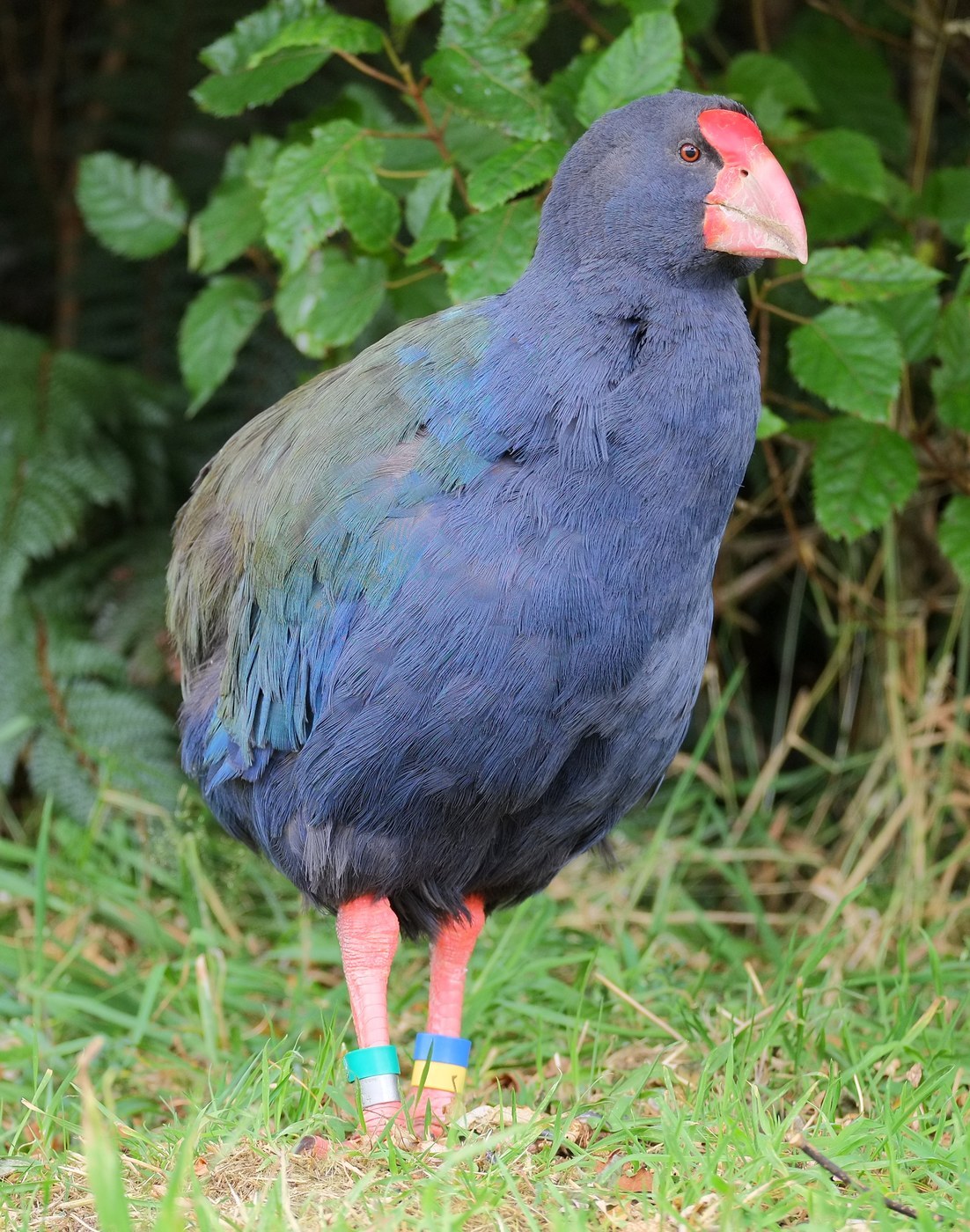
Key Field Marks
- Size & shape: A huge, heavy-bodied rail roughly the size of a large goose (about 50 cm long, 2.3–3.3 kg) — far bigger and bulkier than any other rail in its range. Flightless, with short, rounded wings held close to the body and a stout, upright stance.
- Plumage: Deep indigo-blue head, neck, and breast contrasting with an olive-green back and wings; a flash of white shows under the short, flicked tail.
- Bill and legs: Massive, laterally compressed red-orange bill (unmistakably large for a rail) and thick coral-red legs and feet built for tearing and trampling tussock grass.
- Behavior: Walks and grazes deliberately through tussock grassland, gripping stems with a foot and stripping the base with its heavy bill. Pairs are territorial and often seen with a single well-grown chick.
Separating Takahe from Similar Species
- Pukeko / Australasian Swamphen: The most likely confusion species, but Pukeko is much smaller and slimmer, has a proportionately smaller red frontal shield and bill, glossy black-and-purple (not olive-backed) plumage, longer legs, and — critically — can fly. Takahe is roughly triple the bulk with a duller, more olive back.
- No other New Zealand bird approaches its size and flightlessness combined with this color pattern, so a large, tame, brightly billed rail-like bird grazing in alpine tussock or on a predator-free sanctuary island is almost certainly a Takahe.
Where and When to See One
- Range: Extremely restricted. Wild birds survive only in the Murchison Mountains and nearby valleys of Fiordland National Park, South Island, in tall alpine and subalpine tussock grassland above the treeline.
- Reintroduced populations: Managed, predator-free populations have been established on offshore islands and fenced sanctuaries such as Tiritiri Matangi, Kapiti Island, Maud Island, and Zealandia (near Wellington), where birds are far easier to see at closer range in lowland grassy habitat.
- Season: Present year-round; alpine birds move to lower altitude in winter when snow covers tussock feeding grounds.
Voice
- Gives deep, resonant booming and grunting contact calls between pair members, along with a soft "oomph" and sharper alarm notes. Calls carry well across open tussock but are used at relatively close range between mates and chicks rather than as long-distance song.
Frequently asked questions
Is the Takahe the same bird as the Pukeko?
No. They are related rails, but the Takahe is much larger, heavier-bodied, flightless, and olive-backed, while the Pukeko is smaller, slimmer, glossier purple-black, and can fly.
Where is the best place to reliably see a Takahe?
Predator-free sanctuaries such as Tiritiri Matangi, Zealandia, or Kapiti Island offer the most reliable, close-range viewing; wild Fiordland birds are far harder to access.
Can Takahe fly at all?
No, they are completely flightless, with short wings used only for balance and display, not flight.
Why was the Takahe once thought extinct?
It was not recorded for decades after the early 1900s and was presumed extinct until a small population was rediscovered in the Murchison Mountains in 1948.
What does a Takahe eat that helps identify its behavior?
It grazes on the bases of tussock grass stems, gripping stalks in one foot and stripping them with its heavy bill — a distinctive feeding action rarely seen in other rails.