
Sword-billed Hummingbird Identification Guide
A remarkable Andean hummingbird with the longest bill relative to body size of any bird in the world, so long it must be held nearly vertical at rest, making identification essentially unmistakable.
Read the full Sword-billed Hummingbird encyclopedia entry →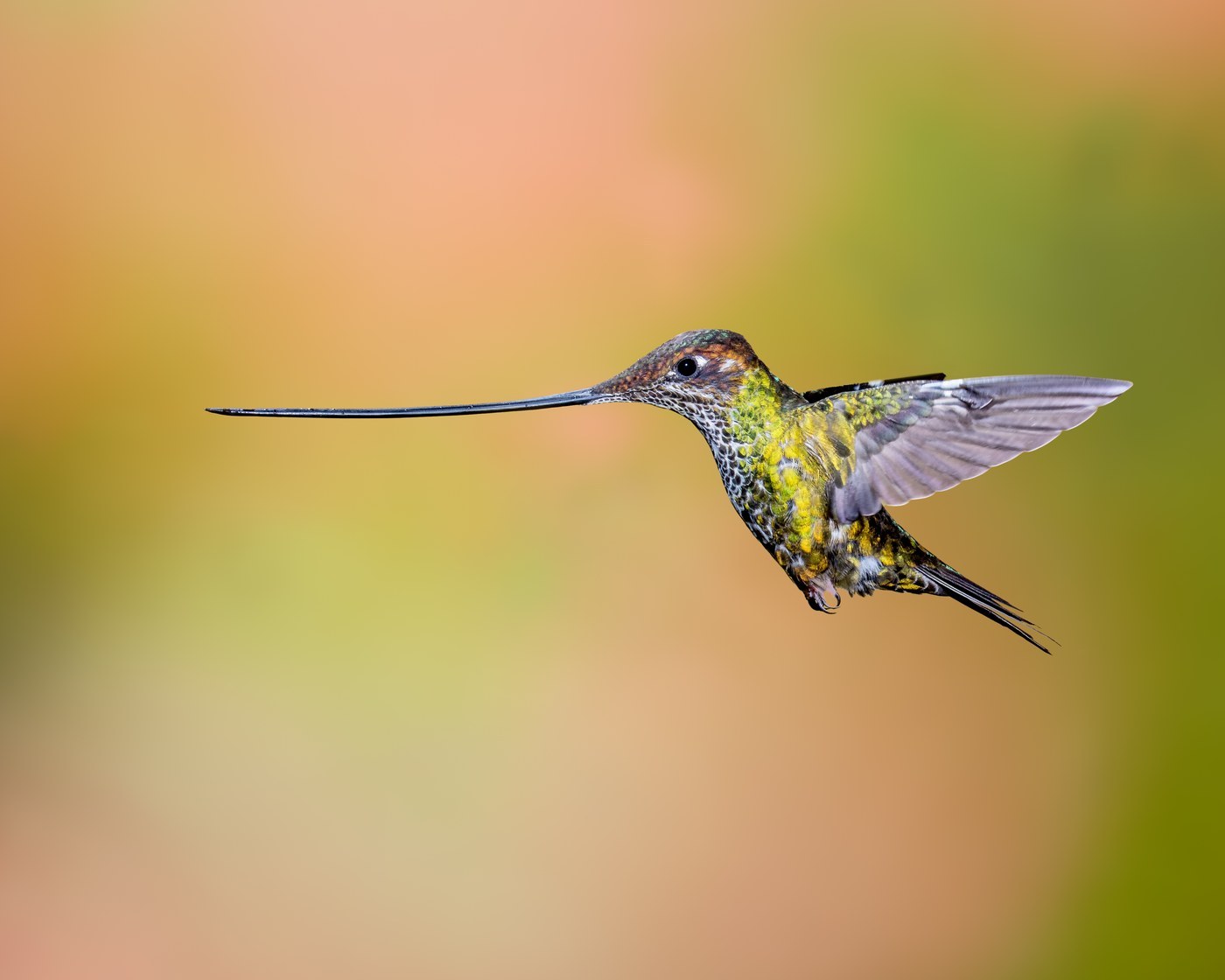
Size & Shape
The Sword-billed Hummingbird is a large hummingbird, about 13-14 cm (5-5.5 in) in body length, but its extraordinary bill adds another 10 cm (4 in) or more, often exceeding the length of the rest of the body combined — the longest bill relative to body size of any bird species in the world. Because the bill is so long and heavy, perched birds typically hold it tilted upward at a steep angle to keep balance.
Plumage & Key Field Marks
- Plumage is relatively subdued for a hummingbird: males are bronzy-green above with a coppery or violet-tinged throat and a grayish to greenish breast/belly, sometimes with fine speckling.
- Females are similar but slightly duller, with a paler, more spotted underside.
- The bill itself is the unmistakable field mark — straight, needle-thin, and so extremely long that no other hummingbird approaches it in proportion; even a poor or partial view of this bill is normally sufficient for identification.
- The tail is moderately long and slightly forked.
Behavior
Sword-billed Hummingbirds specialize in feeding from long, tubular flowers (particularly certain Passiflora and Datura species) that other hummingbirds cannot reach into, using their extreme bill and long extensible tongue to access nectar inaccessible to other species — a classic example of coevolution between flower and pollinator. Because balancing such a long bill at rest is awkward, perched birds often sit with the bill pointed almost straight up. They also glean small insects and are important long-distance pollinators in cloud forest ecosystems.
Similar Species
No other hummingbird in its range or anywhere else has a bill of comparable length relative to body size, making confusion with other species very unlikely once the bill is seen. At a quick glance, in silhouette, a perched bird's odd upward-tilted posture and dramatically elongated bill are themselves diagnostic even before plumage details are checked.
Voice
Calls are relatively quiet, high-pitched, thin chips and twitters typical of many hummingbirds; vocalizations are not a primary identification tool given how visually distinctive the species is.
Habitat, Range & Season
Found in humid montane cloud forest and forest edge along the Andes, from Venezuela and Colombia south through Ecuador, Peru, and into Bolivia, typically at elevations roughly between 1,700 and 3,500 m (5,600-11,500 ft). It is present year-round within its elevational range, though it may make local altitudinal movements tied to the flowering season of its preferred long-tubed nectar plants; feeders at cloud-forest lodges in Ecuador and Colombia are a reliable way to see it well.
Frequently asked questions
What makes the Sword-billed Hummingbird so easy to identify?
Its bill is proportionally the longest of any bird in the world, often exceeding the length of its own body, making it essentially unmistakable once the bill is seen.
Why does a Sword-billed Hummingbird perch with its bill pointing up?
The bill is so long and heavy that the bird must tilt it upward at a steep angle while perched to maintain its balance.
What flowers does the Sword-billed Hummingbird feed on?
It specializes in long, tubular flowers such as certain Passiflora and Datura species that have coevolved with its extreme bill length, allowing it to access nectar other hummingbirds cannot reach.
Where does the Sword-billed Hummingbird live?
Humid montane cloud forest along the Andes from Venezuela and Colombia south to Bolivia, typically between about 1,700 and 3,500 meters elevation.
Is the Sword-billed Hummingbird rare?
It is uncommon but not considered globally threatened, and is a reliable, sought-after sighting at hummingbird feeders in Andean cloud-forest lodges.