
Swallow-winged Puffbird Identification Guide
A small, chunky, all-dark South American puffbird with a contrasting white lower belly and rump, easily recognized by its habit of perching upright on exposed high snags and sallying out like a giant swallow to catch insects.
Read the full Swallow-winged Puffbird encyclopedia entry →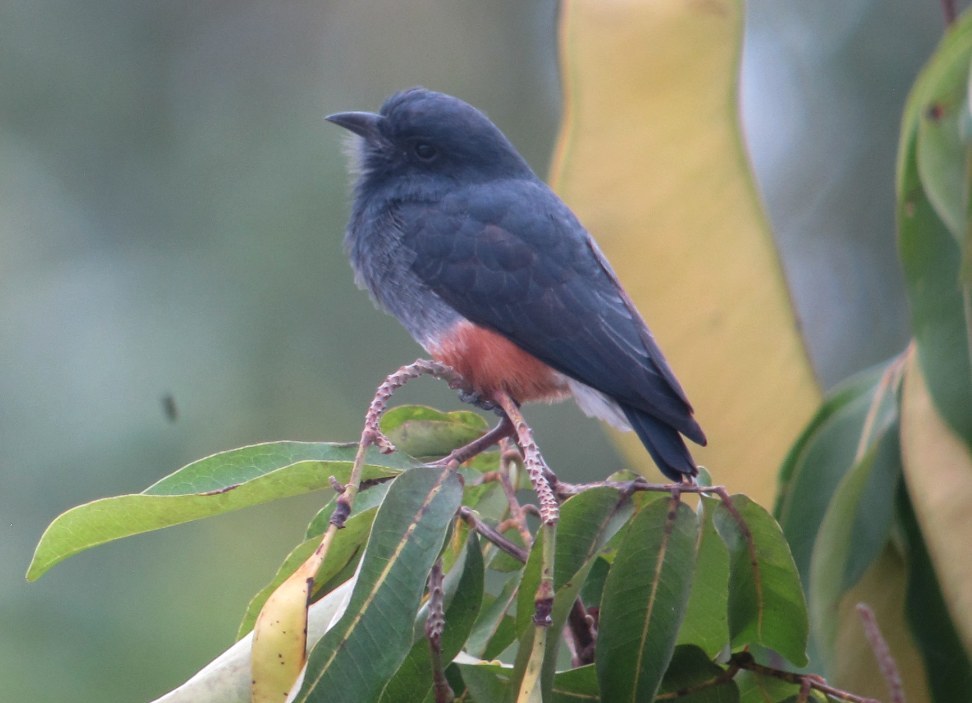
Size & Shape
The Swallow-winged Puffbird is a small, big-headed, short-tailed puffbird about 14-15 cm (5.5-6 in) long, with a large head, short neck, and a compact, rounded body that gives it a distinctive top-heavy, upright silhouette when perched.
Plumage & Key Field Marks
- Overall plumage is sooty blackish-brown, appearing essentially all-dark at a distance.
- The lower belly, undertail coverts, and rump are contrastingly white, visible especially when the bird turns or flies — this white patch against otherwise dark plumage is a key mark.
- Some individuals show a fine white speckling or scaling on the throat/chest, but this is subtle compared to the bold white rear-end patch.
- The bill is short, stout, and blackish, typical of puffbirds, and the wings are relatively long and pointed for the family, aiding its swallow-like sallying flight (the source of its name).
Behavior
Unusual among puffbirds for spending long periods perched conspicuously in the open on tall dead snags, wires, or the tops of riverside trees, from which it makes long, swooping, swallow-like sallies to catch flying insects, often high in the air, before returning to the same or a nearby perch. It is frequently seen in small groups perched together in a row on exposed branches.
Similar Species
- Other puffbirds in its range (such as White-necked Puffbird or Black-fronted Nunbird) are larger, differently patterned, and prefer more concealed perches within or below the canopy rather than exposed high snags.
- Its combination of small size, all-dark body with a white rear patch, and habit of perching high in the open on bare branches while sallying for insects is fairly distinctive once learned, though at a distance it can suggest a large swallow or swift — its stockier shape and puffbird posture (upright, big-headed) should clarify.
Voice
Gives thin, high-pitched, slightly buzzy or squeaky notes, often in a short irregular series, typically delivered from its exposed perch; not loud or far-carrying compared to some other tropical birds.
Habitat, Range & Season
Widespread across the Amazon Basin and other lowland regions of tropical South America, including the Guianas, Amazonian Brazil, Peru, Ecuador, Colombia, Venezuela, and Bolivia. It favors river edges, forest borders, clearings, and areas with scattered tall dead trees or snags, especially along large rivers. A resident, non-migratory species seen year-round, most easily located by scanning exposed high perches along rivers and forest edges.
Frequently asked questions
What is the best field mark for a Swallow-winged Puffbird?
Overall sooty-dark plumage contrasting with a white lower belly, rump, and undertail area, combined with its habit of perching upright on exposed high snags.
Why is it called 'swallow-winged'?
Because of its long, pointed wings and habit of making long, swooping aerial sallies after flying insects, reminiscent of a swallow, unlike most other puffbirds that sally short distances from concealed perches.
Where should I look for a Swallow-winged Puffbird?
Scan tall dead snags, bare branches, and wires along rivers and forest edges in Amazonian lowlands, where it often perches conspicuously, sometimes in small groups.
How is it different from other puffbirds?
Most puffbirds sit quietly and inconspicuously within or below the forest canopy, while Swallow-winged Puffbird favors exposed, high, open perches and makes longer, more active sallying flights.
Is the Swallow-winged Puffbird migratory?
No, it is a non-migratory resident throughout its range in the Amazon Basin and adjacent lowland South America.