
Swainson's Hawk Identification Guide
A long-winged, long-distance migrant buteo of open western North American grasslands, best known for its contrasting dark flight feathers against pale wing linings and its habit of soaring in huge migratory flocks called kettles.
Read the full Swainson's Hawk encyclopedia entry →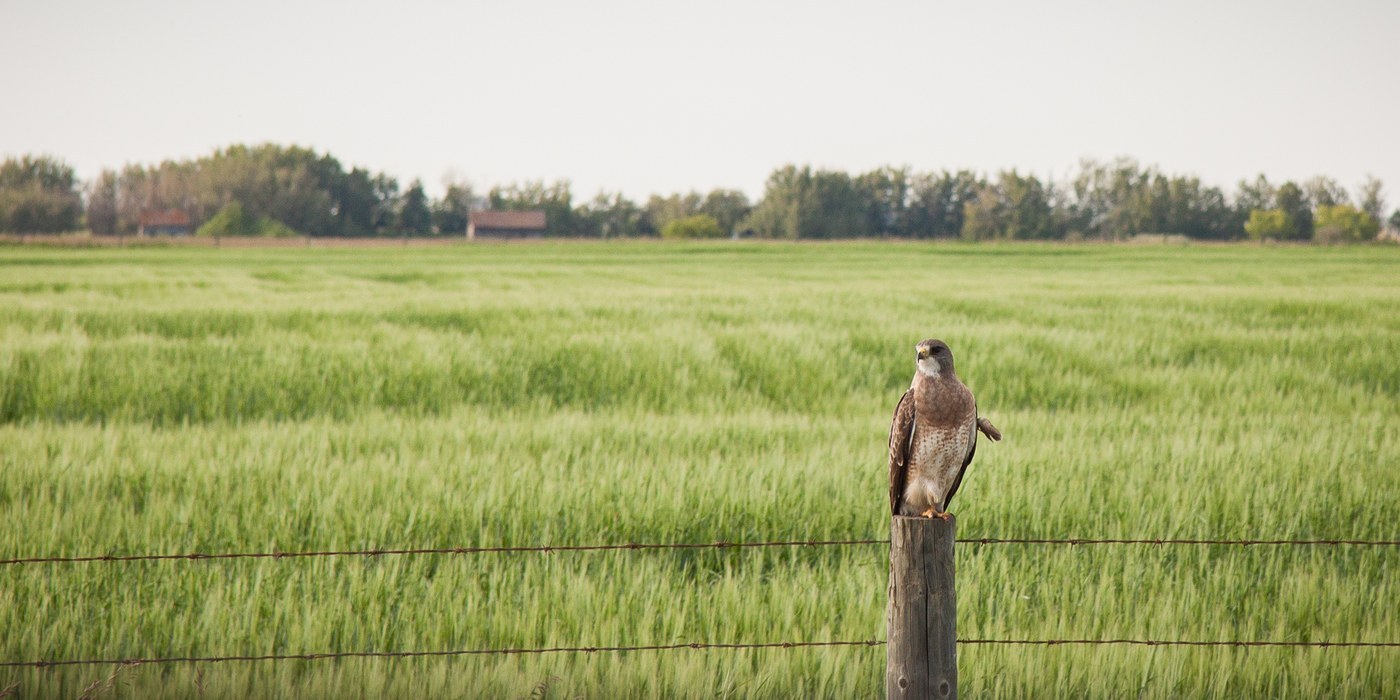
Size & Shape
Swainson's Hawk is a large buteo, 46-56 cm (18-22 in) long, with notably long, pointed wings for a soaring hawk — narrower and more angled than a Red-tailed Hawk's — giving it a somewhat more falcon- or eagle-like silhouette in flight. The tail is relatively narrow and squared.
Plumage & Key Field Marks
- The classic "light morph" (most common) shows a dark brown chest bib contrasting with a pale, whitish belly and throat, and in flight the underwing shows a sharp two-tone pattern: pale/white wing linings against dark gray flight feathers (primaries and secondaries) — this contrast is the single best field mark.
- Dark and rufous morphs also occur, ranging from mostly dark brown overall to rufous-chested birds, but even these usually retain some contrast between wing linings and darker flight feathers.
- The tail is pale gray-brown with fine dark banding and a slightly wider dark subterminal band.
- Perched birds show a small yellow-based bill, yellow legs, and a relatively small head compared to Red-tailed Hawk.
Behavior
Swainson's Hawks are highly aerial, soaring on thermals with wings held in a shallow dihedral (raised V). They are famous for gathering in enormous migratory flocks called "kettles," sometimes numbering in the thousands, as they funnel through Central America en route to and from wintering grounds in Argentina — one of the longest migrations of any North American raptor. On breeding grounds they hunt rodents and other small vertebrates from perches or while soaring, and are notable for eating large quantities of insects (especially grasshoppers) on the wintering grounds.
Similar Species
- Red-tailed Hawk is bulkier with broader, rounder wings, a rusty-red tail in adults, and lacks the sharp two-tone underwing contrast of Swainson's Hawk.
- Broad-winged Hawk is much smaller and stockier with a strongly banded black-and-white tail, quite different from Swainson's narrow gray-banded tail.
- Ferruginous Hawk is larger and paler overall with a rufous back and legs, and lacks the dark chest bib pattern.
Voice
The call is a plaintive, thin, drawn-out whistled scream, often transcribed as "kreeeeer" — higher-pitched and less harsh than the raspy call of a Red-tailed Hawk.
Habitat, Range & Season
Breeds across open grasslands, prairies, and agricultural land of western North America, from the Canadian prairie provinces south through the Great Plains and intermountain West to parts of Mexico. It is a long-distance migrant, wintering primarily on the pampas of Argentina, with migration concentrated through Texas, Mexico, and Central America in spring (March-April) and fall (September-October), often forming massive kettles over narrow migration corridors like Veracruz, Mexico.
Frequently asked questions
What is the best field mark for a light-morph Swainson's Hawk in flight?
A sharp contrast between pale, whitish underwing linings and dark gray flight feathers, combined with a dark brown chest bib above a pale belly.
How does Swainson's Hawk differ from Red-tailed Hawk?
Swainson's has longer, narrower, more pointed wings held in a slight dihedral, a gray-banded (not rusty-red) tail, and a distinct two-tone underwing pattern that Red-tailed Hawk lacks.
Why do Swainson's Hawks form huge flocks called kettles?
They are strongly migratory soaring birds that ride thermals in large groups to conserve energy on their extremely long migration between North American breeding grounds and Argentine wintering grounds.
Do all Swainson's Hawks look alike?
No, the species has light, dark (rufous), and intermediate color morphs, though even darker birds typically retain some contrast between the wing linings and flight feathers.
What do Swainson's Hawks eat?
Small mammals and other vertebrates during the breeding season, switching to a diet dominated by insects, especially grasshoppers and crickets, during migration and on the wintering grounds.