
Superb Starling Identification Guide
A dazzling, iridescent East African starling with a metallic blue-green back, orange-rufous belly, and a bold white breast band, commonly seen in gardens, savanna, and safari lodges.
Read the full Superb Starling encyclopedia entry →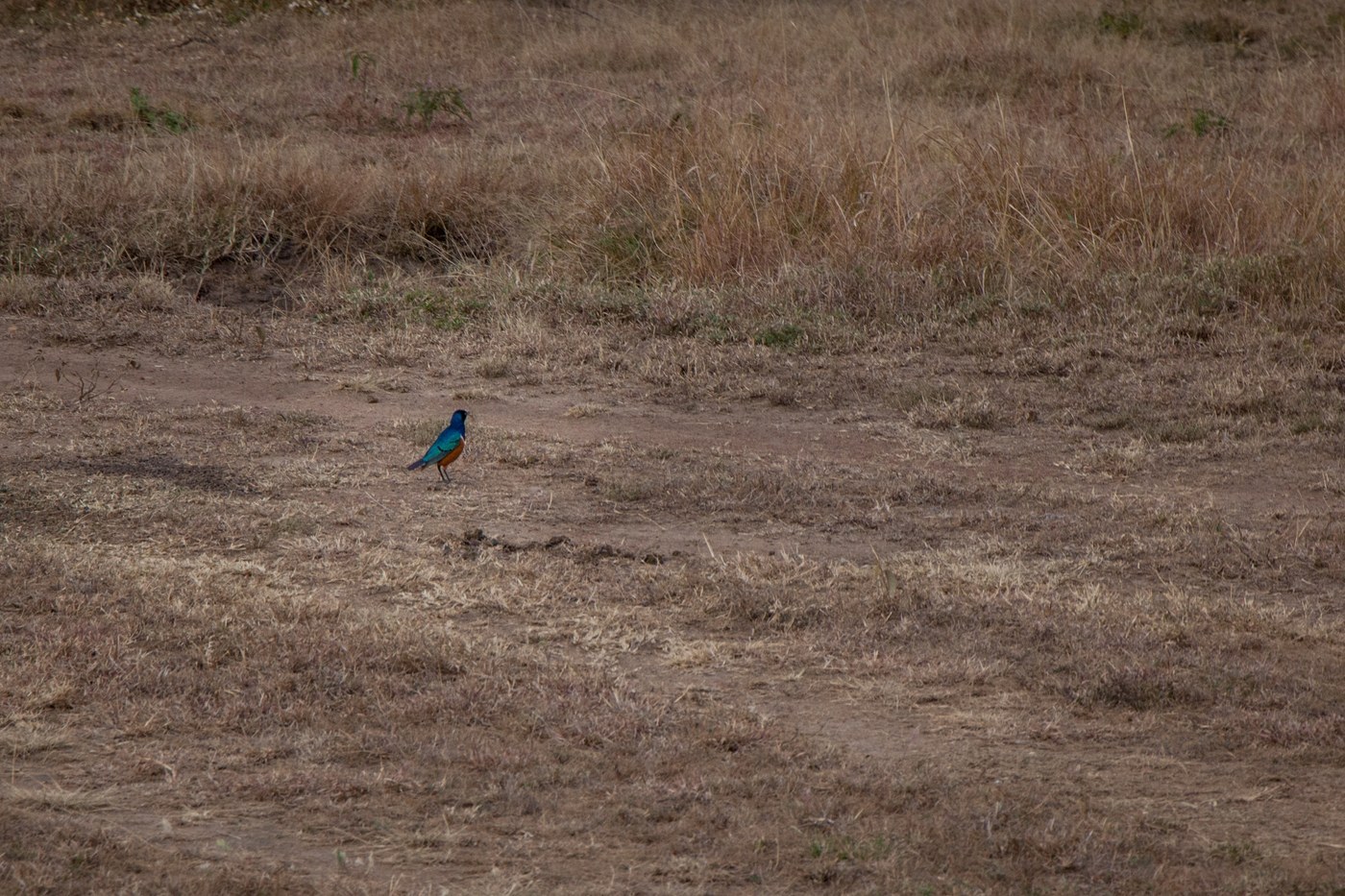
Size & Shape
The Superb Starling is a medium-sized starling, about 18 cm (7 in) long, with a fairly stocky body, a straight, sharply pointed black bill, and a moderately long tail typical of glossy starlings.
Plumage & Key Field Marks
- The head, throat, and upper breast are glossy iridescent blue-black to blue-green, shifting with the light.
- A crisp white breast band separates the dark throat from the bright orange-rufous belly and flanks — this white band is the single most reliable field mark distinguishing it from similar glossy starlings.
- The back and wings are metallic green-blue, and the eye is pale creamy white to yellowish, standing out against the dark head.
- Juveniles are duller, with a browner head and less defined white breast band, taking a few months to acquire full adult iridescence.
Behavior
Highly social and often tame, Superb Starlings move in noisy flocks, foraging on the ground for insects and seeds and readily visiting lodges, campsites, and picnic areas in East African parks. They are cooperative breeders, with helpers assisting at the nest, and they are frequently one of the most conspicuous and confiding birds encountered on safari.
Similar Species
- Hildebrandt's Starling is very similar but lacks the white breast band (the dark throat runs directly into the orange belly) and has a red-orange (not pale) eye — range overlaps in parts of Kenya and Tanzania, so check the breast band and eye color carefully.
- Ruppell's Starling lacks the orange belly entirely, being glossy blue-green overall with a white eye, and has a longer tail.
- Other glossy starlings in the region (e.g., Greater Blue-eared Starling) lack the contrasting orange belly and white chest band combination.
Voice
Vocal and varied, Superb Starlings give a range of chattering, squeaky, and warbling notes, harsh chacks, and whistled phrases, often as a running commentary while foraging in groups. Flocks are frequently detected by their constant chatter before being seen.
Habitat, Range & Season
Widespread and common across East Africa, including Ethiopia, Somalia, Kenya, Uganda, Rwanda, Burundi, and Tanzania. It inhabits open savanna, bushland, scrub, cultivated areas, and is especially common around human settlements, gardens, and safari camps. A resident, non-migratory species seen year-round throughout its range.
Frequently asked questions
How do I tell Superb Starling from Hildebrandt's Starling?
Superb Starling has a clean white breast band separating the dark throat from the orange belly and a pale (whitish) eye; Hildebrandt's Starling lacks the white band and has a red-orange eye.
Why does a Superb Starling look different in color depending on the angle?
Its head and back feathers are iridescent, so the metallic blue-green sheen shifts and shimmers with the angle of light, a common feature of glossy starlings.
Are Superb Starlings tame around people?
Yes, they are notably confiding and often forage boldly around lodges, campsites, and picnic tables in East African parks.
What color is a juvenile Superb Starling?
Juveniles are duller and browner-headed with a less distinct white breast band, gradually molting into the full glossy adult plumage.
Where is the best place to see a Superb Starling?
It is common and widespread across East African savanna and garden habitats, particularly in Kenya and Tanzania's safari parks, making it one of the easiest colorful birds to see there.