
Superb Fruit Dove Identification Guide
A compact, brilliantly multicolored fruit dove of Australasian rainforests, with the male showing a striking purple crown, orange nape band, and green body that make it one of the most colorful pigeons in the region.
Read the full Superb Fruit Dove encyclopedia entry →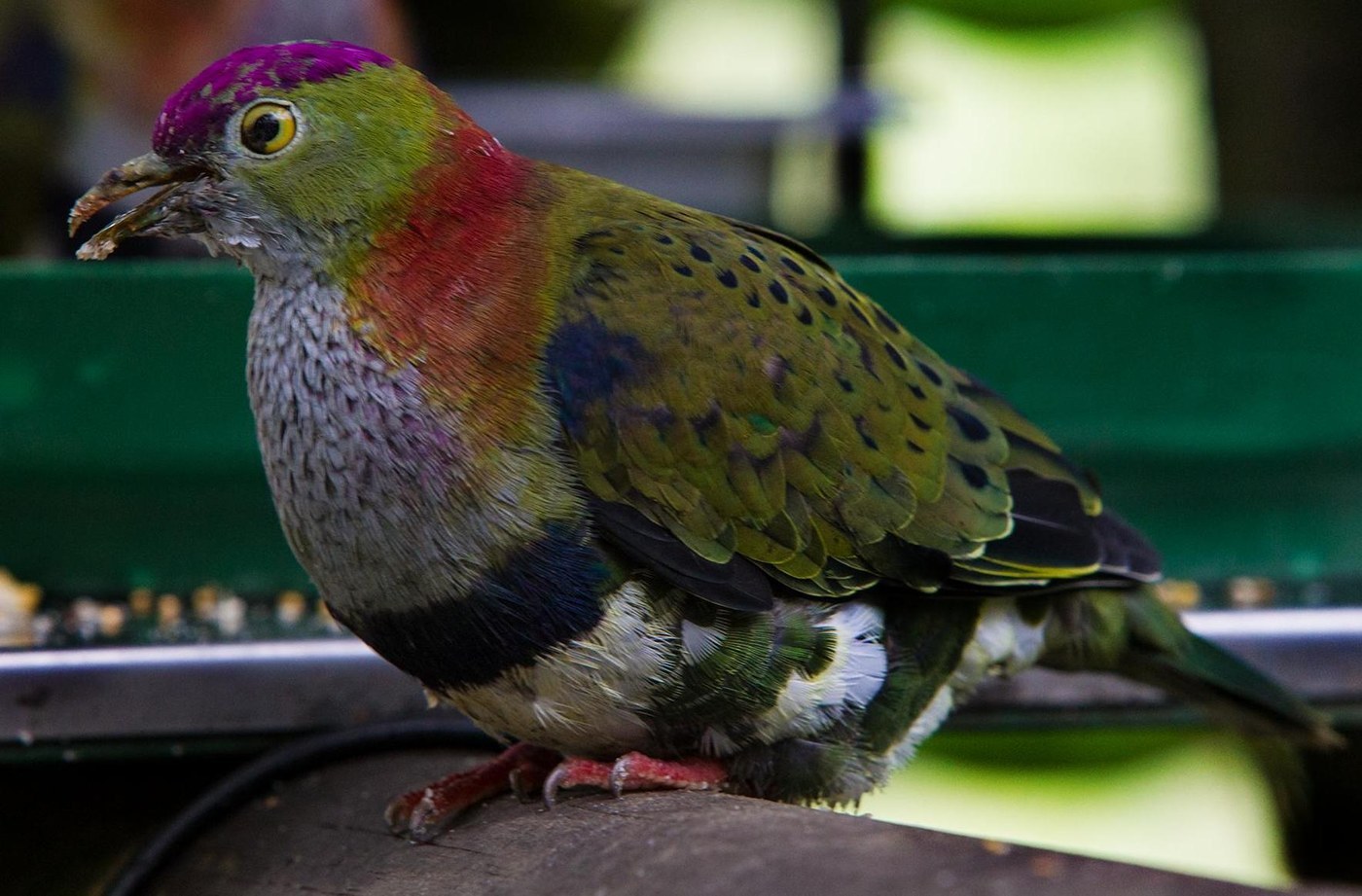
Key Field Marks
- Size & shape: Small and compact for a fruit dove, about 22–24 cm long, with a short tail, plump body, and small head typical of the genus Ptilinopus.
- Male plumage: Bright green upperparts and wings; a rich violet-purple crown patch bordered below by a narrow orange-chestnut band across the nape; underparts show a gray breast grading into a yellow-and-green scaled belly, with a purple-tinged throat in some views — an extremely colorful combination for a pigeon.
- Female plumage: Much plainer, mostly green above and below with a pale grayish-white belly showing faint scaling, and lacking the male's purple crown and orange nape band — far less conspicuous and easily mistaken for other female fruit doves.
- Bill: Short, thick-based, mostly yellowish-green to greenish, typical of fruit doves that swallow fruit whole.
- Behavior: Quiet and often surprisingly hard to see despite bright coloration, as it forages high in the fruiting canopy and sits motionless for long periods; usually solitary or in pairs, occasionally gathering at heavily fruiting trees.
Separating It From Similar Species
- Rose-crowned Fruit Dove: Male has a pinkish-rose (not violet-purple) crown and a yellow band across the belly with a more orange wash on the breast, plus a grayish (not orange-chestnut) hindneck — best separated by the exact crown and nape color combination.
- Wompoo Fruit Dove and other larger fruit doves: Considerably larger-bodied with different color patterns (e.g., Wompoo has a purple breast and yellow wing markings on an olive-green body) and a deeper, more resonant voice.
- Female fruit doves generally: Female Superb Fruit Doves are notoriously difficult to distinguish from females of other regional fruit dove species by plumage alone; range, associated males, and subtle differences in belly scaling pattern are the best clues.
Where and When to See It
- Habitat: Rainforest and dense forest canopy, including monsoon forest and forest edges, generally staying high in fruiting trees such as figs.
- Range: Found across northern and eastern Australia (Queensland and parts of New South Wales), New Guinea, and many islands of the Indonesian archipelago and the western Pacific, with numerous island subspecies varying subtly in plumage tone.
- Season: Largely resident, though some Australian populations show local or partial movements linked to fruit availability and may be more migratory at the southern edge of their range.
Voice
- A low, soft, repeated cooing typical of fruit doves, often a series of moaning or hooting notes that build and then trail off; frequently heard from deep within canopy foliage well before the bird itself is located.
Frequently asked questions
What is the easiest way to identify a male Superb Fruit Dove?
Look for the combination of a bright green body, a violet-purple crown patch, and a narrow orange-chestnut band across the nape — a color pattern unique among regional fruit doves.
Why are female Superb Fruit Doves harder to identify?
They lack the male's purple crown and orange nape band, appearing mostly plain green with a pale scaled belly, which closely resembles females of several other fruit dove species.
How do I tell Superb Fruit Dove from Rose-crowned Fruit Dove?
Superb Fruit Dove's male has a violet-purple crown and orange-chestnut hindneck band, while Rose-crowned Fruit Dove shows a pinkish-rose crown, a yellow belly band, and a grayish hindneck.
Where in the canopy should I look for a Superb Fruit Dove?
High in fruiting rainforest trees, especially figs, where it often sits quietly and can be difficult to spot despite its bright colors.