
Superb Fairywren Identification Guide
A tiny, long-tailed Australian songbird whose breeding male dazzles with brilliant blue and black plumage, while females and non-breeding males are soft brown — both sexes recognized by their cocked tail and lively group behavior.
Read the full Superb Fairywren encyclopedia entry →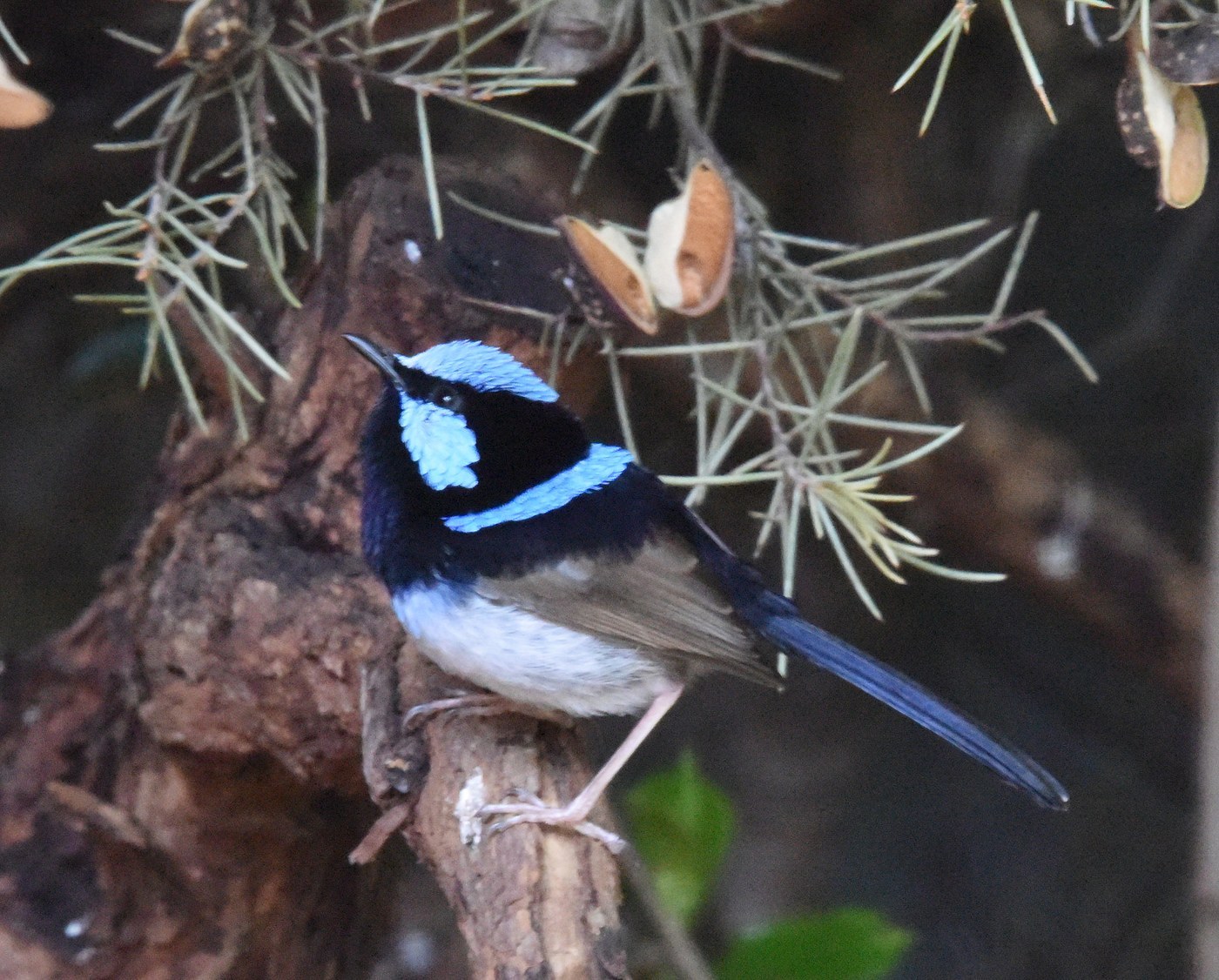
Key Field Marks
- Size & shape: Very small, about 14 cm long including a notably long, thin tail that is frequently held cocked upright at an angle — one of the group's most characteristic postures. Rounded body, short rounded wings, fine bill.
- Breeding male plumage: Brilliant iridescent blue crown, ear coverts, and upper back, contrasting with a black face mask, black throat and breast band, and a deep blue tail; the back and belly are otherwise dark blue-black to grayish, and the overall effect is jewel-like and unmistakable.
- Female plumage: Soft warm brown above, pale grayish-white below, with a distinctive rufous-chestnut eye-ring/lores patch and a bluish tail — lacking any of the male's blue or black head pattern.
- Eclipse/non-breeding male plumage: Resembles the female (brownish) but often retains bluer tail tones and sometimes a hint of blue on the wings; can be told from females in some cases by a duller blackish (rather than rufous) bill base or a more variable transitional plumage.
- Behavior: Lives in small cooperative family groups, typically one brightly colored dominant male, a female, and several duller helper birds; forages low in dense shrubby understorey, hopping actively with tail cocked, rarely staying still for long.
Separating It From Similar Species
- Splendid Fairywren: Breeding male is entirely deep blue (lacking the black breast band and contrasting patches of Superb Fairywren) with an all-blue face; ranges overlap only marginally, mainly separated geographically (Splendid Fairywren is more western/inland).
- Variegated Fairywren: Breeding male shows chestnut shoulder patches, a feature entirely absent in Superb Fairywren, plus a somewhat different blue tone and pattern.
- Red-backed Fairywren: Breeding male is black with a bright red/orange back patch rather than blue, making confusion unlikely once color is seen.
- Female fairywrens generally: Female Superb Fairywren's rufous eye patch is a useful mark; other fairywren females can look quite similar, so range and any associated males in the group are the best confirming clues.
Where and When to See It
- Habitat: Dense shrubby understorey in woodlands, forest edges, heathland, coastal scrub, and well-vegetated gardens and parks.
- Range: Common and widespread across southeastern Australia, including Tasmania, extending from southeastern Queensland through New South Wales, Victoria, and into southeastern South Australia.
- Season: Resident year-round; cooperative breeding groups are active and visible in all seasons, with breeding activity concentrated in spring and summer.
Voice
- A high-pitched, rapid, reeling trill or churring song, along with sharp "tsit" or "reet" contact calls used to keep the family group in touch while foraging in dense cover.
Frequently asked questions
Why do some Superb Fairywren males look brown instead of blue?
Males molt out of their bright breeding plumage into a duller brown 'eclipse' plumage resembling females for part of the year, though they often retain bluer tail tones or other subtle differences.
How can I tell a female Superb Fairywren from a female of a similar species?
Female Superb Fairywren shows a distinctive rufous-chestnut patch around the eye and lores, which helps separate it from similarly plain-brown females of other fairywren species.
What social structure do Superb Fairywrens live in?
They live in small cooperative groups typically consisting of one dominant breeding pair plus several helper birds, often offspring from previous broods, that assist in raising young.
What is the easiest way to distinguish Superb Fairywren from Splendid Fairywren?
Breeding male Superb Fairywren has a black face mask and breast band contrasting with blue crown and ear coverts, while Splendid Fairywren's breeding male is essentially all deep blue without the black breast band.