
Superb Bird-of-paradise Identification Guide
A New Guinea rainforest bird famed for the male's extraordinary transformation into a flattened black cape-and-breastplate 'smiley face' display during courtship, one of the most striking displays in the bird world.
Read the full Superb Bird-of-paradise encyclopedia entry →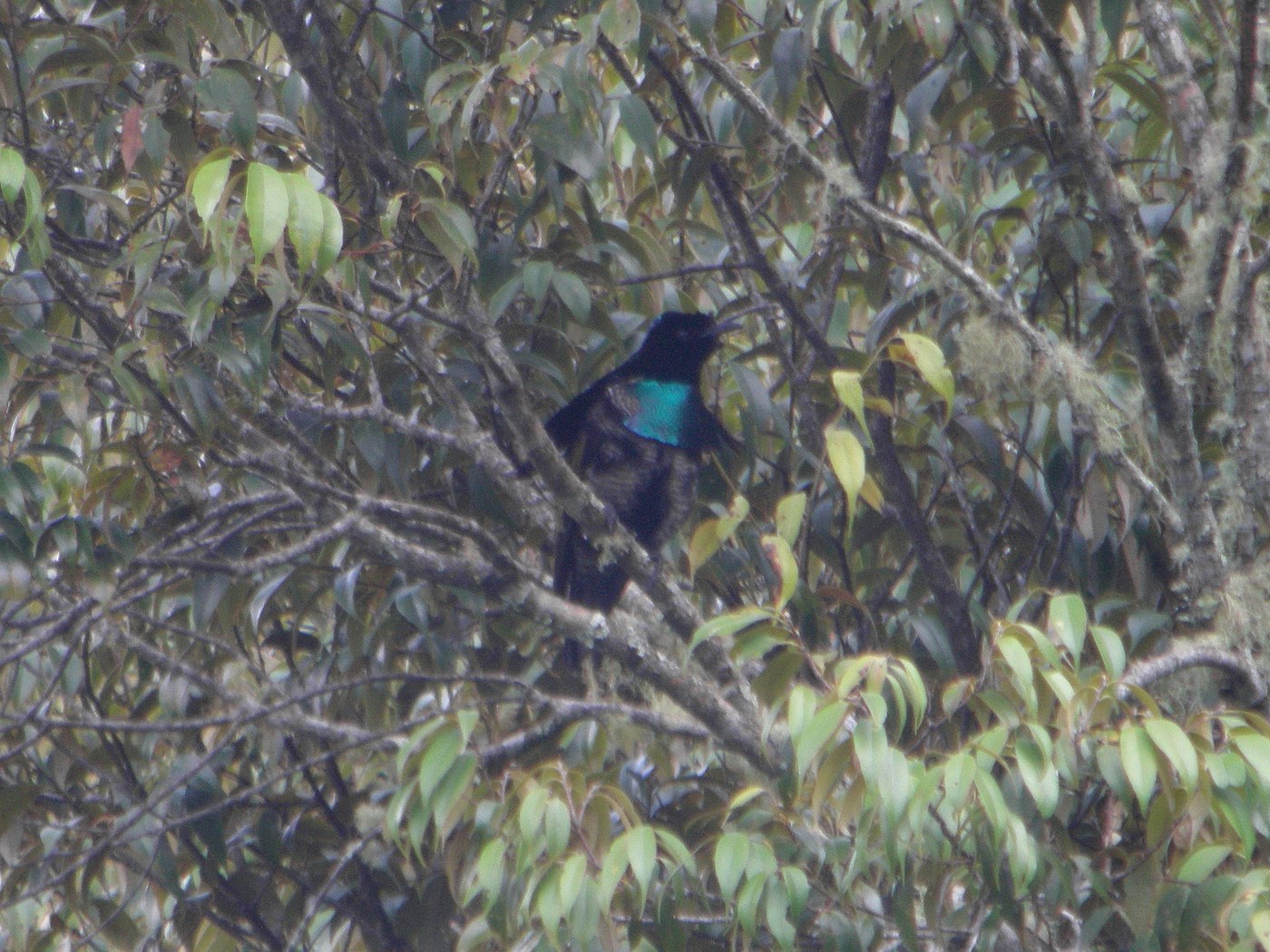
Key Field Marks
- Size & shape: A small to medium forest bird, about 25 cm long, with a slim body typical of birds-of-paradise, a fairly short tail, and a strong, slightly downcurved black bill.
- Male plumage (perched, undisplayed): Appears almost entirely velvety black with a subtle bluish-green sheen, but carries two dramatically modified feather structures: an erectile cape of elongated black feathers across the nape/back and an iridescent blue-green breast shield — both folded flat and inconspicuous when not displaying.
- Male display: During courtship, the male raises the nape cape forward and up into a wide, flattened oval cloak, and expands the breast shield outward and downward, creating a dramatic black oval shape marked with a vivid blue-green crescent smile and paired oval eye spots on the raised cape — an iconic transformation that looks almost nothing like the bird at rest.
- Female/immature plumage: Dull brown above with barred or scalloped dark brown and buff underparts, entirely lacking the male's ornamental feathers — cryptic and easily overlooked, typical of female birds-of-paradise.
- Behavior: Displays are performed on a cleared patch of forest floor or a low horizontal perch, with the male hopping and shuffling before a visiting female while fully expanded.
Separating It From Similar Species
- Other black birds-of-paradise (e.g., Superb Bird-of-paradise vs. Lophorina superba complex members / Vogelkop Superb Bird-of-paradise): Recent taxonomic splits separate populations formerly lumped as one "Superb Bird-of-paradise" into distinct species/subspecies differing subtly in the shape of the displayed breast shield (straight-edged vs. crescent-shaped) and cape outline — best distinguished by displaying males and by range (e.g., Vogelkop Peninsula birds vs. central/eastern New Guinea birds).
- Female/immature vs. other female birds-of-paradise: Female plumages across many bird-of-paradise species are similarly dull brown and barred, making females very difficult to separate by plumage alone; habitat, range, and associated calls/displays of nearby males are the most reliable clues.
- Glossy starlings or other all-black birds: Lack the bird-of-paradise's characteristic shape, forest-floor display behavior, and specialized nape/breast feathering.
Where and When to See It
- Habitat: Mid-montane and hill forest interior, typically between about 600–1,800 m elevation, where males maintain traditional display sites (courts) on the forest floor or low perches.
- Range: Endemic to the island of New Guinea, occurring across much of its central mountain ranges (with the closely related Vogelkop form restricted to the Bird's Head Peninsula in the far west).
- Season: Resident year-round; display activity by males peaks in the local breeding season but can be observed intermittently at traditional courts across much of the year.
Voice
- Gives a variety of harsh, buzzy, mechanical-sounding notes and clicks around the display court, along with softer, more nasal calls; vocalizations are relatively unmusical compared to many songbirds, functioning mainly to draw female attention to the display site.
Frequently asked questions
Why does the male Superb Bird-of-paradise look so different when displaying?
It raises a normally folded cape of black nape feathers into a wide flattened oval and spreads an iridescent blue-green breast shield, together creating a dramatic 'smiley face' shape used entirely for courtship — very different from its plain black appearance at rest.
How can you tell a female Superb Bird-of-paradise from the male?
Females are dull brown above with barred brown-and-buff underparts and completely lack the male's iridescent cape and breast shield, making them far less conspicuous.
Where do male Superb Birds-of-paradise perform their displays?
At traditional display sites, called courts, typically on a cleared patch of forest floor or a low horizontal branch within mid-montane New Guinea forest.
Is the Superb Bird-of-paradise found anywhere outside New Guinea?
No, it is endemic to the island of New Guinea, restricted to its central mountain forests, with a closely related form found separately on the Bird's Head Peninsula.