
Sungrebe Identification Guide
A secretive, finfoot-related waterbird of Neotropical rivers, recognized by its slim dark body, bold white facial stripes, and unusual habit of carrying chicks in pouches under its wings.
Read the full Sungrebe encyclopedia entry →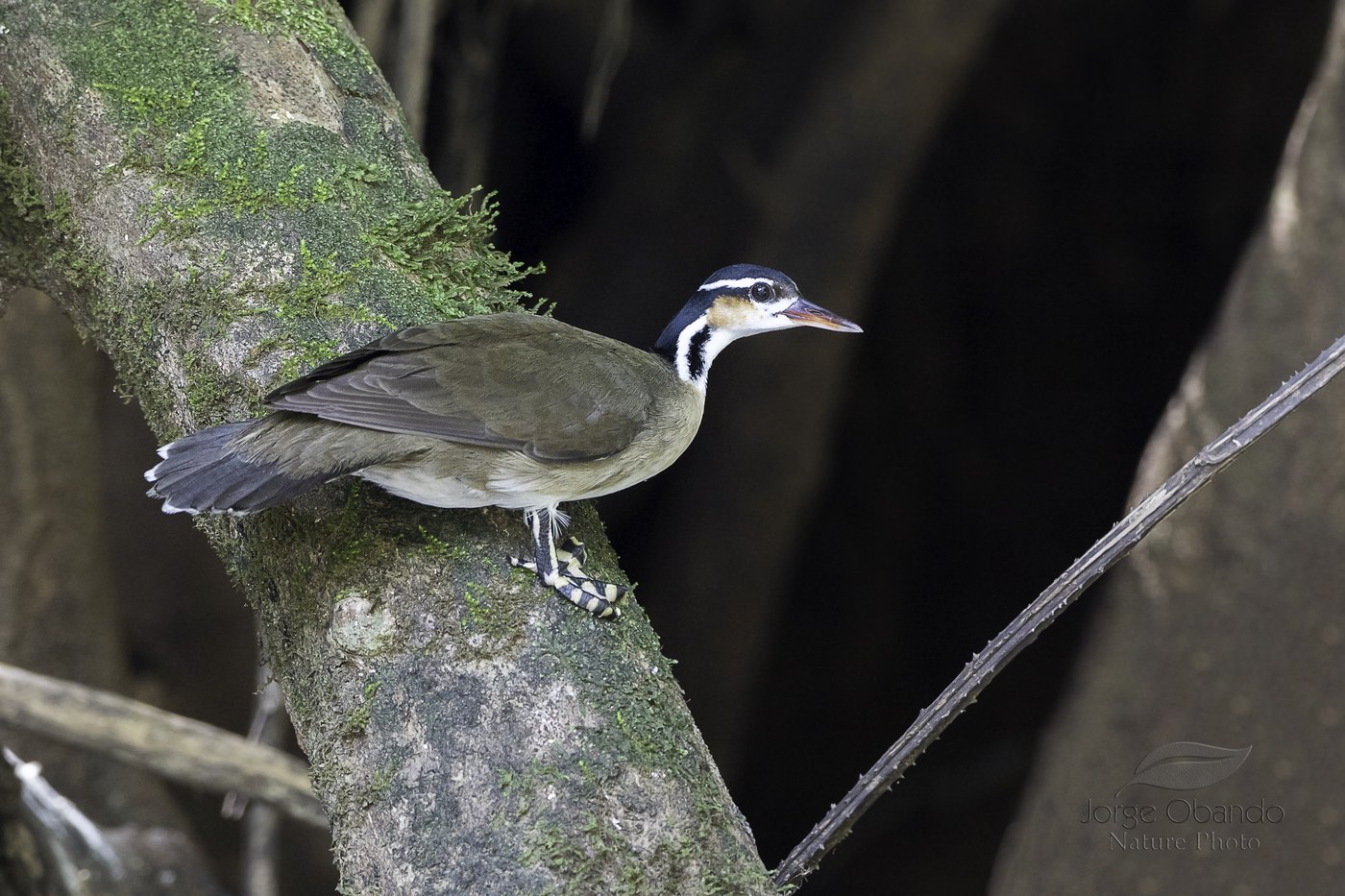
Key Field Marks
- Size & shape: A slender, elongated waterbird about 28–30 cm long, with a long thin neck, small head, a pointed yellowish-red bill, and a long tail often held cocked or trailing on the water surface — recalling a small grebe or cormorant hybridized in shape with a rail.
- Plumage: Upperparts are dark blackish-brown to olive-brown; underparts are paler grayish to whitish. The head shows bold black-and-white striping — a black crown and a black stripe through the eye bordered by white stripes above and below — a highly distinctive facial pattern.
- Bill: Slim, pointed, and notably colorful — yellowish with red at the base, contrasting with the dark head.
- Legs and feet: Feet are lobed (not fully webbed) similar to a grebe's, an adaptation for swimming and diving, with greenish-yellow coloring.
- Behavior: Swims low in the water like a small grebe or cormorant, often close to overhanging riverbank vegetation; dives readily when alarmed and can swim submerged with just the head above water. Extremely secretive and often overlooked. Uniquely, the male carries newly hatched chicks in special skin pouches under each wing, even in flight — a trait found in no other bird.
Separating It From Similar Species
- Pied-billed Grebe / other grebes: Grebes lack the bold black-and-white striped head pattern and have a stubbier, thicker bill rather than the Sungrebe's slim, pointed, colorful bill; grebes also lack a long trailing tail.
- Anhinga / cormorants: Much larger, with a longer neck and different overall proportions; lack the striking facial striping and have entirely different bill shapes (Anhinga's bill is thin but straight and lacks the red-and-yellow coloring).
- Rails and gallinules (e.g., Purple Gallinule): Rails generally lack the combination of lobed swimming feet, striped face, and slender colorful bill; most rails are more terrestrial or skulk in marsh vegetation rather than swimming openly on rivers.
- Sungrebe is the sole New World member of the small finfoot family (Heliornithidae), so once the head pattern and swimming behavior are noted, confusion is minimal.
Where and When to See It
- Habitat: Quiet forested rivers, oxbow lakes, and slow streams with overhanging bank vegetation in lowland tropical forest, where it stays close to cover.
- Range: Found from southern Mexico through Central America and much of tropical South America, including the Amazon and Orinoco basins.
- Season: Resident year-round; because of its shy, retiring habits it is most often detected by quietly scanning riverbanks from a boat rather than from shore.
Voice
- Generally quiet; gives soft, low grunting or clucking notes, and occasionally a harsher croaking call, most often heard rather than the bird being seen.
Frequently asked questions
What is the most distinctive feature of a Sungrebe's appearance?
Its bold black-and-white striped head pattern combined with a slim, pointed bill that is yellow with a reddish base.
Why is the Sungrebe famous among ornithologists?
The male carries newly hatched chicks in special skin pouches tucked under each wing, even while flying — a parental care behavior unique among birds.
How does a Sungrebe differ from a grebe?
Unlike true grebes, Sungrebe has a slender, colorful pointed bill, a distinct striped facial pattern, and a longer tail often trailed on the water; it belongs to a completely different family, the finfoots.
Where should I look for a Sungrebe?
Along quiet, forested tropical rivers and oxbow lakes with overhanging vegetation, from Mexico through Central and South America, scanning close to the bank.