
Sunbittern Identification Guide
A cryptically patterned Central and South American wetland bird that transforms into a dazzling display of sunburst wing patterns when it spreads its wings and tail in threat or courtship.
Read the full Sunbittern encyclopedia entry →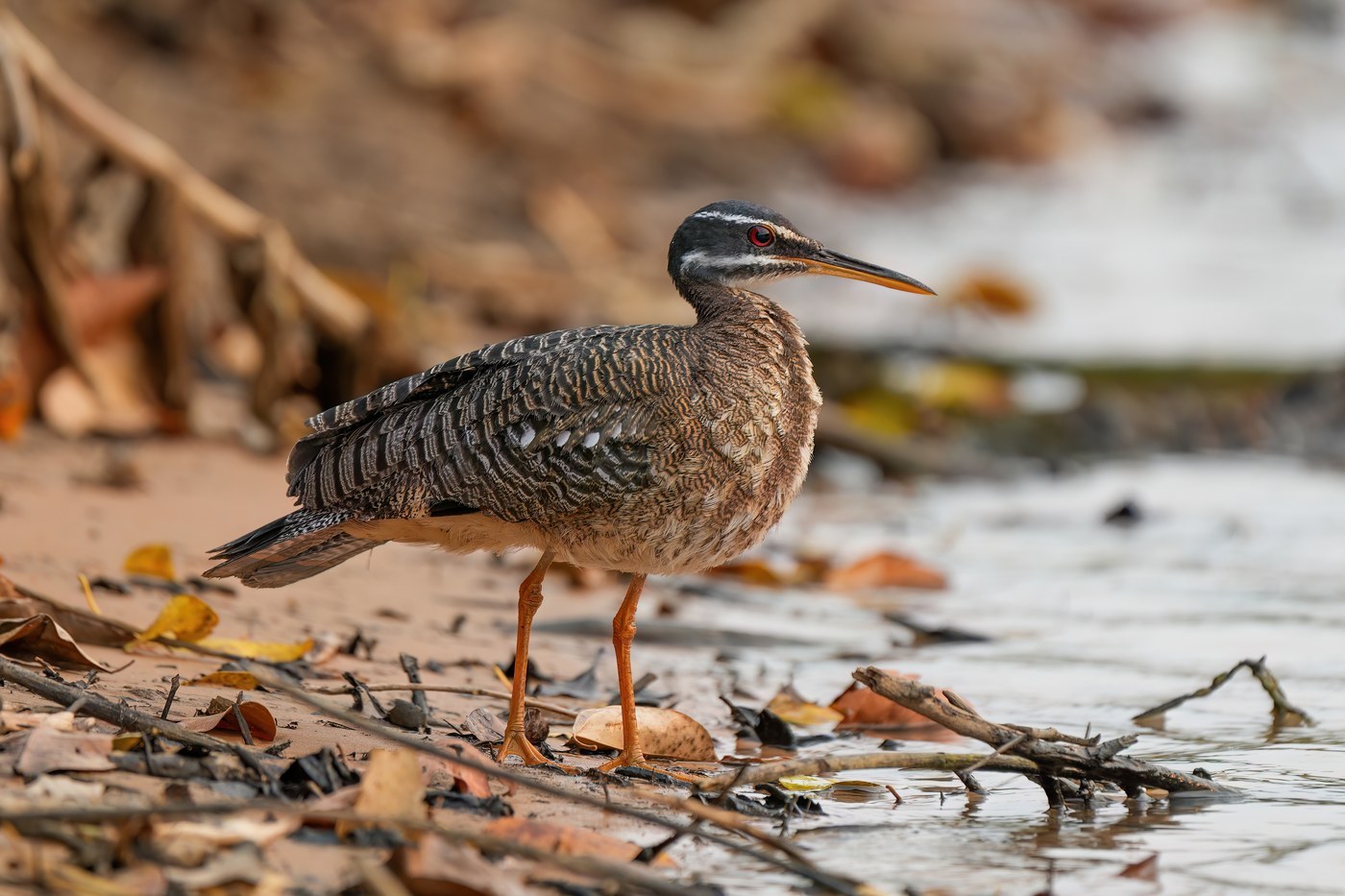
Key Field Marks
- Size & shape: A medium-sized, slender wading bird about 43–48 cm long, with a long neck, small head, long slim legs, and a long, straight, sharply pointed bill — superficially heron- or rail-like in silhouette.
- Folded plumage: At rest, plumage appears finely and intricately patterned in grays, browns, and blacks with fine vermiculations and barring — excellent camouflage against leaf litter and stream banks, making the bird easy to overlook.
- Diagnostic display: When alarmed or displaying, the Sunbittern spreads its wings and fans its tail to reveal large, bold chestnut, black, and golden-orange "eye-spot" patches on the wings, resembling two huge sunburst eyes — an extraordinary and unmistakable pattern found in no other bird.
- Bill and legs: Bill is blackish and dagger-like; legs are orange-yellow to yellowish, notably bright against the muted body plumage.
- Behavior: Walks slowly and deliberately along stream edges and shaded forest margins, stalking prey with careful, high-stepping movements; often solitary or in pairs, generally shy and quick to freeze or retreat when disturbed.
Separating It From Similar Species
- Rails and bitterns: Superficially similar in habitat and shy behavior, but no rail or bittern shows the Sunbittern's fine vermiculated plumage pattern or slender long-legged, long-necked shape combined with a heron-like bill.
- Immature herons: Could be dismissed as a small heron at a glance, but the Sunbittern's uniquely patterned, cryptic body plumage (rather than plain gray or brown) and orange legs are diagnostic; the spectacular wing pattern when flushed is conclusive and shared by no heron.
- Overall, the Sunbittern is unique enough (its own family, Eurypygidae) that confusion is unlikely once its patterning or wing display is seen.
Where and When to See It
- Habitat: Shaded streams, forest rivers, and swampy margins within lowland and foothill tropical forest; prefers slow-moving or still water with overhanging vegetation and exposed rocks or logs.
- Range: Found from southern Mexico and Central America south through much of tropical South America, including the Amazon basin, generally below about 1,200–1,800 m elevation.
- Season: Resident year-round throughout its range; most reliably found by quietly walking forest trails along streams at dawn or dusk when the birds are actively foraging.
Voice
- Gives a thin, high-pitched, whistled call, often described as a series of clear "peeeu" or "pssiuu" notes; also produces a low, rolling or bubbling song during courtship, audible at a distance in quiet forest.
Frequently asked questions
What makes the Sunbittern's threat display so unusual?
When it spreads its wings, it reveals huge chestnut, black, and golden 'eye-spot' patches that resemble two enormous sun-like eyes, a pattern unmatched by any other bird and used to startle predators or in courtship.
What does a Sunbittern look like when its wings are folded?
It appears cryptically patterned in fine grays, browns, and blacks with intricate vermiculations, blending in remarkably well with leaf litter and streamside vegetation.
Where is the best habitat to find a Sunbittern?
Shaded, slow-moving forest streams and swampy margins in lowland tropical forest, from Mexico and Central America through the Amazon basin.
Is the Sunbittern related to herons or bitterns?
No — despite the name and superficial resemblance, it belongs to its own unique family, Eurypygidae, and is not closely related to true herons or bitterns.