Sun Parakeet Identification Guide
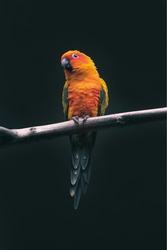
A dazzling golden-orange parakeet of the Guiana Shield savannas, distinguished by its sunburst body color and green-and-blue wings, now Endangered in the wild.
Read the full Sun Parakeet encyclopedia entry →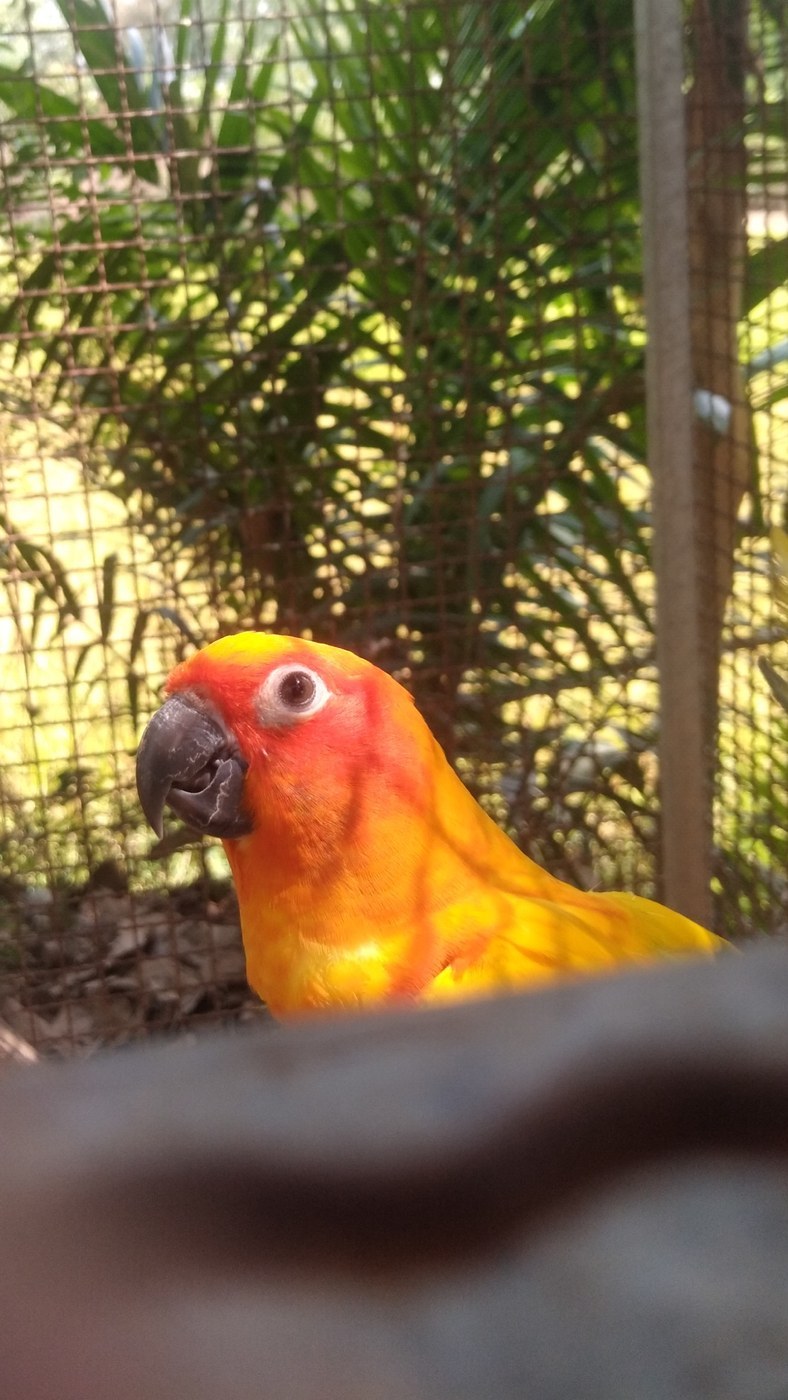
Key Field Marks
- Size & shape: Medium-small, roughly 30 cm long including a long tapering tail, with a compact body, large rounded head, and thick pale-gray hooked bill typical of Aratinga parakeets.
- Adult plumage: Overall brilliant golden-yellow to orange, deepest on the face and belly, with green wing coverts and blue-tipped flight feathers and tail — an unmistakable sunset-colored combination when seen well.
- Immature plumage: Predominantly green with only patches of yellow-orange emerging; full adult coloration takes about a year to develop.
- Bare parts: Blackish-gray bill, pale whitish bare eye-ring, grayish legs.
- Behavior: Gregarious and noisy, moves in flocks through savanna woodland and forest edge, feeding on fruit, seeds, flowers, and nectar-rich blossoms; fast, direct flight with rapid, shallow wingbeats.
Separating It From Similar Species
- Sun Conure (identical species): "Sun Parakeet" is the standard English ornithological name and "Sun Conure" the common aviculture name for the same species, Aratinga solstitialis — they are not separable because they are the same bird.
- Jandaya Parakeet: Close relative with similar golden-orange head and chest, but retains substantially more green on the back, rump, and belly, whereas Sun Parakeet is more evenly golden across the body.
- Sulphur-breasted / hybrid forms: Captive-bred hybrids between Sun and Jandaya or Sun and Golden-capped Parakeets can show intermediate or patchy plumage; genuinely wild individuals show the classic clean, even golden-orange coverage.
- Golden-capped Parakeet: Orange largely confined to the crown and underparts against a mostly green body, unlike the far more extensively golden Sun Parakeet.
Where and When to See It
- Habitat: Tropical savanna, dry woodland, and forest-edge habitat with scattered trees, particularly favoring areas near palms and fruiting trees.
- Range: Restricted to the Guiana Shield of northeastern South America — Guyana, Suriname, French Guiana, and adjacent far northern Brazil and southeastern Venezuela. Listed as Endangered due to unsustainable capture for the cage-bird trade and ongoing habitat degradation, with wild numbers now low and fragmented.
- Season: Present year-round in its range, with local movements tracking fruit and flower availability; nests in natural tree cavities.
Voice
- High-pitched, piercing screeches and shrill chattering calls typical of the genus Aratinga, frequently given in flight; flocks are conspicuous by sound well before they come into view.
Frequently asked questions
What is the difference between a Sun Parakeet and a Sun Conure?
There is no biological difference — both names refer to the same species, Aratinga solstitialis; 'parakeet' is used in formal ornithology while 'conure' is common in aviculture and the pet trade.
Why is the Sun Parakeet considered Endangered?
Its wild population has declined sharply due to heavy trapping for the international pet trade combined with habitat loss in its restricted Guiana Shield range.
How do I separate Sun Parakeet from Jandaya Parakeet in the field?
Sun Parakeet shows more extensive, even golden-orange coloring across the body, while Jandaya Parakeet retains substantially more green on the back, rump, and belly.
What habitat should I search for wild Sun Parakeets?
Tropical savanna and dry forest-edge woodland with scattered trees and palms in Guyana, Suriname, French Guiana, and adjacent parts of Brazil and Venezuela.
Sun Parakeet identified by the community
Recent Sun Parakeet sightings identified with Bird Identifier.