
Sun Conure Identification Guide
A vividly golden-orange South American parakeet with green and blue flight feathers, easily recognized by its brilliant sunset coloration and loud, screeching calls.
Read the full Sun Conure encyclopedia entry →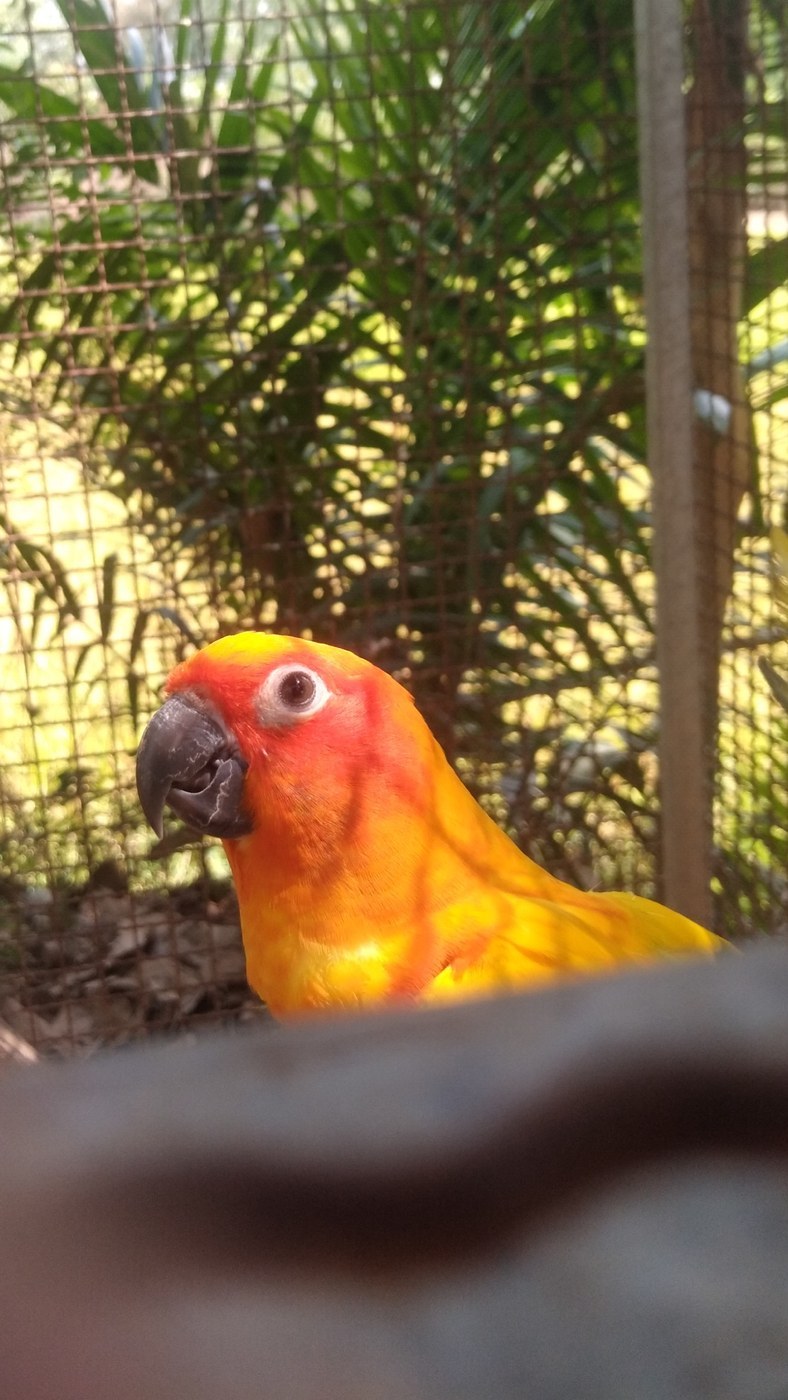
Key Field Marks
- Size & shape: A medium-small parakeet, about 30 cm long including a long, tapered tail, with a fairly stocky body, a large rounded head, and a strong, hooked pale-gray to horn-colored bill typical of Aratinga parakeets.
- Adult plumage: Brilliant golden-yellow to orange overall on the head, neck, and underparts, with orange tones intensifying on the face and belly; wings show green primary coverts and blue-tipped flight feathers, and the tail is olive-green tipped with blue — a striking, almost fiery combination unlike any other parrot in its range.
- Immature plumage: Young birds are considerably greener overall, with the golden-orange color developing gradually over roughly the first year as green feathering is replaced.
- Bare parts: Bill is blackish-gray; a bare whitish eye-ring encircles a dark eye; legs are grayish.
- Behavior: Highly social, typically encountered in noisy flocks of a dozen or more, feeding in the canopy on fruit, seeds, flowers, and berries; flight is fast and direct with rapid wingbeats.
Separating It From Similar Species
- Sun Parakeet (same species, different common name): "Sun Conure" and "Sun Parakeet" refer to the identical species (Aratinga solstitialis) — one name derived from aviculture usage, the other the standard English ornithological name — so no field separation is needed.
- Jandaya Parakeet: Very similar golden-orange coloring but shows more extensive green on the lower back, rump, and belly, with the orange largely restricted to the head and chest, unlike the more uniformly golden Sun Conure.
- Sulphur-breasted Parakeet / Sunday Parakeet (hybrid forms): Intermediate plumages seen in captivity or hybrid zones can complicate identification; pure wild Sun Conures show the classic even golden-orange body without extensive green mottling on the underparts.
- Golden-capped Parakeet: Shows orange mainly restricted to a cap and underparts with a mostly green body and back, lacking the near-total golden coverage of Sun Conure.
Where and When to See It
- Habitat: Tropical savanna, dry forest edges, and gallery woodland in the Guiana Shield region of northern South America.
- Range: Native to a fairly restricted range in northeastern South America, including parts of Guyana, Suriname, French Guiana, and adjacent far northern Brazil and southern Venezuela; considered Endangered in the wild due to trapping for the pet trade and habitat loss, with wild populations now fragmented.
- Season: Resident year-round with local movements linked to fruiting and flowering cycles; breeding occurs in tree cavities.
Voice
- Loud, sharp, high-pitched screeching and shrieking calls typical of Aratinga parakeets, often given in flight and audible over long distances; flocks are noisy and easily located by sound before being seen.
Frequently asked questions
Is a Sun Conure the same bird as a Sun Parakeet?
Yes — Sun Conure and Sun Parakeet are two common names for the exact same species, Aratinga solstitialis; 'conure' is an aviculture term while 'parakeet' is the standard ornithological name.
How can I tell an adult Sun Conure from an immature one?
Immatures are much greener overall, with the vivid golden-orange adult coloration developing gradually over roughly their first year of life.
What is the main species confused with Sun Conure in the wild?
Jandaya Parakeet, which shows more extensive green on the back, rump, and belly compared to the more uniformly golden-orange Sun Conure.
Where do wild Sun Conures live?
In a restricted range of dry savanna and forest edge habitat in the Guiana Shield of northeastern South America, including Guyana, Suriname, French Guiana, and adjacent Brazil and Venezuela.