
Summer Tanager Identification Guide
A medium-sized North American songbird known for the male's all-rosy-red plumage and heavy pale bill, found in woodland canopies where it specializes in catching bees and wasps.
Read the full Summer Tanager encyclopedia entry →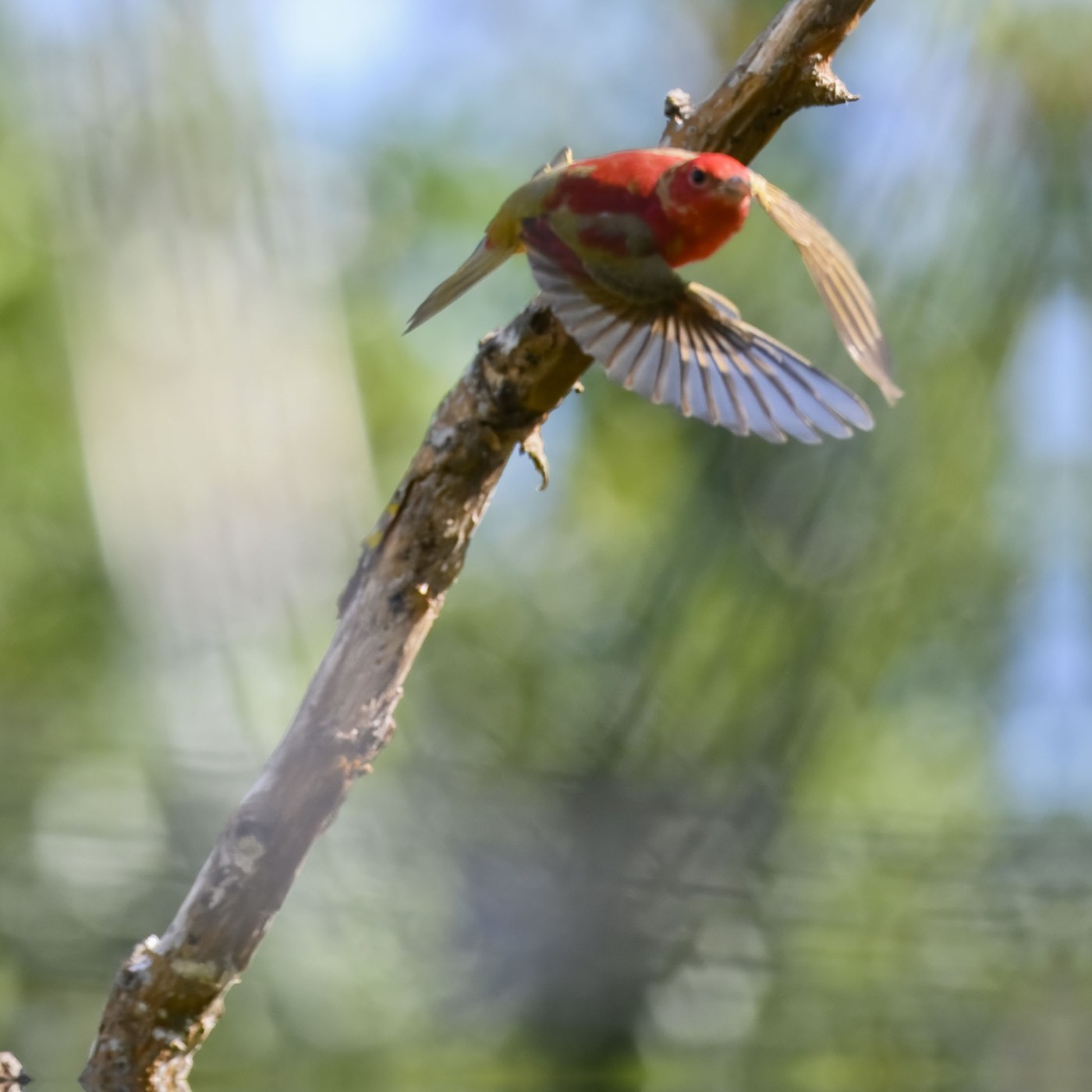
Key Field Marks
- Size & shape: A stocky, medium-sized songbird about 16.5–19.5 cm long, with a fairly large head, a thick, blunt-tipped bill, and a moderately long tail — bulkier and more full-bodied than a typical warbler.
- Male plumage: Entirely rose-red to deep red year-round (the only entirely red bird in North America without a crest or black markings), with a pale, thick, slightly downcurved bill that is diagnostic among red songbirds.
- Female/immature plumage: Olive-yellow to mustard-yellow overall, with a dull orange or yellowish wash and the same heavy pale bill shape as the male; some first-year males show a blotchy mix of red and yellow-green feathers during molt.
- Bill: Notably large, thick, and pale horn-colored — a key mark separating it from other red or yellow songbirds.
- Behavior: Often stays high in the leafy canopy of deciduous or mixed woodlands, can be inconspicuous despite bright color; noted for catching bees and wasps in flight, then removing the stinger by beating the insect against a branch before eating it.
Separating It From Similar Species
- Northern Cardinal: Male cardinals are also red but show a prominent crest and a black face mask around a bright orange-red (not pale) bill — features entirely absent in Summer Tanager.
- Scarlet Tanager: Breeding male Scarlet Tanager has bright red body plumage but jet-black wings and tail, contrasting sharply with the body — Summer Tanager males are uniformly red with no black wings. Females are trickier but Scarlet Tanager has a smaller, less swollen bill and generally grayer wings.
- Hepatic Tanager (range overlap in the southwest): Male Hepatic Tanager is a duller, brick-red (not rosy-red) with a dark grayish, not pale, bill and darker cheek/auricular area.
- House Finch / Purple Finch: Much smaller-billed, streakier birds with a notched tail, lacking the tanager's heavy, smooth pale bill.
Where and When to See It
- Habitat: Open deciduous and mixed woodlands, riparian corridors, oak groves, and pine-oak woodlands; in the western part of its range favors cottonwood/willow riparian strips.
- Range: Breeds across the southern and southeastern United States, extending into the south-central and southwestern states; winters from Mexico south through Central America into northern South America.
- Season: A neotropical migrant — arrives on breeding grounds in spring (April–May), departs by early fall (September–October) for wintering grounds; best looked for in the canopy during the breeding season when singing.
Voice
- Song is a series of rich, burry, robin-like phrases, somewhat faster and less musical than an American Robin's song. The distinctive call note is a staccato "pik-i-tuk-i-tuk" or "pit-i-tuk," often the best clue to its presence in dense canopy foliage.
Frequently asked questions
How do I tell a male Summer Tanager from a Northern Cardinal?
Summer Tanager lacks a crest and black face mask and has a pale bill, while Northern Cardinal has a prominent crest, a black face around the bill, and a bright orange-red bill.
What distinguishes a male Summer Tanager from a male Scarlet Tanager?
Summer Tanager is uniformly rosy-red all over including the wings and tail, while Scarlet Tanager has bright red body plumage contrasted with black wings and tail.
What does a female Summer Tanager look like?
Olive-yellow to mustard-yellow overall with the same thick, pale bill shape as the male, lacking any red coloring except sometimes in transitional first-year males.
Why is the Summer Tanager known for eating bees and wasps?
It specializes in catching bees, wasps, and other flying insects on the wing, then beats the prey against a branch to remove the stinger before consuming it.