
Striated Pardalote Identification Guide
A tiny, boldly patterned Australian canopy bird best identified by its striped crown, yellow-spotted or red-spotted wing markings, and sharp, repetitive whistled call heard more often than the bird is seen.
Read the full Striated Pardalote encyclopedia entry →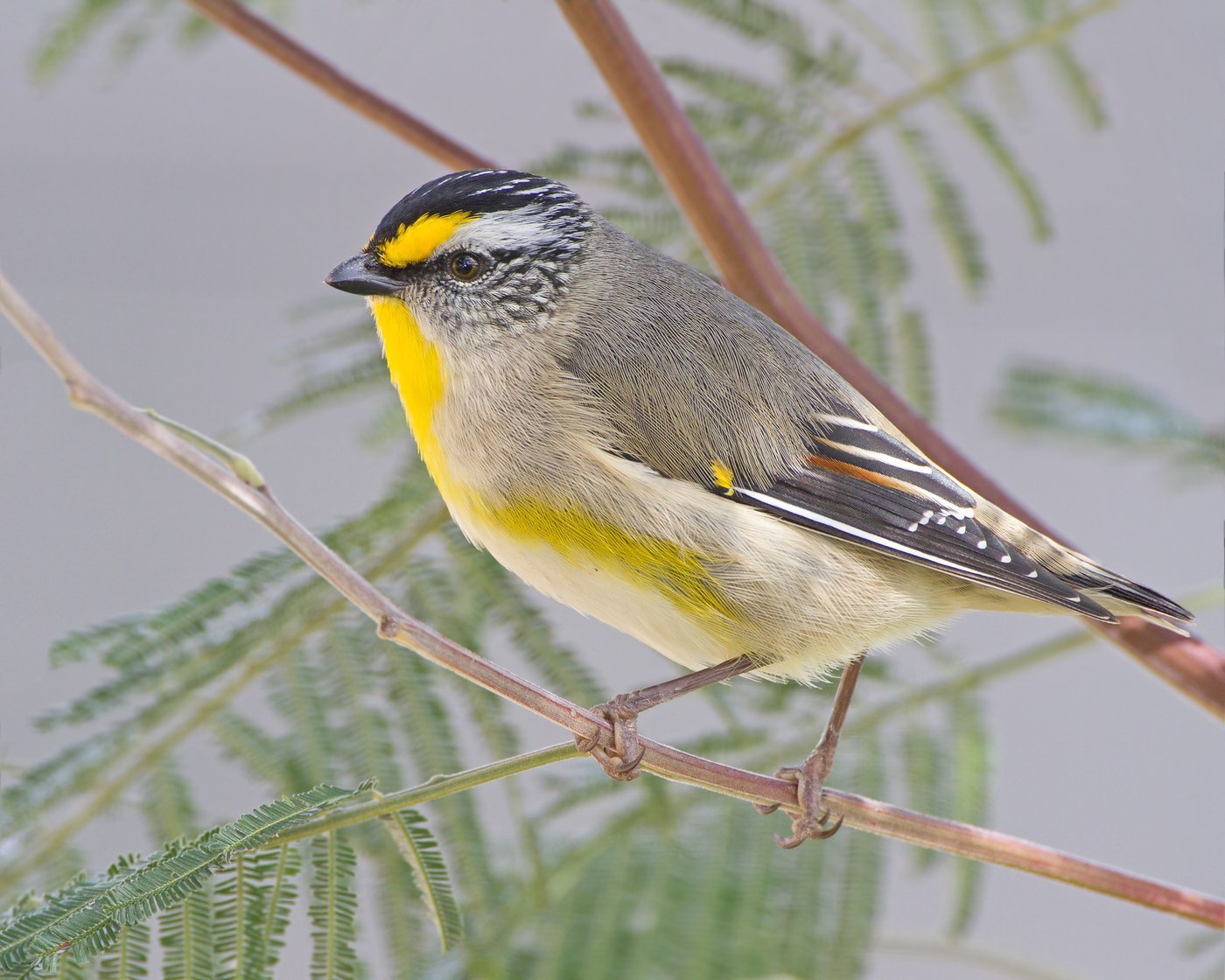
Key Field Marks
- Size & shape: Very small and compact, only about 9–11.5 cm long, with a short tail, short thick bill, and a large head relative to its stocky body — giving it a rounded, almost stubby silhouette.
- Plumage: Crown is black or dark gray with fine white or cream streaks (striations) running front to back — the source of the name. A pale eyebrow (supercilium) is often present. Upperparts are olive-gray to gray-brown; underparts are pale buffy-white to yellowish, particularly on the throat and flanks in some subspecies.
- Wing markings: Shows a bold wing pattern combining a white or cream wing stripe with a spot of red, orange, or yellow at the bend of the wing (subspecies-dependent) — a key diagnostic feature visible even in quick views.
- Behavior: Forages actively and acrobatically high in eucalypt canopies, gleaning lerps (sugary insect coverings) and small insects from leaves; frequently hangs upside down on foliage. Often detected by voice well before being seen due to its habit of staying high in the canopy.
Separating It From Similar Species
- Spotted Pardalote: Has a black crown covered in bold white spots (not fine stripes) and a bright yellow throat/rump patch with a red rump in males — overall more boldly spotted than striped, and its call is a rising three-note whistle versus the Striated Pardalote's different rhythm.
- Other pardalote subspecies: Striated Pardalote itself is variable across Australia (with forms sometimes called "red-tipped," "yellow-tipped," and "black-headed" pardalote), differing mainly in wing-spot color and crown pattern, but all share the fine crown striations that distinguish the species from Spotted Pardalote.
- Thornbills and gerygones: Much plainer, longer-tailed, and lack the bold wing spot and striped crown; typically forage lower in shrubs rather than high eucalypt canopy.
Where and When to See It
- Habitat: Eucalypt forests and woodlands across Australia, including urban parks and gardens with mature gum trees; also mallee and other dry woodland types depending on region.
- Range: Found across most of mainland Australia and Tasmania, with southern populations partially migratory, moving north in autumn/winter to escape cold, and returning south in spring to breed.
- Season: Breeding season generally spring through summer (September–January in most of range); nests are built in tunnels excavated in earth banks or in tree hollows, a somewhat unusual habit for a canopy-feeding bird.
Voice
- A distinctive, far-carrying, sharply whistled call, often rendered as a rhythmic "witta-wit" or "chip-chip-chip," repeated steadily and monotonously from high in the canopy — frequently the first and only clue to the bird's presence.
Frequently asked questions
How do I tell a Striated Pardalote from a Spotted Pardalote?
Check the crown: Striated Pardalote has fine white stripes on a dark crown, while Spotted Pardalote has bold white spots; wing and throat colors also differ, with Spotted Pardalote showing a brighter yellow throat and red rump.
Why is the Striated Pardalote hard to see even when calling nearby?
It typically forages high in the eucalypt canopy and is tiny and well camouflaged against foliage, so birders often locate it by its persistent whistled call before spotting it.
What does a Striated Pardalote eat?
Mainly small insects and lerps (sugary secretions produced by psyllid insects) gleaned from eucalypt leaves.
Where do Striated Pardalotes nest?
In tunnels dug into earth banks, or sometimes in tree hollows or even man-made cavities, despite feeding high in the tree canopy.