
Striated Heron Identification Guide
A small, stocky, dark-backed heron of tropical and subtropical shorelines worldwide, identified by its crouched hunting posture, greenish-gray back, and short orange-yellow legs.
Read the full Striated Heron encyclopedia entry →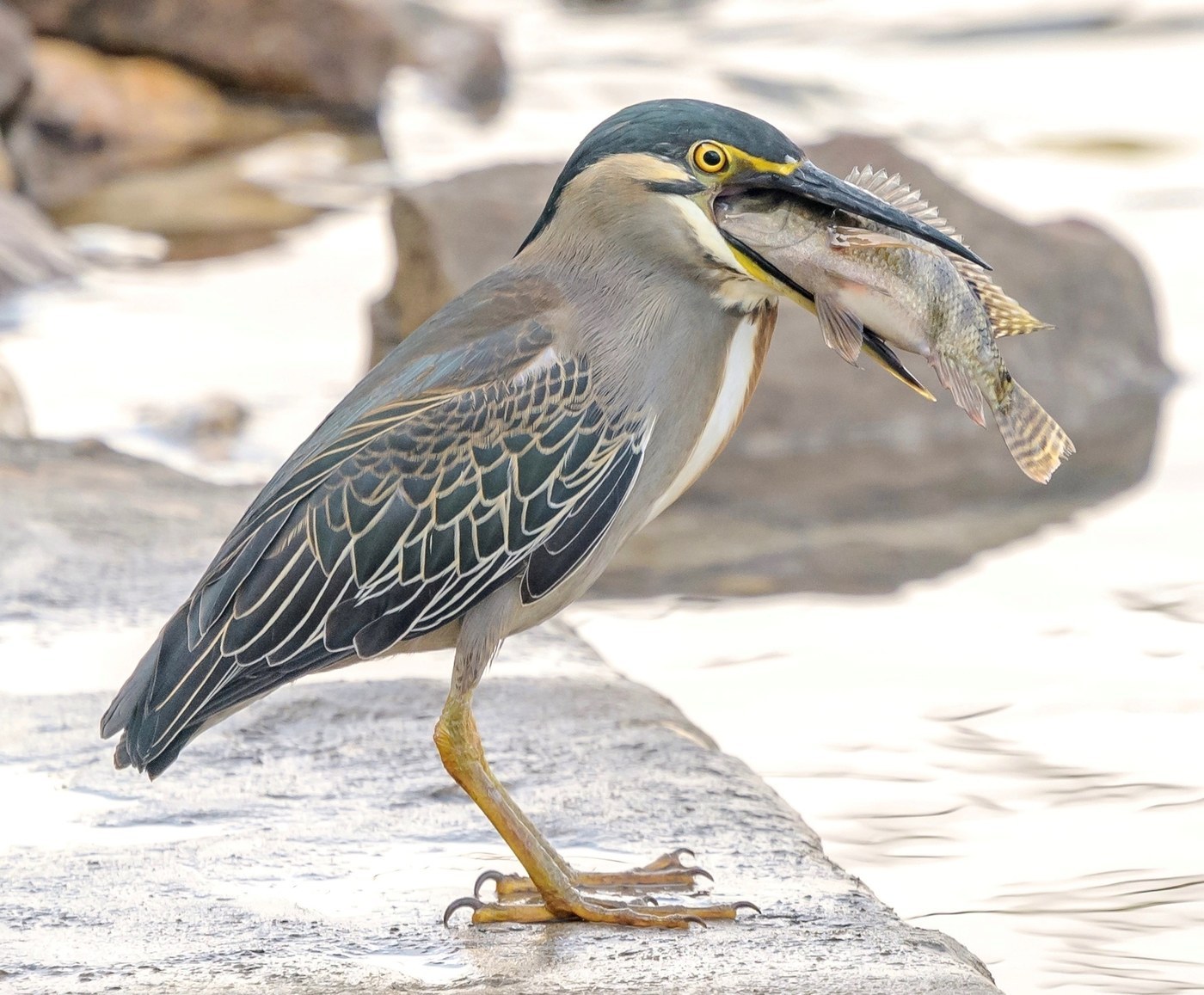
Key Field Marks
- Size & shape: A small, compact heron, about 40–48 cm long, with a short neck often held drawn in against the body, a relatively large head, and short legs — giving a hunched, low-slung profile compared to larger herons.
- Plumage: Crown and long nape feathers (forming a slight crest) are glossy blackish-green; back and wings are dark slaty-green to greenish-gray with narrow pale feather edges giving a faintly streaked or scaled look. Underparts are pale gray, sometimes with a rufous or buffy wash on the neck sides in some populations.
- Bill: Long, straight, dagger-like, blackish above and yellowish below, well suited for spearing prey.
- Legs: Short and yellow to orange-yellow, brightening during the breeding season.
- Behavior: Highly characteristic — stands motionless or moves in slow, deliberate crouched steps at the water's edge, often with body nearly horizontal, neck retracted, poised to strike at fish or invertebrates. Frequently perches on mangrove roots, rocks, or low branches overhanging water.
Separating It From Similar Species
- Green Heron (where ranges overlap or in taxonomic discussions): Green Heron (of the Americas) is very similar and was formerly considered the same species; Green Heron tends to show a more pronounced chestnut neck and slightly richer coloring, but the two are best separated by range, as their distributions are largely allopatric.
- Juvenile night-herons (Black-crowned, Yellow-crowned): Juvenile night-herons are larger, bulkier, more heavily streaked below, and have thicker, less needle-like bills; Striated Heron is smaller and proportionately shorter-necked with a plainer, less spotted back.
- Little Bittern: Much smaller and more secretive, with buffy wing patches visible in flight and a habit of freezing in reeds rather than foraging in the open at water margins.
Where and When to See It
- Habitat: Mangroves, mudflats, tidal creeks, rocky and sandy shorelines, freshwater marshes, rivers, and ponds — coastal habitats especially favored, but also inland wetlands in the tropics.
- Range: Extremely widespread, occurring across Africa, southern Asia, Australia, the Pacific islands, and coastal Central and South America (with Green Heron as its close relative/counterpart in North America). Generally sedentary or only locally dispersive.
- Season: Present year-round throughout most of its tropical and subtropical range; some populations show local movements tied to water levels and tides rather than long-distance migration.
Voice
- Usually silent while foraging. When flushed or alarmed, gives a sharp, explosive "skeow" or "kyow" call. Also produces low clucking or croaking notes around nesting sites.
Frequently asked questions
How can I recognize a Striated Heron's hunting posture?
It typically crouches low with its neck retracted and body held nearly horizontal at the water's edge, moving in slow, deliberate steps before striking quickly at prey.
Is the Striated Heron the same bird as the Green Heron?
They are extremely close relatives, formerly lumped as one species; Green Heron occurs in the Americas while Striated Heron occupies Africa, Asia, Australia, and parts of Central/South America, and most authorities now treat them as separate species.
What habitat is best for finding a Striated Heron?
Mangrove edges, tidal mudflats, rocky shorelines, and quiet freshwater margins are the most reliable habitats.
What color are a Striated Heron's legs?
Short and yellow to orange-yellow, sometimes brightening to deeper orange during the breeding season.