Straw-necked Ibis Identification Guide
A glossy black-and-white Australian ibis with distinctive straw-like neck plumes, best identified by its iridescent purple-green back and habit of foraging in large flocks on grasslands.
Read the full Straw-necked Ibis encyclopedia entry →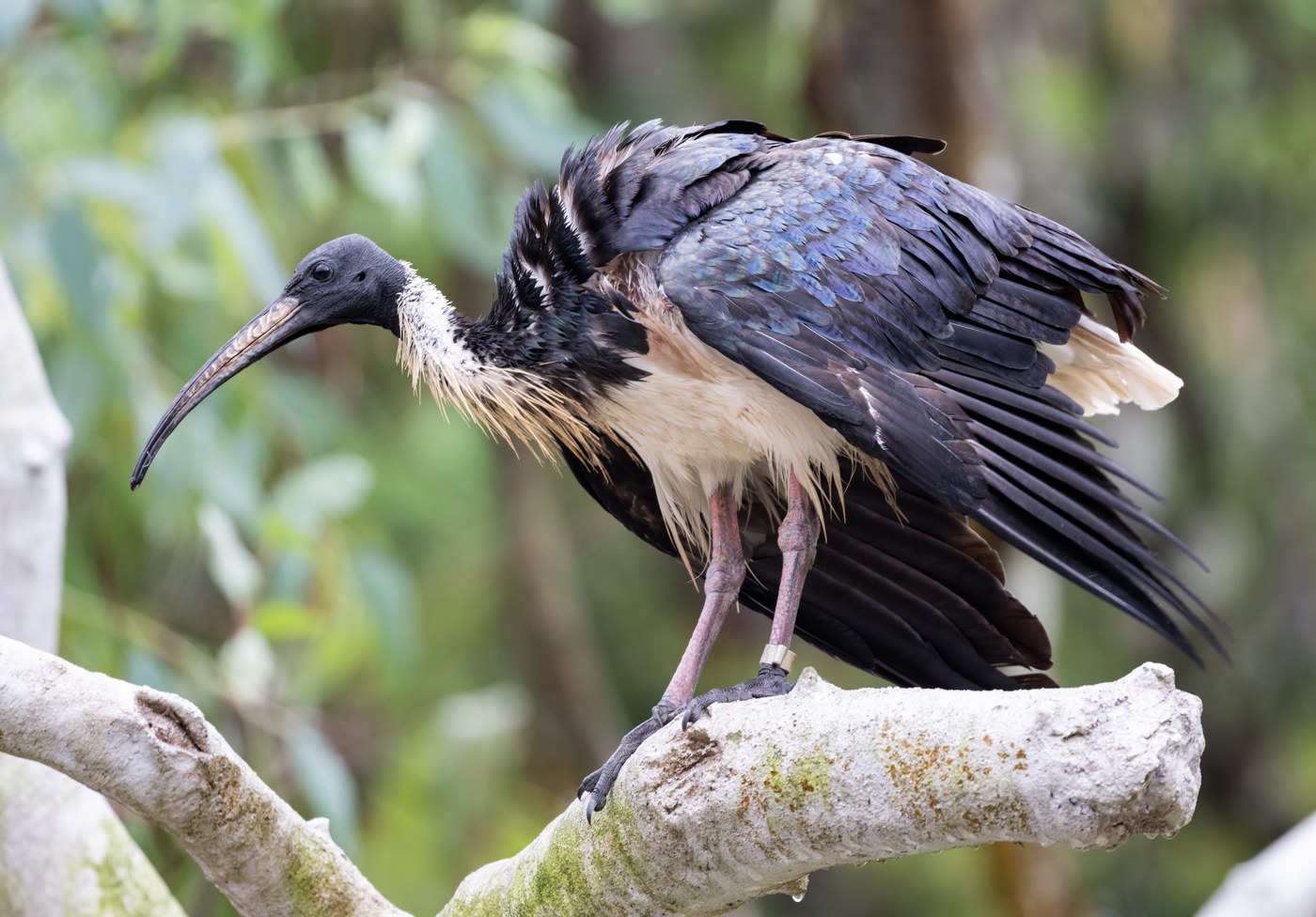
Key Field Marks
- Size & shape: A large wading bird, roughly 59–76 cm long, with a long, strongly downcurved black bill, long dark legs, and a hunched, upright stance when standing.
- Plumage: Head and neck are largely bare, dark, and unfeathered (adults), contrasting with a white breast and underparts. The back, wings, and tail are glossy black with strong iridescent purple, green, and bronze sheen in good light.
- Diagnostic feature: Fine, stiff, straw-yellow plumes project from the lower neck and upper breast, giving the species its name — visible at close range or through binoculars.
- Bill and legs: Bill is long, thin, and evenly curved downward, blackish overall. Legs are dark reddish to blackish, sometimes appearing pinkish during breeding.
- In flight: Shows a white body and neck contrasting with black flight feathers and glossy black wing coverts; often flies in long lines or V-formations with slow, deliberate wingbeats interspersed with glides, neck and legs fully extended.
Separating It From Similar Species
- Australian White Ibis: The most likely confusion species. Australian White Ibis has an almost entirely white body (not black-backed), a bare black head and neck, and lacks the straw neck plumes and glossy black back. Straw-necked Ibis looks predominantly dark above with a white underside — essentially the reverse impression in flight.
- Glossy Ibis: Much smaller, entirely chestnut-brown to glossy dark maroon-green overall (no white on the body), with a slimmer, more uniformly dark appearance and no straw plumes.
- Royal Spoonbill / Yellow-billed Spoonbill: Superficially white-bodied but have flat, spatulate bills rather than a curved ibis bill, ruling out confusion once the bill shape is seen.
Where and When to See It
- Habitat: Favors open grasslands, pastures, floodplains, shallow wetlands, and cultivated paddocks, often well away from permanent water compared to other ibis species. Frequently seen foraging in dry or damp grassy fields alongside cattle or sheep.
- Range: Widespread across mainland Australia, with populations also reaching southern New Guinea and parts of Indonesia (Aru Islands) as vagrants or seasonal visitors. Highly nomadic, moving in response to rainfall and flooding.
- Season: Present year-round in core range, but numbers fluctuate seasonally as birds move to exploit temporary wetlands and insect flushes after rain; large breeding colonies form in wetlands during favorable wet periods, often alongside other waterbirds.
- Social behavior: Highly gregarious, typically encountered in flocks of dozens to thousands, walking steadily through grass with head down, probing and picking at insects, especially grasshoppers and crickets.
Voice
- Generally quiet away from breeding colonies. Utters low, guttural grunting or croaking notes, and a harsh, hoarse honking or growling sound at nesting colonies, deeper and rougher than the calls of Australian White Ibis.
Frequently asked questions
What is the easiest way to tell a Straw-necked Ibis from an Australian White Ibis?
Look at the back and wings: Straw-necked Ibis is glossy iridescent black above with a white underside, while Australian White Ibis is almost entirely white-bodied with only black wingtips and a bare black head.
Do Straw-necked Ibis actually have straw sticking out of their necks?
No — the 'straw' refers to fine, stiff, straw-yellow feather plumes on the lower neck and breast, not actual straw; they are best seen at close range.
Where is the best habitat to find Straw-necked Ibis?
Open grassy paddocks, pastures, and floodplains, often far from open water, where they forage on foot for insects like grasshoppers and crickets.
Are Straw-necked Ibis found outside Australia?
Their core range is mainland Australia, but they occasionally range into southern New Guinea and nearby Indonesian islands, particularly during dispersal after breeding.
Straw-necked Ibis identified by the community
Recent Straw-necked Ibis sightings identified with Bird Identifier.