
Stock Dove Identification Guide
A compact, unmarked grey pigeon of European farmland and woodland edges, told from the similar Rock Dove/feral pigeon and Common Wood-Pigeon by its plain wings, dark eye, and lack of a white neck patch.
Read the full Stock Dove encyclopedia entry →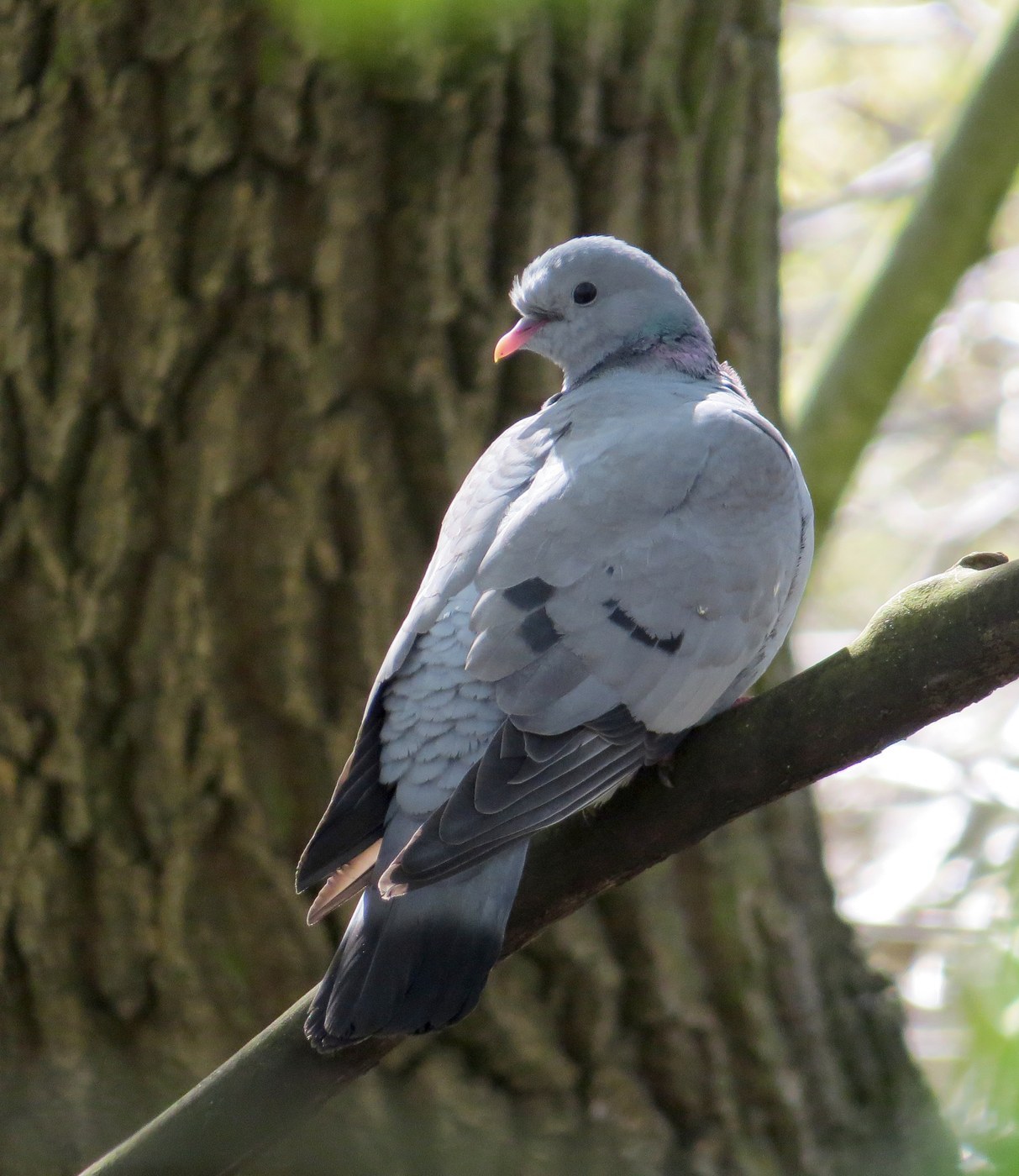
Key Field Marks
- Size & shape: A medium-sized pigeon, about 32-34 cm, noticeably smaller and more compact than Common Wood-Pigeon, with a rounder head and shorter neck.
- Plumage: Uniform soft blue-grey overall, with a subtle pinkish wash on the breast and an iridescent green-and-purple patch on the sides of the neck; crucially, it lacks any white on the neck or wings.
- Wings: Two short, incomplete dark bars on the wing (much less bold and shorter than the wing bars of Rock Dove/feral pigeon), visible mainly at rest and in flight.
- Eye & bill: Dark brown eye (not orange/red as in Rock Dove) and a short pinkish-based bill with a pale yellowish tip.
- Flight: Fast and direct with quick wingbeats, showing a plain grey wing lacking the bold white underwing or wingbar patterns of other pigeons.
Separating It From Similar Species
- Common Wood-Pigeon: Larger and bulkier, with a conspicuous white patch on the side of the neck and a bold white bar across the wing in flight, both features entirely absent in Stock Dove.
- Rock Dove / Feral Pigeon: Highly variable in feral form, but "true" wild-type Rock Dove has a white rump and bold black double wing bars, plus orange eyes; Stock Dove has a grey (not white) rump, only faint short wing bars, and dark eyes.
- Behavior/habitat as a clue: Stock Dove is a hole-nester found in open farmland with old trees or cliffs/quarries, whereas Wood-Pigeon is more of a generalist including gardens and urban parks, and feral Rock Doves cluster around buildings and city centers.
Where & When to See It
- Habitat: Open farmland with mature trees (especially those with nesting holes), parkland, old orchards, and woodland edges; also uses cliffs, quarries, and old buildings for nesting where available.
- Range: Widespread breeding resident across most of Europe and parts of western Asia and North Africa; northern and eastern populations are partial migrants, moving south and west in winter, while western European populations are largely resident.
- Season: Present year-round in much of its resident range; migratory populations arrive on breeding grounds in spring (March-April) and depart in autumn (September-October).
- Behavior: Often forages on open ground in fields, feeding on seeds, grain, and other plant material, sometimes in small flocks, and frequently associates loosely with Wood-Pigeons.
Voice & Song Cues
- Song is a low, rhythmic, repeated cooing, often rendered as "oo-WOOO-oo" or a soft double-noted "coo-coo," distinctly different from the longer, more complex five-syllable cooing of Wood-Pigeon.
- The cooing is generally softer, lower, and more monotonous than Wood-Pigeon's song, and lacks the emphatic rhythm of Rock Dove/feral pigeon calls.
- Often the first clue to separating Stock Dove from Wood-Pigeon in mixed flocks, since visual differences can be subtle at a distance.
Frequently asked questions
How do I tell a Stock Dove from a Common Wood-Pigeon?
Stock Dove is smaller and lacks the white neck patch and bold white wing bar of Wood-Pigeon; look for plain grey wings with only faint short dark bars.
How is Stock Dove different from a feral pigeon (Rock Dove)?
Stock Dove has dark eyes, a grey (not white) rump, and only faint wing bars, while wild-type Rock Dove has orange eyes, a white rump, and bold black double wing bars.
Where does the Stock Dove nest?
It is a hole-nester, using cavities in old trees, as well as cliffs, quarries, and old buildings, generally near open farmland or parkland.
Does the Stock Dove migrate?
Western European populations are largely resident, while northern and eastern populations are partial migrants that move south and west for the winter.