
Steller's Sea Eagle Identification Guide
One of the largest and heaviest eagles in the world, a massive dark raptor of the North Pacific coast with a huge orange-yellow bill and bold white shoulder, leg, and tail patches.
Read the full Steller's Sea Eagle encyclopedia entry →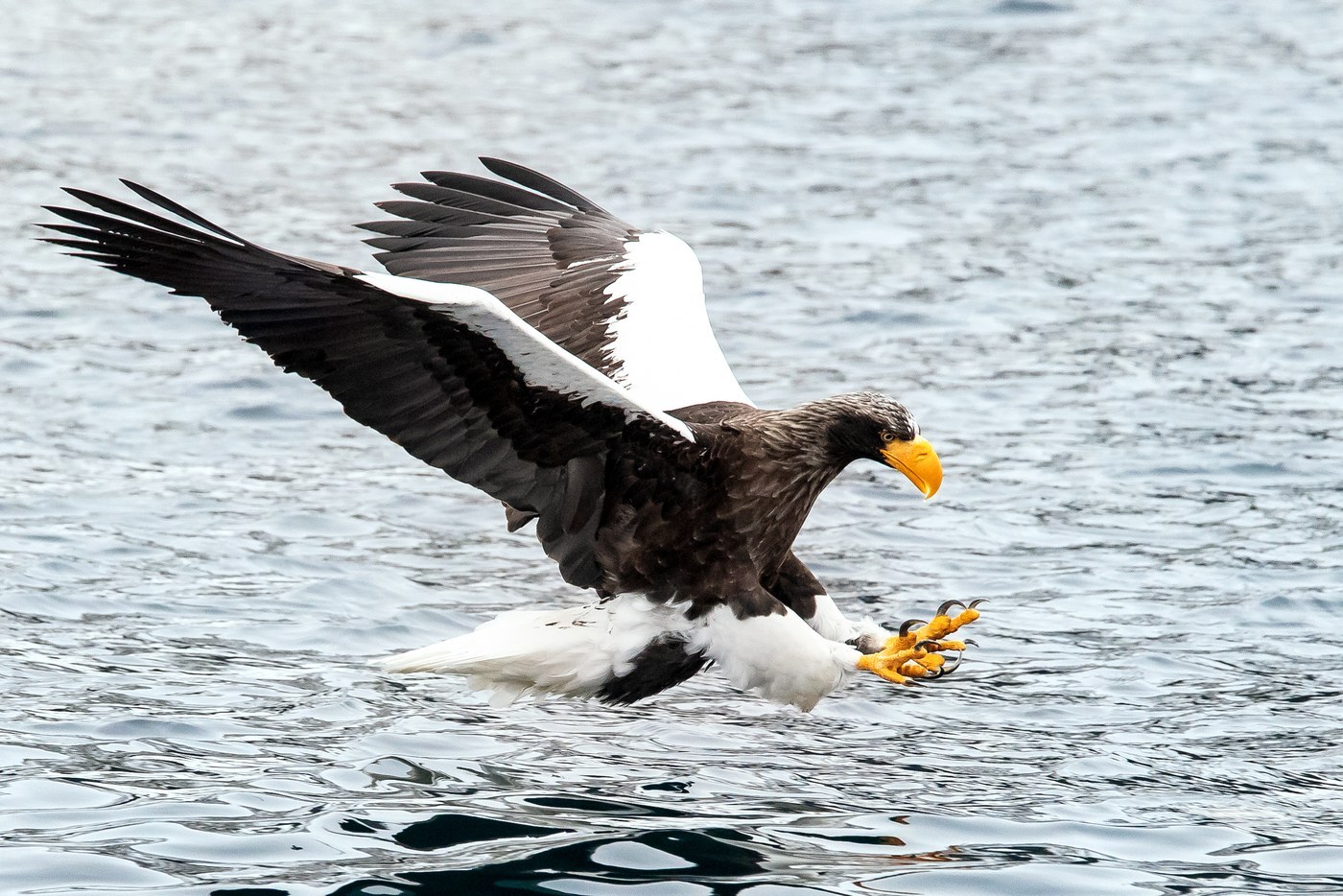
Key Field Marks
- Size & shape: An enormous eagle, among the heaviest raptors on Earth, with a wingspan up to about 2.5 meters, a bulky body, broad long wings, and a proportionally massive head and bill.
- Bill: Huge, deep, bright orange-yellow bill, notably larger and more prominent than that of Bald Eagle — one of the most striking features of the species.
- Plumage: Overall blackish-brown body, with contrasting bright white on the shoulders (lesser wing coverts), thighs, and a wedge-shaped white tail; adults are unmistakable with this pattern.
- Legs & feet: Bright yellow legs and feet, with powerful talons adapted for catching large fish.
- Juveniles: Duller brown overall with less defined white patches, mottled underwing coverts, and a dark-tipped bill that yellows with maturity over several years.
Separating It From Similar Species
- White-tailed Eagle: Smaller and more uniformly brown with a smaller, though still yellow, bill, an all-white wedge tail but no white shoulder or thigh patches; ranges overlap in eastern Russia.
- Bald Eagle: Not normally range-overlapping (Bald Eagle is North American, Steller's Sea Eagle is Asian/rare vagrant to North America), but if compared, Bald Eagle has a fully white head and tail rather than a mostly dark body with white shoulder/thigh patches, and a noticeably smaller bill.
- Juvenile Steller's vs. juvenile White-tailed Eagle: Both are mottled brown and challenging, but Steller's shows a proportionally larger bill and bulkier structure even as a juvenile.
- Adult Steller's Sea Eagle's combination of huge orange bill, dark body, and white shoulder/thigh/tail patches is diagnostic and not shared by any other eagle.
Where & When to See It
- Habitat: Coastal areas, estuaries, and major rivers rich in fish, particularly where salmon are spawning; also found around sea ice edges in winter.
- Range: Breeds mainly in far eastern Russia (Kamchatka Peninsula, Sea of Okhotsk coast, Sakhalin); winters primarily in Japan (especially Hokkaido) and the Kuril Islands, with rare vagrants recorded in Alaska and elsewhere in North America.
- Season: Best viewed at coastal Japanese wintering grounds (Hokkaido) roughly December-March, when large numbers congregate; breeding activity occurs May-September in Russia.
- Behavior: Feeds primarily on fish (especially salmon), supplemented by seabirds, carrion, and occasionally mammals; often seen perched on ice floes, riverbanks, or dead trees near water, sometimes in large winter congregations.
Voice & Song Cues
- Gives deep, resonant barking or croaking calls, often "ra-ra-ra" or a deep gull-like croak, typically heard around nest sites or when interacting with other eagles over food.
- Vocalizations are lower-pitched and harsher than those of the smaller Bald Eagle.
- Calls are most often heard during territorial disputes or feeding congregations rather than in routine daily activity.
Frequently asked questions
What is the most distinctive feature of the Steller's Sea Eagle?
Its enormous bright orange-yellow bill, one of the largest of any raptor, combined with a dark body and contrasting white shoulder, thigh, and wedge-shaped tail patches.
Where is the best place to see Steller's Sea Eagle?
Hokkaido, Japan, during winter (roughly December-March) hosts large wintering concentrations; the species breeds mainly in far eastern Russia.
How do you tell Steller's Sea Eagle from White-tailed Eagle?
Steller's Sea Eagle is larger with a much bigger orange bill and shows white shoulder and thigh patches, while White-tailed Eagle is smaller, more uniformly brown, and lacks those white patches, though both have white wedge tails.
What does the Steller's Sea Eagle eat?
Primarily fish, especially salmon, along with seabirds, carrion, and occasionally small mammals, typically caught or scavenged near coasts, rivers, and sea ice.