
Steller's Jay Identification Guide
A bold, crested jay of western North American conifer forests, dark sooty-black on the head and chest grading into deep blue on the wings, tail, and body.
Read the full Steller's Jay encyclopedia entry →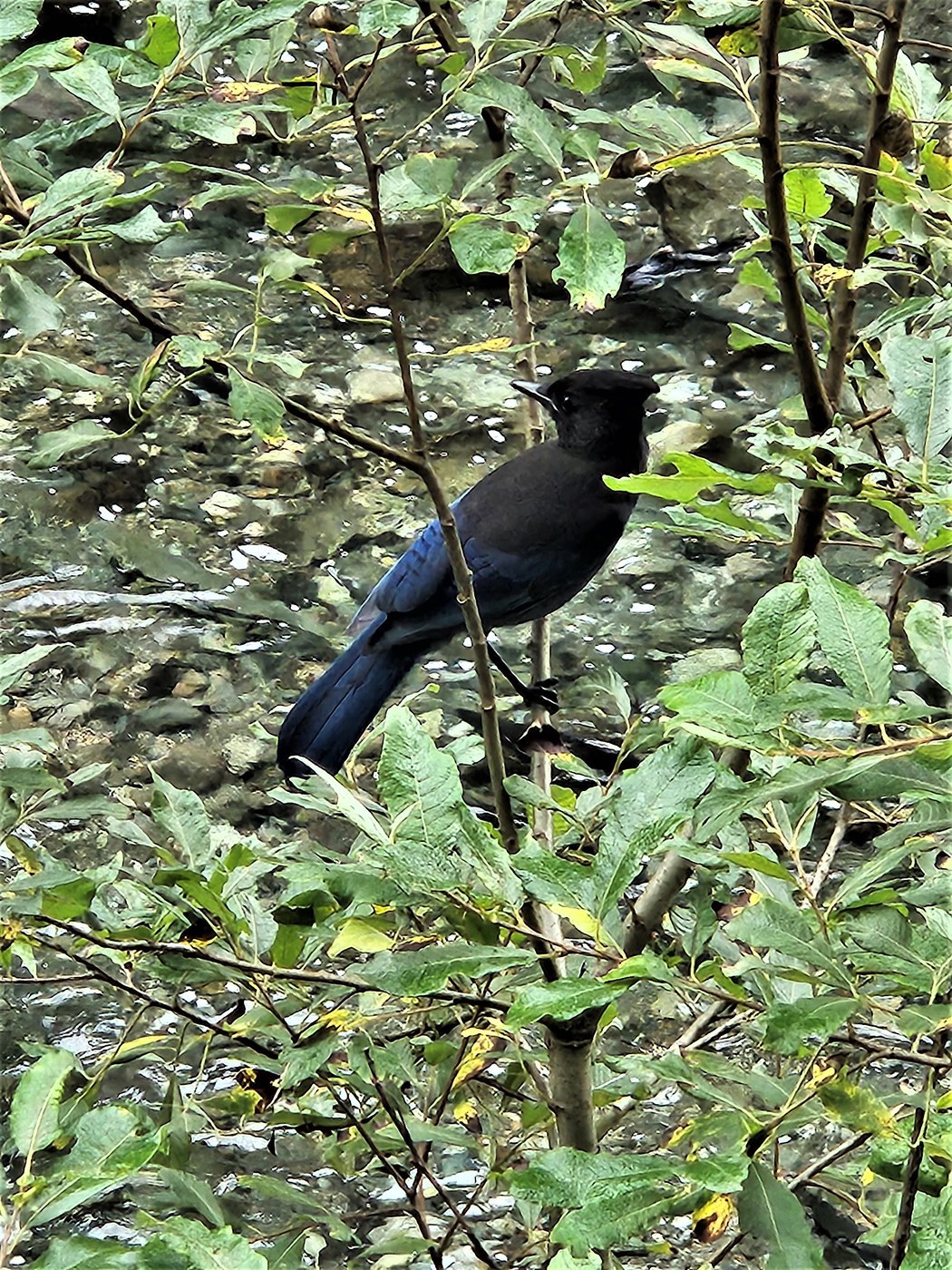
Key Field Marks
- Size & shape: A large jay, about 30-34 cm, with a prominent, tall, pointed crest — the tallest crest of any North American jay — a stout bill, and a long tail.
- Head & chest: Sooty black to dark brownish-black covering the head, crest, throat, and upper breast, sometimes with faint pale streaking on the forehead in some populations.
- Body: Rich deep blue on the wings, tail, back, and lower underparts, with fine dark barring visible on the wings and tail at close range.
- Regional variation: Interior Rocky Mountain populations often show white or pale streaks above the eye and on the forehead; coastal Pacific populations lack these pale marks and appear more uniformly dark-headed.
- Behavior: Bold, noisy, and inquisitive, often approaching campsites and picnic areas; frequently raises and lowers its crest to signal mood.
Separating It From Similar Species
- Blue Jay: Ranges barely overlap (mainly in the Rockies/Great Plains); Blue Jay has a pale grey-blue head and underparts with a black necklace, entirely lacking the dark sooty head-and-chest of Steller's Jay.
- California Scrub-Jay: Lacks a crest entirely, is paler blue overall with a whitish throat and belly, and has a longer, less bulky tail.
- Woodhouse's Scrub-Jay: Also crestless, greyer-blue overall, and found in more open, arid habitats rather than dense conifer forest.
- The tall crest combined with the dark sooty head/chest contrasting against deep blue body is unique among western jays.
Where & When to See It
- Habitat: Coniferous and mixed forests, from lowland pine woods to high mountain forests, including campgrounds, parks, and residential areas within forested regions.
- Range: Resident from southern Alaska and western Canada south through the western United States into the mountains of Mexico and Central America.
- Season: Non-migratory and present year-round, though some high-elevation populations move to lower elevations in winter.
- Behavior: Omnivorous and highly opportunistic, eating seeds, nuts (especially pine and oak), insects, small vertebrates, and readily taking food scraps around human activity; known for caching food and for boldly raiding picnic tables.
Voice & Song Cues
- Loud, harsh, repeated "shack-shack-shack" or "shaaaar" scolding calls are the most frequently heard vocalization, often given in response to intruders or predators.
- An excellent vocal mimic, capable of imitating the calls of hawks (especially Red-shouldered Hawk) and other birds, which can cause confusion when trying to identify calls by ear alone.
- Also gives a variety of softer rattles, clicks, and low mutters during social interactions with other jays.
Frequently asked questions
What is the best way to identify a Steller's Jay?
Look for the tall, pointed crest combined with a dark sooty-black head and chest that contrasts sharply with deep blue wings, tail, and lower body — a combination unique among North American jays.
Can Steller's Jay mimic other birds?
Yes, it is a skilled vocal mimic and frequently imitates hawk calls, especially Red-shouldered Hawk, which can fool birders listening for raptors.
How is Steller's Jay different from Blue Jay?
Steller's Jay has a dark sooty-black head, throat, and chest, while Blue Jay has a pale grey-blue head and underparts with a black necklace; their ranges only narrowly overlap in the Rockies and Great Plains.
Does the head pattern of Steller's Jay vary across its range?
Yes, interior Rocky Mountain birds often show white or pale streaks above the eye and forehead, while coastal Pacific populations have a more uniformly dark head.