
Star Finch Identification Guide
A small, brightly colored Australian grassfinch with a red face and fine white spotting on olive flanks, found near grassy wetlands and rivers across northern Australia.
Read the full Star Finch encyclopedia entry →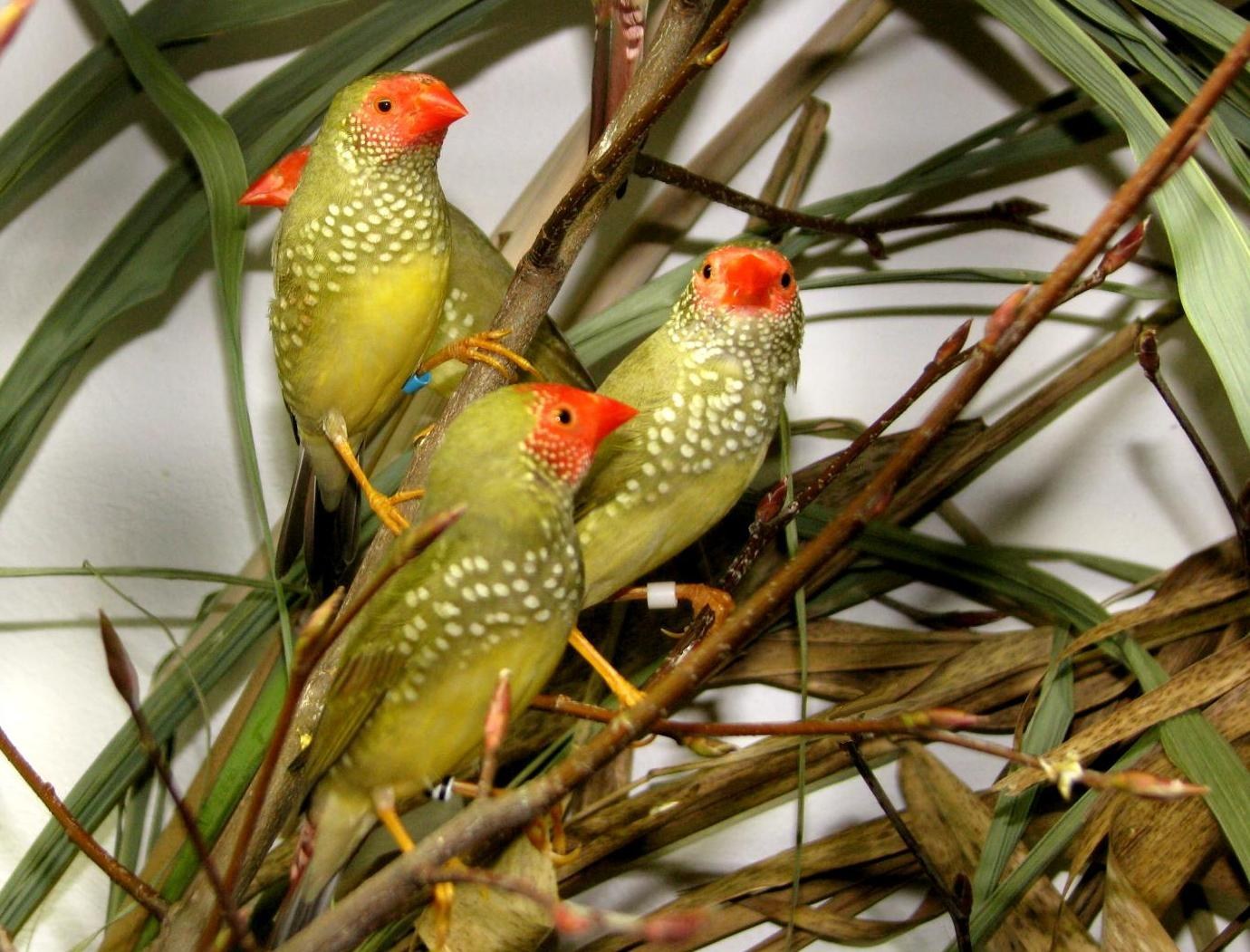
Key Field Marks
- Size & shape: A small finch, about 10-11 cm, with a compact body, short conical bill, and moderately long tail typical of Australian grassfinches.
- Face: Bright red face and forehead extending around the eye, a key diagnostic feature shared by both sexes (though brighter and more extensive in males).
- Body: Olive-green upperparts and back; underparts are yellowish-olive with distinctive fine white spots on the flanks and lower breast, giving a "starry" spotted appearance.
- Bill: Red, conical, seed-eating bill, matching the red face.
- Sex differences: Males show a more extensive red face and brighter overall coloration; females are duller with a smaller red face patch and less vivid spotting.
Separating It From Similar Species
- Red-browed Finch: Has a red eyebrow stripe and red rump but an olive-grey (not red) face and lacks the white flank spotting of Star Finch.
- Diamond Firetail: Larger, with a black band across the breast and bold white-spotted black flanks, but a grey head rather than a red face, and a different overall body shape.
- Crimson Finch: Much more extensively red or crimson across the face, breast, and flanks, with a longer tail, and lacks the fine white spotting pattern of Star Finch.
- The combination of a red face plus fine white-spotted olive flanks is unique to Star Finch among Australian grassfinches.
Where & When to See It
- Habitat: Tall grass and reeds near wetlands, rivers, floodplains, and swamp margins, particularly favoring dense grassy cover close to water.
- Range: Northern Australia, from the Kimberley region of Western Australia across the Top End of the Northern Territory to Cape York Peninsula in Queensland; a separate, now much-reduced population historically occurred in coastal southeastern Queensland/northern New South Wales.
- Season: Largely resident, though flocks may move locally in response to seasonal water availability and grass seed abundance, especially in the dry season.
- Behavior: Highly social, typically foraging and moving in small flocks through tall grass, feeding on ripening grass seeds close to the ground.
Voice & Song Cues
- Contact calls are soft, high-pitched "tseet" or "tsit" notes, typical of small grassfinches, often given by flock members to stay in touch while foraging in dense grass.
- Song is a quiet, warbling series of soft notes, not far-carrying and easily masked by wind or other bird activity.
- Flocks are often detected first by soft contact calls emanating from dense grass before individual birds are seen.
Frequently asked questions
What is the easiest way to identify a Star Finch?
Look for the combination of a bright red face and bill with fine white spots scattered across olive-green flanks — no other Australian grassfinch shares exactly this pattern.
How can I tell a male from a female Star Finch?
Males have a more extensive, brighter red face and richer overall coloration, while females show a smaller, duller red face patch and less vivid spotting.
Where in Australia is the Star Finch found?
Across northern Australia from the Kimberley through the Northern Territory's Top End to Cape York Peninsula, favoring tall grass near wetlands and rivers; a separate southeastern population has become very rare.
Does the Star Finch migrate?
It is largely resident but flocks move locally in response to seasonal changes in water and grass seed availability, particularly during the dry season.