
Spruce Grouse Identification Guide
A tame, dark forest grouse of the North American boreal woods, often approachable at close range and best identified by its blackish plumage, barred flanks, and preference for dense conifer cover.
Read the full Spruce Grouse encyclopedia entry →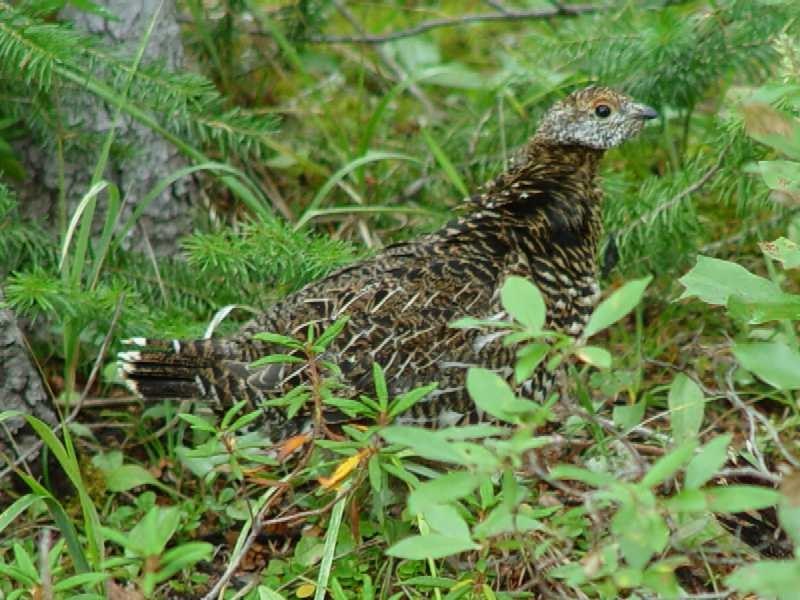
Key Field Marks
- Size & shape: A medium-sized, chicken-like grouse, about 38-43 cm, with a compact rounded body, short rounded tail, and short legs.
- Male plumage: Blackish overall with fine grey-and-white barring on the flanks, a black throat and breast, a red comb of bare skin over the eye, and (in most populations) a chestnut-tipped tail band.
- Female plumage: Mottled brown or reddish-brown with dark barring throughout, in two color morphs (grey-brown and red-brown), providing excellent camouflage in conifer forest.
- Behavior: Famously tame and unwary around humans — often allows very close approach, earning it the nickname "fool hen" in parts of its range.
- Tail: Relatively short, dark tail, often fanned during display; some subspecies (e.g., Franklin's Grouse in the west) lack the chestnut tail tip and instead show white-tipped uppertail coverts.
Separating It From Similar Species
- Ruffed Grouse: Larger tail with a broad dark subterminal band, more strongly mottled brown-grey plumage overall, a ruff of neck feathers used in display, and much more wary/flushes readily, unlike the tame Spruce Grouse.
- Sooty and Dusky Grouse: Larger-bodied mountain grouse of the Pacific Northwest and Rockies, found in different (often higher-elevation, more open) habitat, with a longer tail and different display behavior (inflatable neck sacs).
- Male vs. female Spruce Grouse: Males are unmistakably dark and blackish with a red eye-comb; females require attention to the mottled brown pattern and short tail combined with tame behavior and dense conifer habitat.
Where & When to See It
- Habitat: Dense boreal and montane conifer forest, especially stands of spruce, jack pine, and lodgepole pine with a thick understory; strongly tied to conifers, whose needles form the bulk of its winter diet.
- Range: Resident across the boreal forest belt of Canada and Alaska, extending south into the northern Great Lakes states, New England, and the northern Rockies/Cascades in the United States.
- Season: Non-migratory and present year-round; easiest to find by walking quietly through dense conifer stands, where birds may sit tight or walk away rather than flush.
- Behavior: Feeds on the ground in summer (berries, insects, leaves) and shifts almost entirely to conifer needles eaten from tree branches in winter.
Voice & Song Cues
- Generally quiet; males perform a low-frequency wing-clapping display flight and soft hooting notes during courtship, which are easily missed.
- Females give sharp clucking alarm notes when defending chicks.
- Because vocalizations are subtle and infrequent, visual detection while walking quietly through conifer forest is usually more productive than listening for calls.
Frequently asked questions
Why is the Spruce Grouse called a 'fool hen'?
Because it is remarkably tame and often allows people to approach very closely without flushing, unlike most other grouse species, which are wary and flush readily.
How can I tell a male Spruce Grouse from a Ruffed Grouse?
Male Spruce Grouse is much darker and blackish with a red comb over the eye and finely barred flanks, while Ruffed Grouse is mottled brown-grey with a broad dark band near the tip of a longer, fanned tail.
What does a Spruce Grouse eat in winter?
It shifts almost entirely to eating conifer needles (spruce, pine, or fir) plucked directly from tree branches, which is unusual among North American grouse.
What habitat should I search for Spruce Grouse?
Dense stands of boreal or montane conifer forest — especially spruce, jack pine, or lodgepole pine with thick understory — across Canada, Alaska, and the northern edges of the contiguous United States.