
Spotted Pardalote Identification Guide
A tiny, jewel-like Australian songbird with a black cap covered in white spots, best located by its high, repetitive whistle from the eucalypt canopy.
Read the full Spotted Pardalote encyclopedia entry →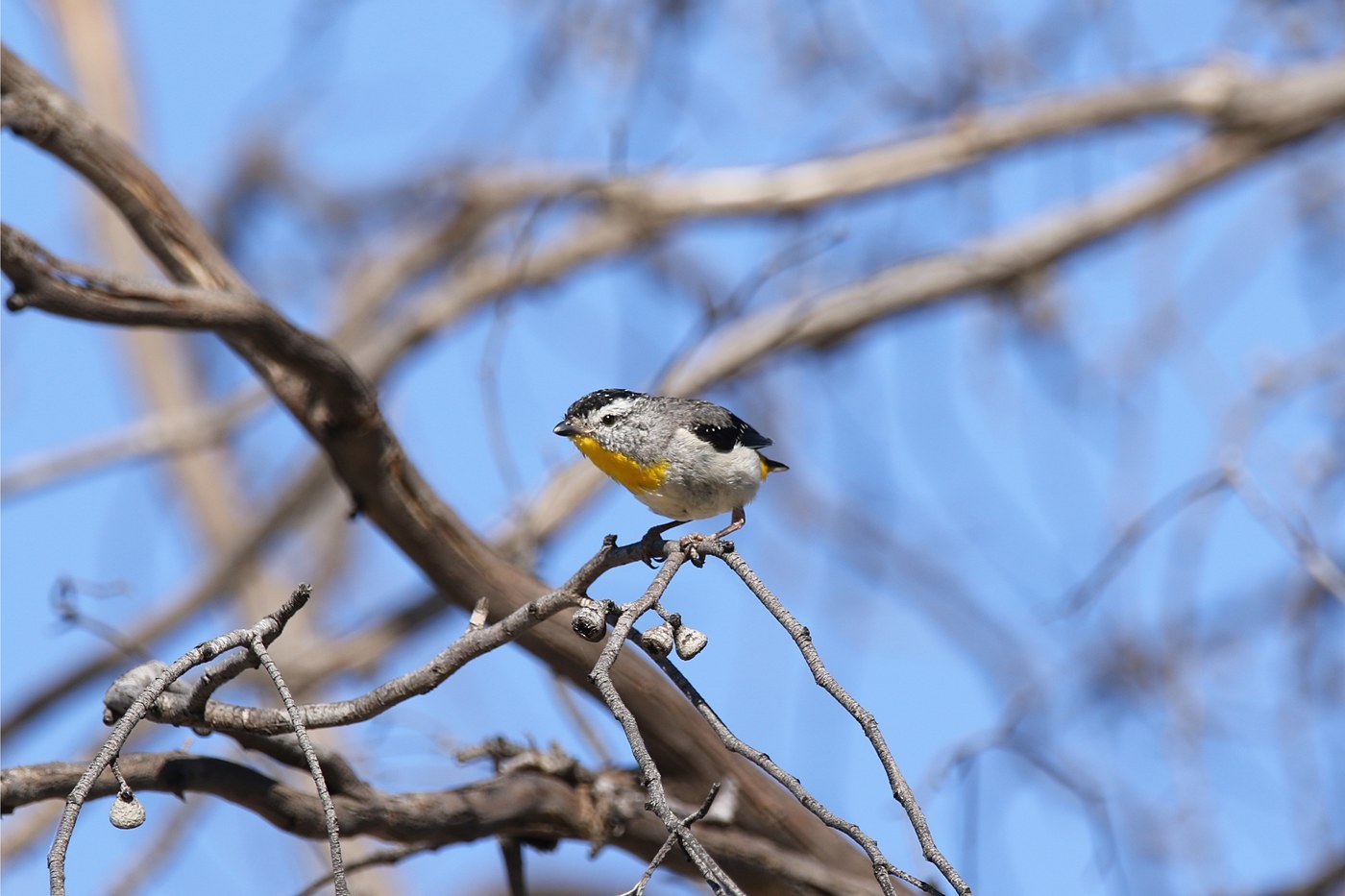
Key Field Marks
- Size & shape: One of Australia's smallest birds, about 8-10 cm long, with a short tail, short stubby bill, and a rounded, compact body.
- Crown & wings: Glossy black crown and wings densely covered in small, crisp white spots — the single best mark for this species.
- Underparts: Bright yellow throat and breast (males brighter than females), fading to buffy or whitish belly.
- Back & rump: Grey back with a bright rufous-orange rump patch, often flashed in flight or when the bird flicks its wings.
- Bill & legs: Very short, stubby black bill adapted for gleaning lerps and insects from eucalypt leaves; legs are pinkish-grey.
Separating It From Similar Species
- Striated Pardalote: The main confusion species. Striated Pardalote has a black crown with fine white streaks (not bold round spots), a yellow spot in front of the eye, and lacks the crisp all-over spotting of Spotted Pardalote.
- Forty-spotted Pardalote: Restricted to Tasmania; duller olive-grey overall with less contrasting spots and no rufous rump, and it's far rarer and more localized.
- Female vs. male Spotted Pardalote: Females are duller, with a grey-buff throat instead of the male's rich yellow, but both sexes retain the diagnostic white-spotted black crown and wings.
Where & When to See It
- Habitat: Eucalypt forests and woodlands, including drier box-ironbark woodland and wetter forest, almost always foraging high in the canopy.
- Range: Endemic to southeastern and southwestern Australia, from southeastern Queensland through New South Wales, Victoria, and into South Australia, plus a separate population in southwestern Australia.
- Season: Resident and often present year-round, though some southern and inland populations shift altitude or move locally outside the breeding season (roughly August-January).
- Nesting: Unusual among songbirds for excavating a nest tunnel in an earth bank or occasionally a soil-filled tree hollow, rather than building an open cup nest.
Voice & Song Cues
- Song is a simple, far-carrying, monotonously repeated two- or three-note whistle, often rendered as "sleep-may-be" or a rising "wit-wit-wit," delivered from high in the canopy.
- Because the bird is tiny and stays high in dense foliage, voice is often the first and easiest clue to its presence — listen for the steady, unhurried whistled rhythm distinct from the faster, buzzier notes of Striated Pardalote.
- Calls are given year-round but increase noticeably during the breeding season.
Frequently asked questions
How do I tell a Spotted Pardalote from a Striated Pardalote?
Look at the crown pattern: Spotted Pardalote has bold round white spots on a black crown and wings, while Striated Pardalote has fine white streaks and a yellow spot in front of the eye.
Why is the Spotted Pardalote so hard to see despite being common?
It's tiny, feeds almost exclusively high in the eucalypt canopy, and is often detected first by its repetitive whistled call rather than by sight.
Where does the Spotted Pardalote nest?
It excavates a narrow tunnel into an earthen bank, roadside cutting, or sometimes a soil-filled tree hollow, ending in a small nest chamber.
What does the Spotted Pardalote eat?
It feeds mainly on lerps (the sugary coverings made by psyllid insects) and small insects gleaned from eucalypt leaves.