
Spotted Owl Identification Guide
A dark-eyed, chocolate-brown North American owl covered in round white spots, closely associated with old-growth forest and now largely replaced or hybridized with the invasive Barred Owl in parts of its range.
Read the full Spotted Owl encyclopedia entry →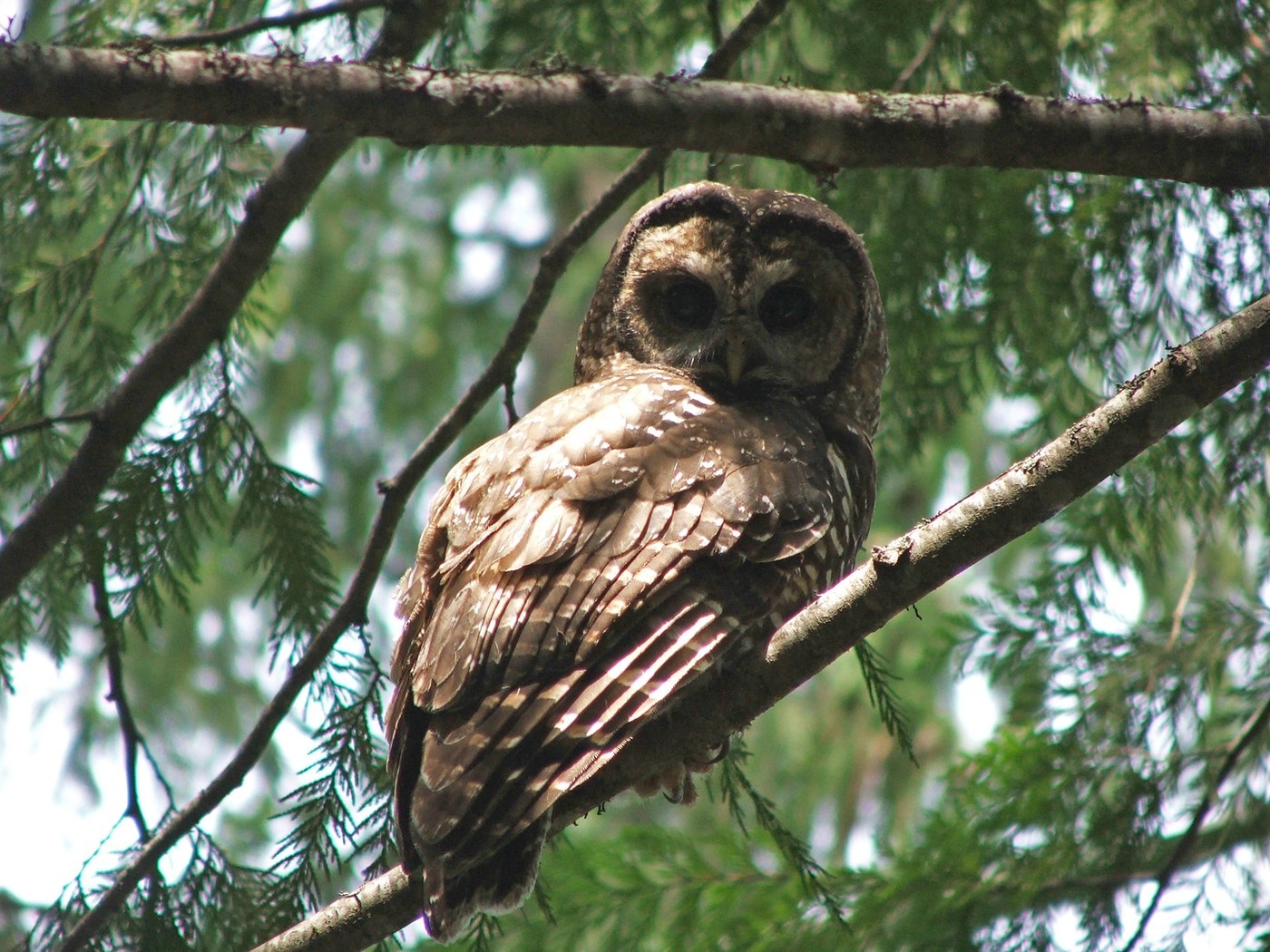
Key Field Marks
- Size & shape: A medium-large owl, about 17–19 inches (43–48 cm), with a large rounded head, no ear tufts, and a relatively long tail for a Strix owl.
- Plumage: Dark chocolate-brown overall, marked with numerous round white spots on the head, back, and underparts (rather than vertical streaks or bars) — this rounded, spotted pattern is the key to the name and to separating it from look-alikes.
- Face & eyes: Rounded facial disc, with dark brown/black eyes (not yellow) — one of the most useful marks versus similar owls.
- Behavior: Strictly nocturnal, roosting in dense canopy by day; relatively tame and approachable compared to most owls; strongly tied to structurally complex, mature/old-growth forest with multi-layered canopy.
Separating It From Similar Species
- Barred Owl — very similar in shape and size but shows vertical brown streaking on the belly (versus horizontal barring on the upper breast) rather than round spots, and is grayer-brown overall compared to the warmer chocolate-brown of Spotted Owl; both have dark eyes, so plumage pattern and tone are the key differences. Barred Owls have expanded aggressively into Spotted Owl range in the Pacific Northwest, out-competing and even hybridizing with them ("Sparred Owls"), making careful comparison important where ranges overlap.
- Great Horned Owl — much larger, with prominent ear tufts and yellow eyes, easily separated by size and tufts alone.
- Range and habitat also help: Spotted Owl is restricted to specific mature-forest regions, while Barred Owl is a habitat generalist now found nearly throughout the same regions.
Habitat, Range & Season
Resident in three recognized subspecies across western North America: the Northern Spotted Owl in old-growth coniferous forest from British Columbia south through Washington, Oregon, and northern California; the California Spotted Owl in the Sierra Nevada and coastal ranges of California; and the Mexican Spotted Owl in canyon and montane forest of the southwestern U.S. and Mexico. All subspecies depend heavily on structurally complex older forest or canyon habitat and are non-migratory, though they may shift locally between summer and winter roost/nest areas. All three subspecies are considered threatened or of high conservation concern, chiefly due to historic old-growth logging and, more recently, competition from Barred Owls.
Voice
A series of deep, resonant hoots, classically a four-note "hoo, hoo-hoo, hooo" pattern with the last note often drawn out; pairs also give a rising contact bark and a distinctive high whistled contact call between mates and family members.
Frequently asked questions
What is the most reliable way to separate Spotted Owl from Barred Owl?
Spotted Owl shows round white spots overall and dark brown eyes on a warmer chocolate-brown body, while Barred Owl has vertical streaking on the belly, horizontal barring on the upper breast, and a grayer-brown tone; voice and range also help.
Why is the Barred Owl a concern for Spotted Owls?
Barred Owls have expanded into Spotted Owl range in western North America, where they out-compete Spotted Owls for territory and food and can hybridize with them, contributing to Spotted Owl population declines.
What habitat should I search for Spotted Owls?
Mature or old-growth forest with a complex, multi-layered canopy, or canyon/montane forest in the case of the Mexican Spotted Owl.
Are all Spotted Owl subspecies threatened?
Yes, the Northern, California, and Mexican Spotted Owl subspecies are all considered threatened or of significant conservation concern due to habitat loss and, increasingly, competition from Barred Owls.