
Spotted Nutcracker Identification Guide
A chunky, chocolate-brown Eurasian corvid covered in crisp white spots, closely tied to coniferous forest and famous for caching pine seeds and hazelnuts.
Read the full Spotted Nutcracker encyclopedia entry →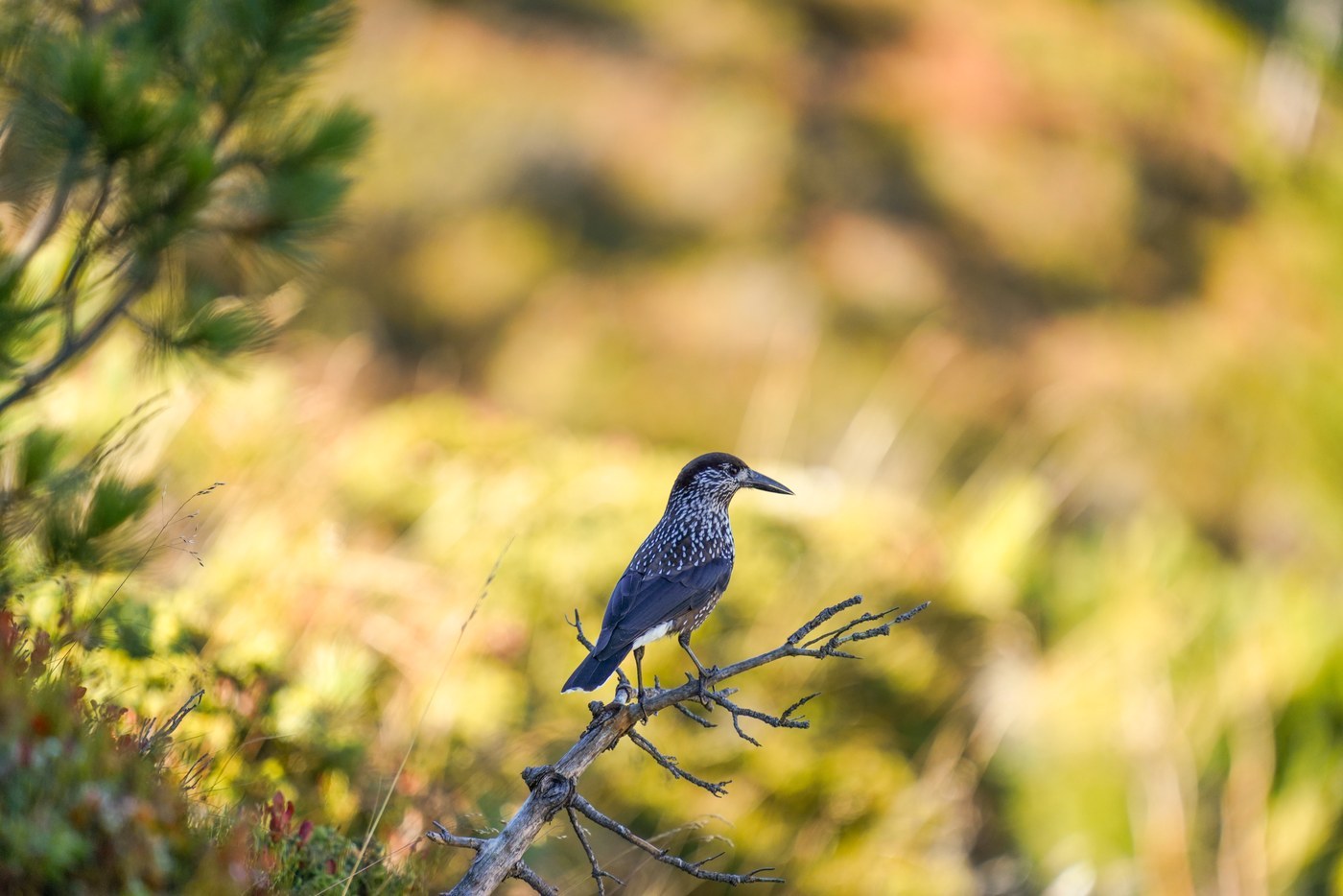
Key Field Marks
- Size & shape: A medium-sized, crow-relative, about 12–13 inches (32 cm), with a stocky body, long straight bill, and relatively short tail compared to other corvids.
- Plumage: Rich dark chocolate-brown overall, densely covered with crisp white spots/streaks across the body, most concentrated on the breast and flanks; the crown is typically plainer/darker with fewer spots.
- Wings & tail: Blackish wings and tail, with white undertail coverts and a white tip to the tail visible in flight — conspicuous in flight against the dark body.
- Bill: Long, straight, and dagger-like, well suited to prying seeds from conifer cones and hazelnuts.
- Behavior: Often perches conspicuously atop conifers; flies with slow, heavy, somewhat labored-looking wingbeats; caches thousands of seeds in the ground for later retrieval, a behavior central to its ecology and to conifer regeneration.
Separating It From Similar Species
- Clark's Nutcracker (North America, non-overlapping range) — pale gray body rather than dark spotted brown; the two nutcracker species are easily separated by range and overall color, as Clark's Nutcracker lacks the dense white spotting.
- Jackdaw — much smaller, plain gray-and-black, lacks spotting and has a shorter bill.
- Spotted woodpeckers or thrushes at a glance — size, straight heavy bill, and corvid flight/behavior quickly rule these out.
- No other bird within the Spotted Nutcracker's Eurasian range shows the same combination of dark chocolate-brown body densely marked with white spots.
Habitat, Range & Season
Resident across the coniferous forest belt of Eurasia, from Scandinavia and the European Alps eastward through Siberia to Japan, with a separate population associated with hazel/pine forests in parts of central and eastern Europe. Strongly tied to stands of arolla/stone pine, spruce, or hazel depending on region, since these provide its staple seed diet. Largely resident, though northern/high-altitude populations may show irruptive movements to lower elevations or farther south in years of poor cone crops.
Voice
A harsh, far-carrying, grating "kraaak" or "krrra-krrra" call, repeated and often given in flight or from a treetop perch — distinctly harsher and more guttural than typical crow calls.
Frequently asked questions
What is the best field mark for Spotted Nutcracker?
A dark chocolate-brown body densely covered in crisp white spots, paired with a long straight bill and white undertail coverts/tail tip visible in flight.
How does it differ from Clark's Nutcracker?
Clark's Nutcracker is pale gray without spotting and occurs only in western North America, while Spotted Nutcracker is dark brown with white spots and found across Eurasia; their ranges do not overlap.
Why does the Spotted Nutcracker matter for forest ecology?
It caches huge numbers of pine and hazel seeds in the ground for winter food, and uncollected caches often germinate, helping regenerate conifer and hazel forests.
Does the Spotted Nutcracker migrate?
It is mostly resident, but can make irruptive movements away from breeding areas in years when cone or nut crops fail.