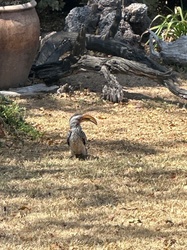
Southern Yellow-billed Hornbill Identification Guide
A familiar southern African savanna hornbill with a large curved yellow-orange bill, spotted grey-and-white plumage, and a distinctive accelerating piping call.
Read the full Southern Yellow-billed Hornbill encyclopedia entry →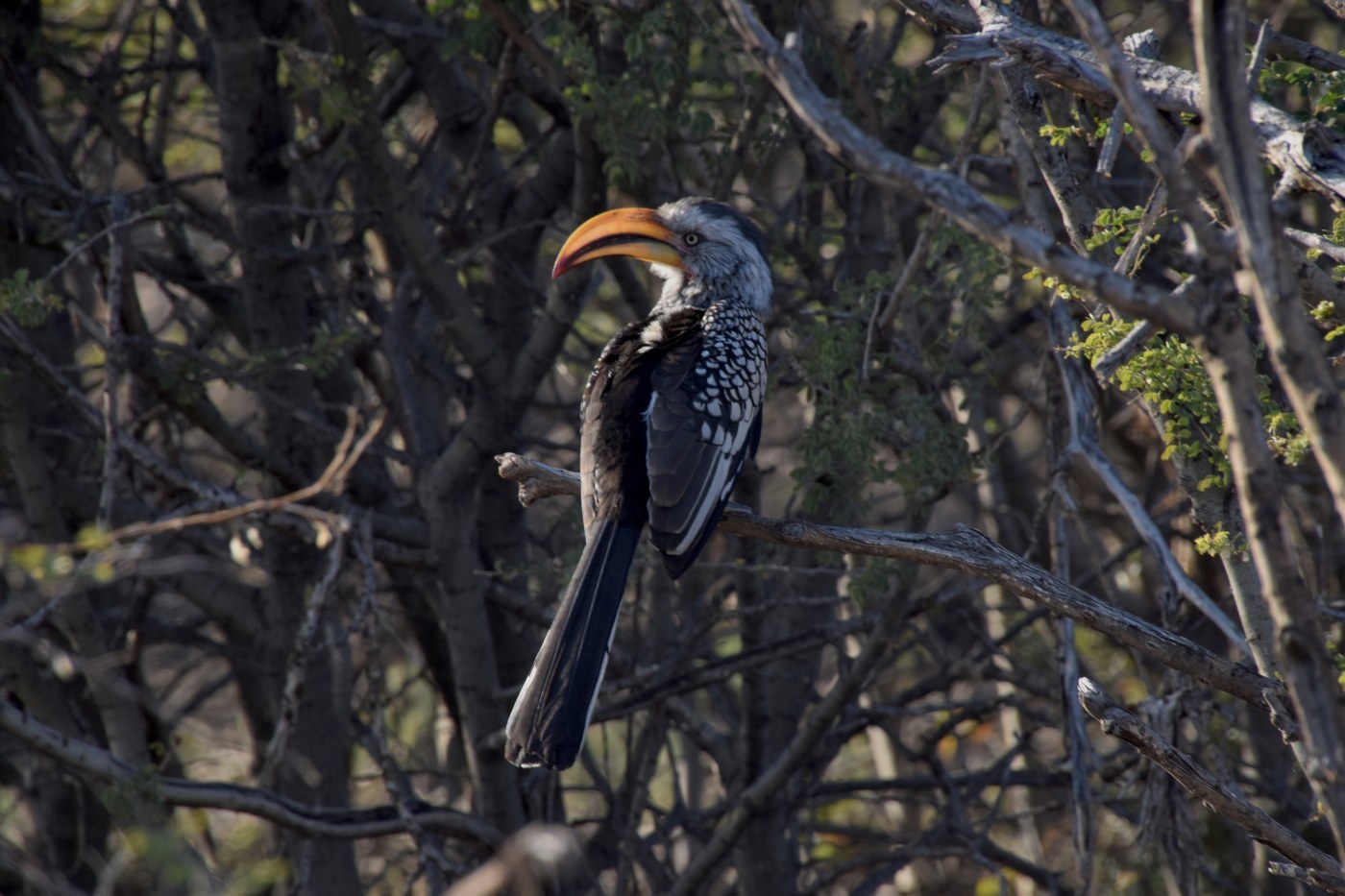
Key Field Marks
- Size & shape: A medium-sized hornbill about 48–60 cm long, with a long tail and a notably large, curved bill relative to its head size.
- Plumage: Grey-brown upperparts heavily spotted with white, clean white underparts, and white outer tail feathers visible in flight.
- Bill: Large, strongly downcurved, and bright yellow to orange-yellow — unmistakable at close to moderate range.
- Facial skin: Pale pinkish skin around the eye.
- Behavior: Often on the ground foraging in pairs or small family groups, hopping and walking with an alert, upright gait; also perches in low trees.
Separating It From Similar Species
- Southern Red-billed Hornbill, which shares much of the same habitat and range, has a slender red bill instead of a yellow one — bill color is the fastest and most reliable separator.
- Northern Yellow-billed Hornbill is very similar in appearance; the two were long treated as one species and are separated mainly by range, with Northern Yellow-billed found roughly north of the Zambezi/Cunene river systems and Southern Yellow-billed found from Zimbabwe/Mozambique southward through Botswana, Namibia, and South Africa.
- African Grey Hornbill has a much darker, mostly blackish bill with a pale casque stripe on top, and lacks the bright yellow bill coloring.
Where and When to See It
A common, non-migratory resident of dry savanna, thornveld, and mopane woodland across southern Africa, including Namibia, Botswana, Zimbabwe, and the drier parts of South Africa (such as Kruger National Park and the Kalahari). It can be found year-round and is one of the most conspicuous and easily seen hornbills in the region, often confiding around lodges and campsites.
Voice
A loud, piping call that starts with slower notes and accelerates into a rapid, laughing duet between pair members — a familiar and characteristic sound of the southern African bush.
Behavior Tip for Identification
Like other Tockus hornbills, the female seals herself inside a tree-cavity nest with mud, leaving a narrow slit for the male to pass food through during incubation — observing this nesting behavior, combined with the bright yellow bill, gives a confident identification.
Frequently asked questions
How do I tell Southern Yellow-billed Hornbill from Southern Red-billed Hornbill?
Bill color is decisive: Southern Yellow-billed Hornbill has a large yellow-orange bill, while Southern Red-billed Hornbill has a slimmer red bill. Both share similar spotted grey-and-white body plumage and overlapping range.
What is the difference between Southern and Northern Yellow-billed Hornbill?
They are nearly identical in appearance and were once considered a single species; they are now separated mainly by range, with Northern Yellow-billed Hornbill occurring roughly north of the Zambezi/Cunene rivers and Southern Yellow-billed Hornbill to the south.
What habitat does the Southern Yellow-billed Hornbill prefer?
Dry savanna, thornveld, and mopane woodland across southern Africa, where it is a common and conspicuous resident, often seen around lodges and campsites.
What does the Southern Yellow-billed Hornbill's call sound like?
A loud piping call that starts slowly and accelerates into a rapid, laughing duet between mates — a very characteristic sound of the southern African bush.
Southern Yellow-billed Hornbill identified by the community
Recent Southern Yellow-billed Hornbill sightings identified with Bird Identifier.