
Southern Red-billed Hornbill Identification Guide
A slender, ground-foraging hornbill of southern African dry savanna, identified by its slim curved red bill, spotted grey-brown back, and clean white underparts.
Read the full Southern Red-billed Hornbill encyclopedia entry →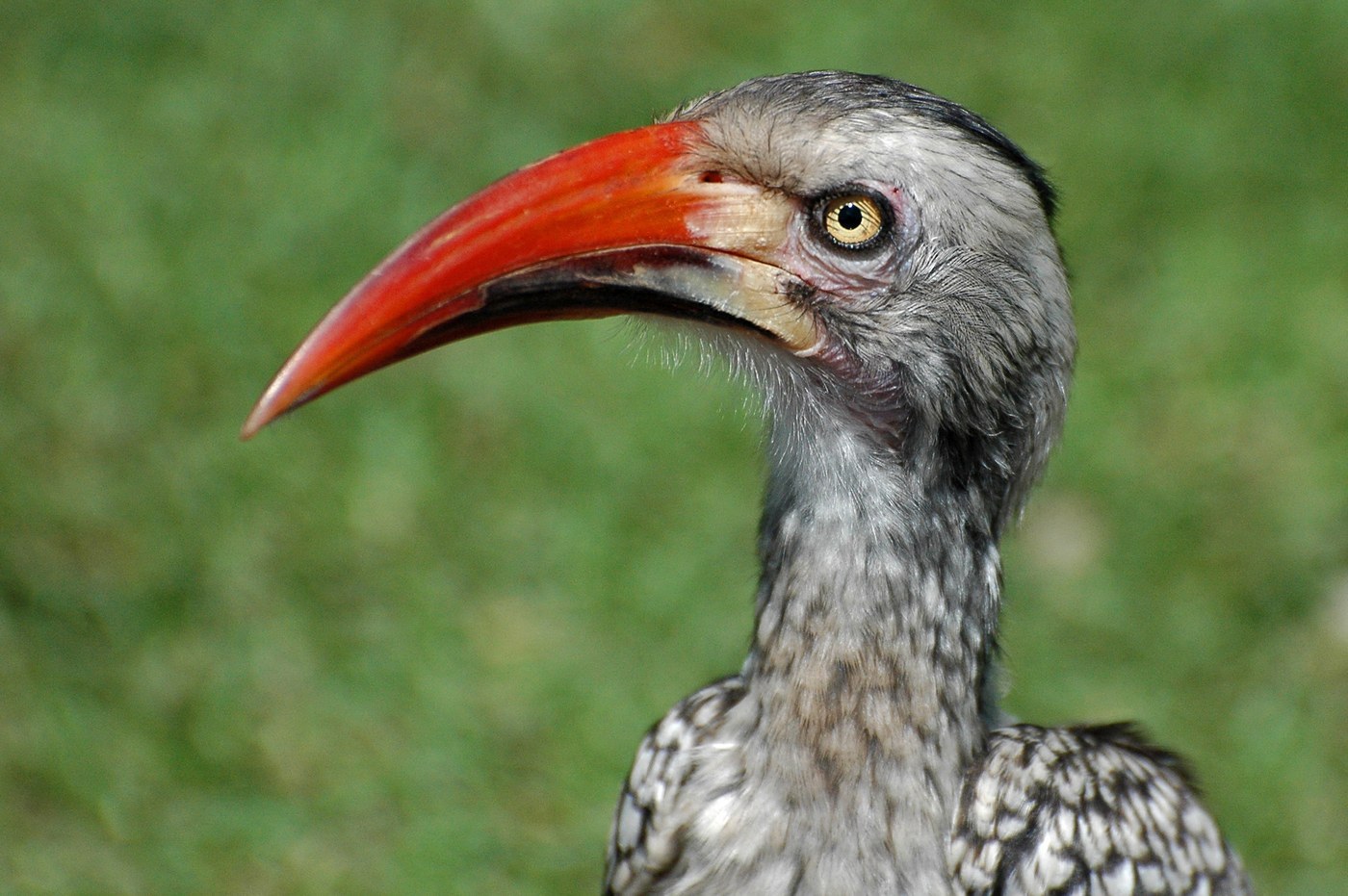
Key Field Marks
- Size & shape: A medium-sized hornbill about 40–48 cm long, with a slim body, long tail, and a distinctly slender, downcurved bill compared to the more robust bill of ground hornbills.
- Plumage: Dark grey-brown to blackish upperparts liberally spotted with white; clean white underparts and outer tail feathers.
- Bill: Slender, downcurved, and bright red — the key field mark distinguishing it from yellow-billed hornbill species sharing its range.
- Facial skin: Dark skin around the eye.
- Behavior: Often seen walking and hopping on the ground foraging, or perched low in dry woodland; frequently in pairs or small family groups.
Separating It From Similar Species
- Southern Yellow-billed Hornbill shares much of the same range and habitat but has a bright yellow-orange bill instead of red — bill color alone reliably separates the two where ranges overlap.
- The red-billed hornbill group has been split by taxonomists into several very similar species (Southern, Western, Tanzanian, Damara Red-billed Hornbill), separated mainly by range and subtle differences in bill shape/plumage spotting — Southern Red-billed Hornbill occupies southeastern Africa (Zimbabwe, Mozambique, eastern Botswana, and the South African lowveld including Kruger National Park).
- African Grey Hornbill has a dark bill with a pale/cream stripe along the top (casque) rather than an all-red bill, and a more uniform grey plumage.
Where and When to See It
A resident, non-migratory species of dry savanna, mopane, and broadleaved woodland across southeastern Africa. It can be found year-round and is a common, easily seen bird in reserves such as Kruger National Park and adjacent lowveld habitats. Family groups forage together on the ground for insects, especially around termite mounds and after bush fires, which flush prey.
Voice
A piping, repetitive "kuk-kuk-kuk" or "kek-kek-kek" call, often given in duet between pair members and increasing in tempo, typical of the Tockus hornbill group.
Behavior Tip for Identification
During breeding, the female seals herself into a tree cavity nest using mud, droppings, and food, leaving only a narrow vertical slit through which the male passes food — watching this feeding behavior at a nest hole is a strong confirming clue for hornbills generally, though bill color remains the fastest way to separate this species from Yellow-billed Hornbill.
Frequently asked questions
How do I tell Southern Red-billed Hornbill from Southern Yellow-billed Hornbill?
Bill color is the simplest distinguishing feature: Southern Red-billed Hornbill has a slender red bill, while Southern Yellow-billed Hornbill has a bright yellow-orange bill. Both share similar spotted grey-brown-and-white plumage and overlapping range.
Where is the best place to see Southern Red-billed Hornbill?
Dry savanna and mopane woodland of southeastern Africa, including Kruger National Park and the South African lowveld, Zimbabwe, and Mozambique, where it is a common, easily observed resident.
Why does the female hornbill seal herself into the nest?
Sealing the nest cavity entrance with mud, leaving only a narrow slit, protects the female and eggs/chicks from predators; the male passes food to her through the slit until the chicks are older.
What does a Southern Red-billed Hornbill eat?
Mainly insects and other invertebrates gathered while walking and hopping on the ground, often concentrating around termite mounds or areas recently burned by bushfires.