
Southern Lapwing Identification Guide
A loud, boldly patterned South American plover with a black breast bib, bronze-green wing sheen, and a reputation for aggressively defending its nest with piercing alarm calls.
Read the full Southern Lapwing encyclopedia entry →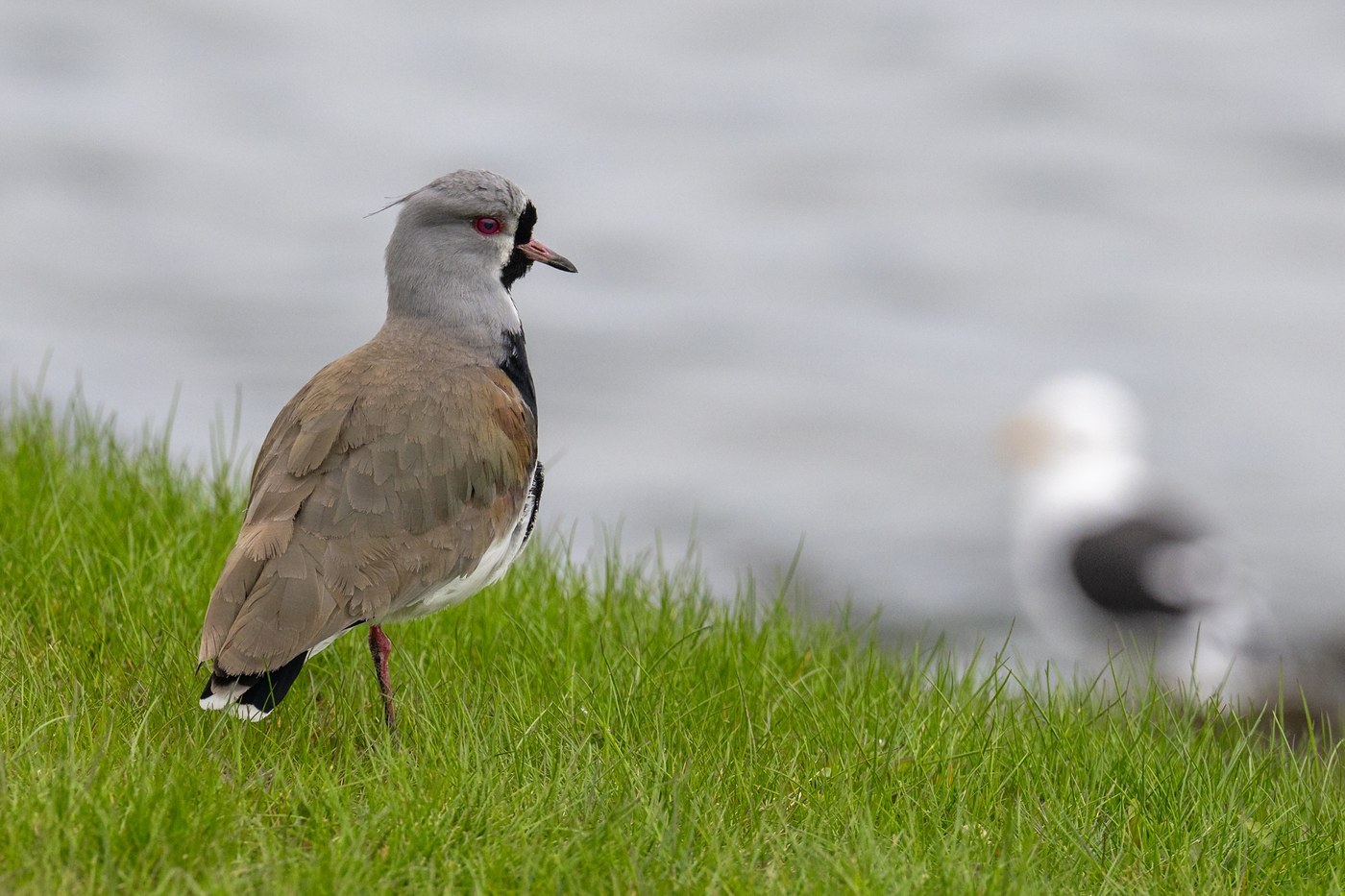
Key Field Marks
- Size & shape: A large, long-legged plover about 32–38 cm long, with a small, rounded head crest, a relatively short bill, and a stocky, upright stance typical of lapwings.
- Plumage: Grey-brown crown, nape, and back; a bold black breast band and throat patch (bib) contrasting with a white belly; the wings show an iridescent bronze-green to purplish sheen visible in good light.
- Bare parts: Red eye-ring, reddish-pink legs, and a bill that is pinkish-red at the base with a black tip.
- In flight: Broad, rounded wings show a striking black-and-white pattern; flight is somewhat floppy and deliberate, often accompanied by loud calling.
- Behavior: Bold and conspicuous, frequently seen standing in open, short grass or wetland margins; extremely vocal and aggressive when defending nests or chicks, often mobbing much larger animals or people.
Separating It From Similar Species
Southern Lapwing is the only widespread lapwing across most of its South American range, making confusion with other lapwings uncommon, but note:
- Andean Lapwing occurs at high elevation in the Andes and shows a more uniform grey-brown body without the bold black breast bib pattern of Southern Lapwing.
- Other regional plovers are generally much smaller and lack the combination of black bib, red legs, and small crest.
Where and When to See It
Southern Lapwings are widespread, common, and largely non-migratory residents (with some local movements) across open habitats throughout most of South America — grassland, pasture, wetland edges, riverbanks, golf courses, sports fields, and airports. In recent decades the species has expanded its range northward into Central America and parts of the Caribbean. It can be seen year-round and is often one of the easiest and most conspicuous birds to find in open country, frequently standing sentinel in flat, short-grass habitats.
Voice
Extremely vocal, giving loud, sharp, repeated calls often rendered as "teru-teru" (the source of its common Spanish/Portuguese name "tero" or "quero-quero"), especially when alarmed — a pair defending a nest will call persistently and dive at intruders.
Frequently asked questions
Why is the Southern Lapwing called 'tero' in South America?
Its loud, repeated alarm call sounds like 'teru-teru' or 'tero-tero,' which gave rise to the common local names 'tero' (Spanish) and 'quero-quero' (Portuguese).
How aggressive is the Southern Lapwing in defending its nest?
Very — pairs will loudly call and dive-bomb intruders, including much larger animals, livestock, and people who venture too close to a nest or chicks.
Has the Southern Lapwing's range been expanding?
Yes, it has been steadily expanding northward from South America into parts of Central America and the Caribbean in recent decades, aided by its adaptability to human-modified open habitats.
What habitat is best for finding Southern Lapwings?
Open, short-grass habitats such as pastures, wetland margins, riverbanks, sports fields, and airports, where they stand conspicuously and are easy to spot.