
Southern Giant Petrel Identification Guide
A huge, barrel-chested Southern Ocean seabird recognized by its heavy pale-tipped bill, hunched flight profile, and habit of scavenging around seal and penguin colonies.
Read the full Southern Giant Petrel encyclopedia entry →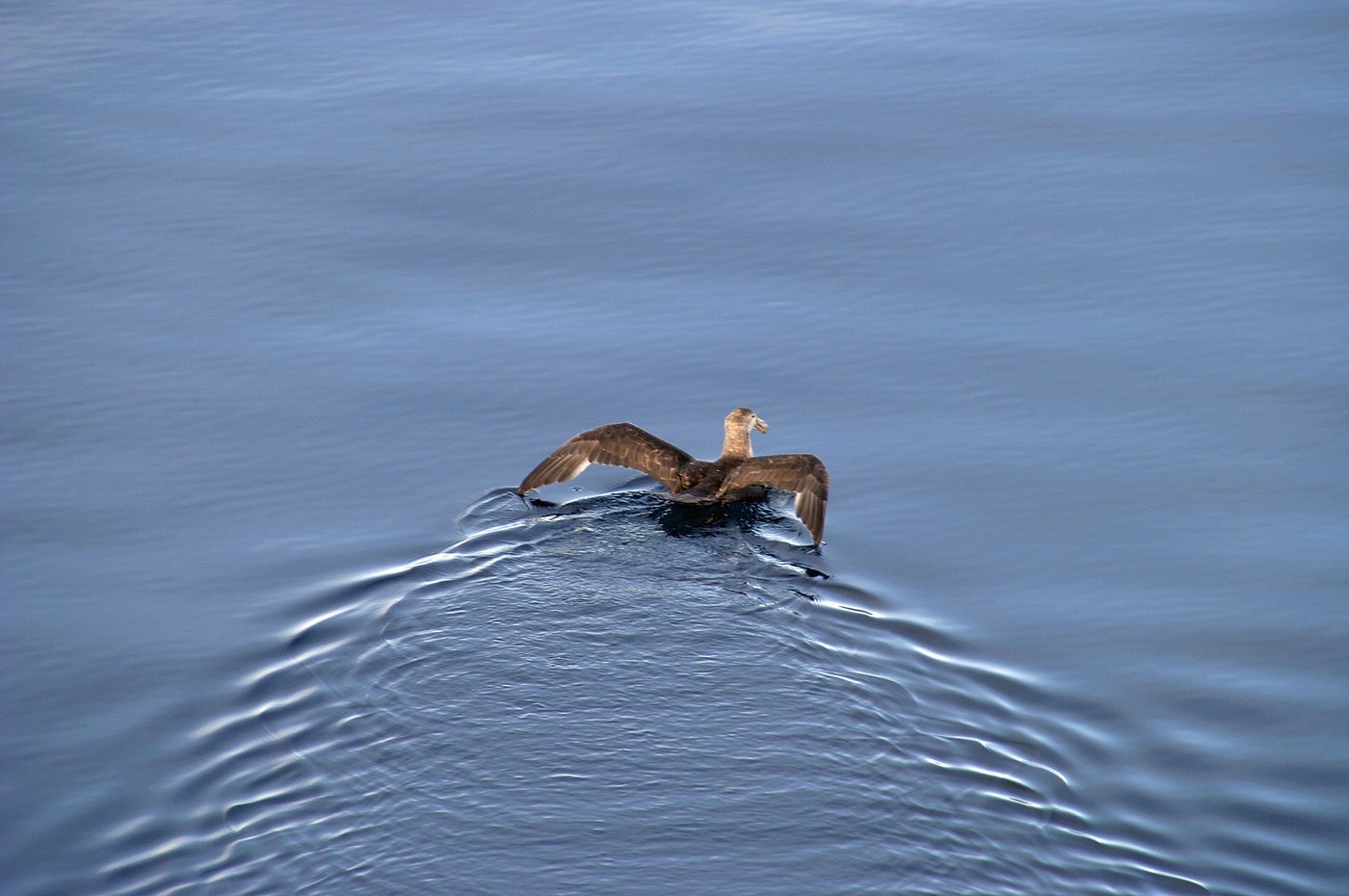
Key Field Marks
- Size & shape: Enormous for a petrel, with a wingspan up to 2 m and a bulky, thick-necked, hunch-shouldered body — often described as resembling a small albatross but with a proportionally larger head and bill.
- Plumage: Typically mottled grey-brown overall, with a paler, whitish head and foreneck that increases with age; a distinct white morph also occurs, appearing all white with scattered black speckling, especially in higher latitudes.
- Bill: Massive, pale horn to greenish, with prominent raised nostril tubes on top — a diagnostic feature of giant petrels versus true albatrosses.
- Eye: Pale eye, visible at reasonably close range.
- Flight: Flies low over the water on stiff, bowed wings with slow wingbeats interspersed with glides, less graceful and more hunched than an albatross.
Separating It From Similar Species
- Northern Giant Petrel is nearly identical in size, shape, and grey-brown plumage; the most reliable distinction is bill tip color — Southern Giant Petrel has a pale greenish bill tip, while Northern Giant Petrel has a reddish-orange/pinkish bill tip. Southern Giant Petrel also shows the white morph, which Northern does not.
- Albatrosses (e.g., Black-browed, Wandering) have longer, narrower wings, a more elegant gliding flight, and lack the giant petrel's massive tubed bill and hunched, thick-necked profile.
- Wilson's Storm-Petrel and other small petrels are vastly smaller and flutter low over the water rather than glide.
Where and When to See It
Southern Giant Petrels are circumpolar in the Southern Ocean, breeding on subantarctic and Antarctic islands and the Antarctic Peninsula (South Georgia, Falklands, Kerguelen, Macquarie Island, and others) and ranging widely at sea, including regularly off the coasts of South America, southern Africa, and Australasia outside the breeding season. They can be seen year-round in Southern Ocean waters, with the best sightings from pelagic boat trips or near seal and penguin colonies, where they gather to scavenge carcasses.
Voice
Generally silent at sea; at breeding colonies and when scavenging, they give harsh, guttural croaking and grunting calls, along with bill-clacking when competing over carrion.
Frequently asked questions
How do I tell Southern from Northern Giant Petrel?
The most reliable field mark is bill tip color: Southern Giant Petrel has a pale greenish bill tip, while Northern Giant Petrel has a reddish or pinkish bill tip. Southern Giant Petrel also has a white morph that Northern Giant Petrel lacks.
What does the white morph of the Southern Giant Petrel look like?
It appears almost entirely white with scattered small black speckles over the body, quite different from the more common mottled grey-brown plumage.
What do Southern Giant Petrels eat?
They are opportunistic scavengers and predators, feeding heavily on carrion (dead seals, penguins, and other seabirds), as well as squid, fish, and krill caught at sea.
How can I distinguish a Southern Giant Petrel from an albatross at a distance?
Giant petrels have a bulkier, thicker-necked body, a large bill with prominent nasal tubes, and a more hunched, heavier flight style compared to the longer, narrower wings and more buoyant, graceful glide of albatrosses.