
Southern Cassowary Identification Guide
A massive, flightless rainforest bird of New Guinea and northeast Australia, identified by its glossy black body, blue-and-purple head, tall casque, and paired red wattles.
Read the full Southern Cassowary encyclopedia entry →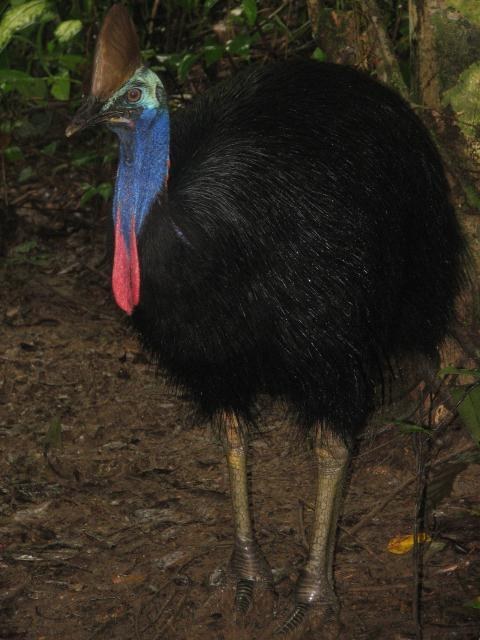
Key Field Marks
- Size & shape: One of the largest birds in the world, standing up to 1.5–2 m tall and weighing up to 70 kg (females larger than males). Bulky black body, heavy legs, and no visible flight feathers — the wings are reduced to bare quills.
- Plumage: Coarse, glossy black, hair-like body feathers.
- Head & neck: Bare skin in vivid blue and purple tones, topped by a tall, laterally-flattened brown casque used for pushing through dense vegetation and possibly for low-frequency communication.
- Wattles: Southern Cassowary is the only cassowary with two hanging red wattles on the foreneck — the key mark separating it from other cassowary species.
- Legs & feet: Extremely powerful legs with three forward-facing toes; the inner toe bears a long, dagger-like claw capable of inflicting serious injury.
Separating It From Similar Species
All three cassowary species overlap in parts of New Guinea, so head and neck details matter:
- Northern Cassowary has a single wattle (not two) and a more orange-to-yellow neck patch in some populations.
- Dwarf Cassowary is noticeably smaller, has no hanging wattles at all, and a shorter casque.
- Southern Cassowary is the only species found in Australia, so in Queensland no confusion with other cassowaries is possible — the main task there is simply confirming it isn't a farmed Emu (Emu is browner, has no casque or wattles, and a fluffier double-shafted plumage).
Where and When to See It
Southern Cassowaries are non-migratory, solitary, shy inhabitants of tropical and subtropical rainforest, including forest edges, swamp forest, and occasionally adjacent woodland and mangroves. They occur in lowland and montane rainforest of southern New Guinea and, in Australia, are restricted to far north Queensland — notably the Wet Tropics around Mission Beach, Daintree, and the Atherton Tablelands. Despite their size they are secretive and most often detected by droppings, tracks, or a sudden crashing retreat through undergrowth; dawn and dusk near fruiting trees along quiet forest tracks offer the best chances.
Voice
Southern Cassowaries produce very low-frequency booming and rumbling calls (some of the lowest-frequency calls of any bird), audible more as a felt vibration than a distinct sound at a distance, along with hissing, rumbling grunts, and bill-clapping when alarmed.
Frequently asked questions
How many wattles does a Southern Cassowary have?
Two hanging red wattles on the foreneck — this is the key feature separating it from the Northern Cassowary (one wattle) and Dwarf Cassowary (no wattles).
Is the Southern Cassowary the only cassowary in Australia?
Yes. It is the only cassowary species found in Australia, restricted to rainforests of far north Queensland; the other two species occur only in New Guinea and nearby islands.
What is the casque on a cassowary's head for?
The tall bony/keratin casque likely helps the bird push through dense rainforest vegetation and may also play a role in low-frequency sound communication, though its exact function is still debated by researchers.
Are Southern Cassowaries dangerous to approach?
They can be, especially if cornered, protecting chicks, or habituated to being fed by people — their powerful legs and dagger-like inner claw can cause serious injury, so they should always be observed from a safe distance.
How can I tell a cassowary from an emu?
Cassowaries have a tall casque, bare blue/purple skin on the head and neck, and red wattles, and live in dense rainforest; emus lack a casque and wattles, have plain brown-grey plumage, and live in open country.